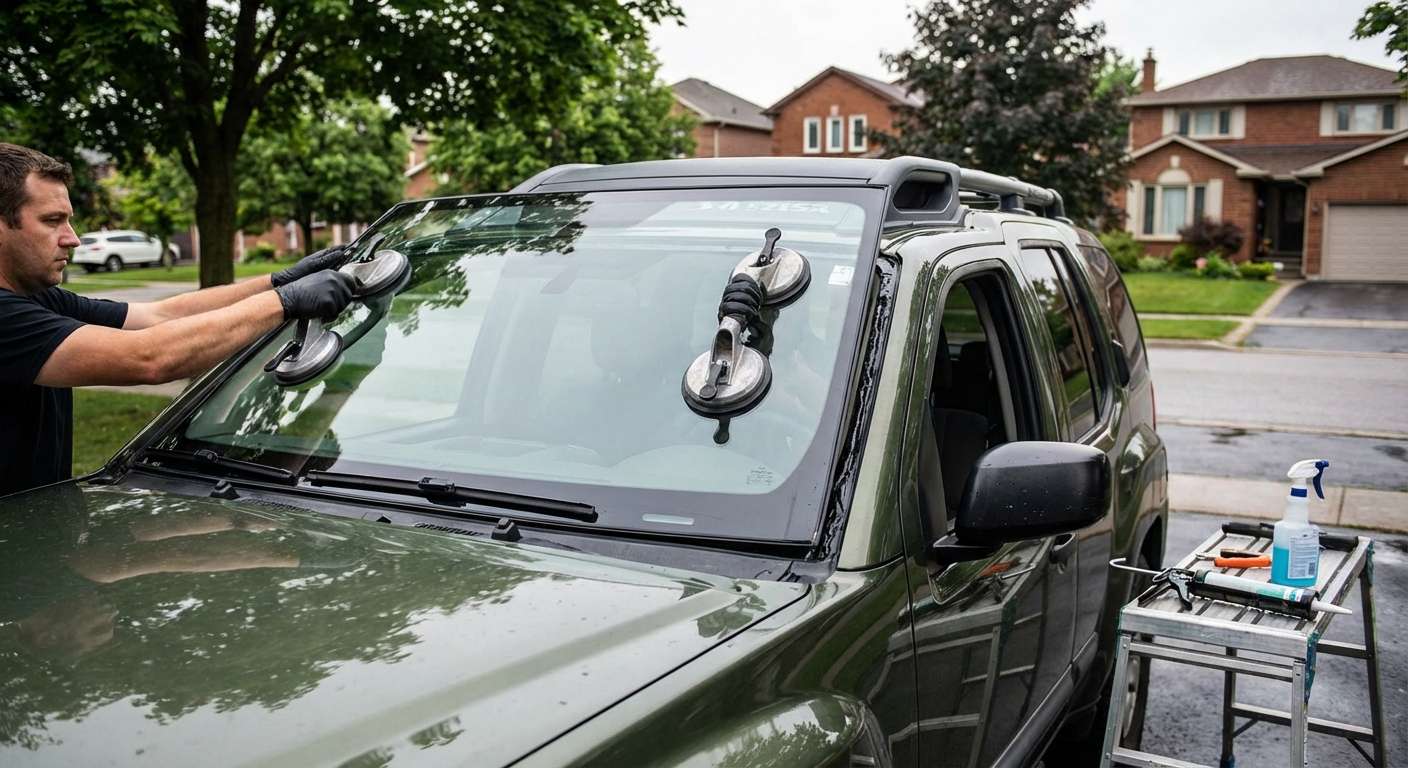
Steep Glass Angles and Road Debris Vulnerability
The upright stance that gives this truck its classic profile is the primary reason stone chips turn into sudden cracks across the glass. Because the windshield sits at a much flatter, more vertical pitch than modern aerodynamic crossovers, highway gravel strikes directly instead of deflecting upward. Owners frequently watch minor pebble impacts instantly bloom into spider cracks. Across the entire production run, the glass is completely passive: you will not find forward-facing ADAS cameras, rain sensors, or integrated heated wiper elements. Factory panels rely on standard laminated solar-absorbing tint with a third-visor ceramic dot matrix pattern surrounding the glued-on rearview mirror button.
Identifying the correct replacement panel depends on the production split. For the initial WD22 run, the 2000 to 2001 models take NAGS part number FW02070, while the updated 2002 to 2004 front end requires FW02229. Both of these early iterations use an exterior perimeter reveal moulding secured with mechanical retainer clips under kits GGG 2070 and GGG 2229. When the N50 platform arrived for 2005 through 2015, the glass switched to NAGS part number FW02510, a shape shared with the Frontier and Pathfinder. Instead of rigid clips, this later pane pairs with a flexible top reveal weatherstrip matching moulding code GGG 2510 and lower urethane stop pads.
Water Leaks: Distinguishing Glass Failure From Roof Rack Seeps
Water dripping from behind the interior A-pillar grab handles or collecting on the floor is a notorious complaint on enthusiast forums, but the windshield adhesive is rarely the culprit. Directly above the upper glass edge, the factory tubular roof basket and front air dam gear box anchor into the roof skin. The forward mounting bolts pass through factory rivnuts placed right next to the top corners of the pinch weld. When the factory sealant on those fasteners dries out and shrinks, water tracks along the roof sheet metal, slips down the interior of the A-pillar garnish trim, and pools under the dashboard. Re-bedding the glass will never fix that leak if those roof rack fasteners remain unsealed.
A second common source of phantom glass leaks occurs at the plastic cowl grille at the base of the glass. Pine needles, leaves, and trail silt routinely pack the lower trough below the wiper arms, blocking the primary fender drains. When rain backs up in the wiper tray, it spills through the fresh air intake directly into the passenger footwell. I provide entirely mobile service throughout Toronto and the GTA, travelling directly to your driveway or job site so you do not have to drive an off-road truck with compromised glass across town. Whenever the glass is out, clearing that hidden drainage channel and replacing aged plastic cowl push pins ensures the cab stays dry.
Cowl Alignment and Exterior Trims
At the bottom edge of the glass, the two-piece cowl panel demands careful handling during any glass swap. The plastic panel links directly against the bottom edge of the windshield with an integrated rubber seal and relies on specialized reusable plastic push-pin fasteners. If these clips are forced or the plastic has warped from engine heat and sun exposure, the weatherstrip sags away from the ceramic frit line, allowing excess road spray to pour into the wiper motor linkage bay. Setting the lower glass stops correctly guarantees the bottom edge aligns flush with the wiper transmission posts so the tandem wiper arms clear the A-pillar frame smoothly.


