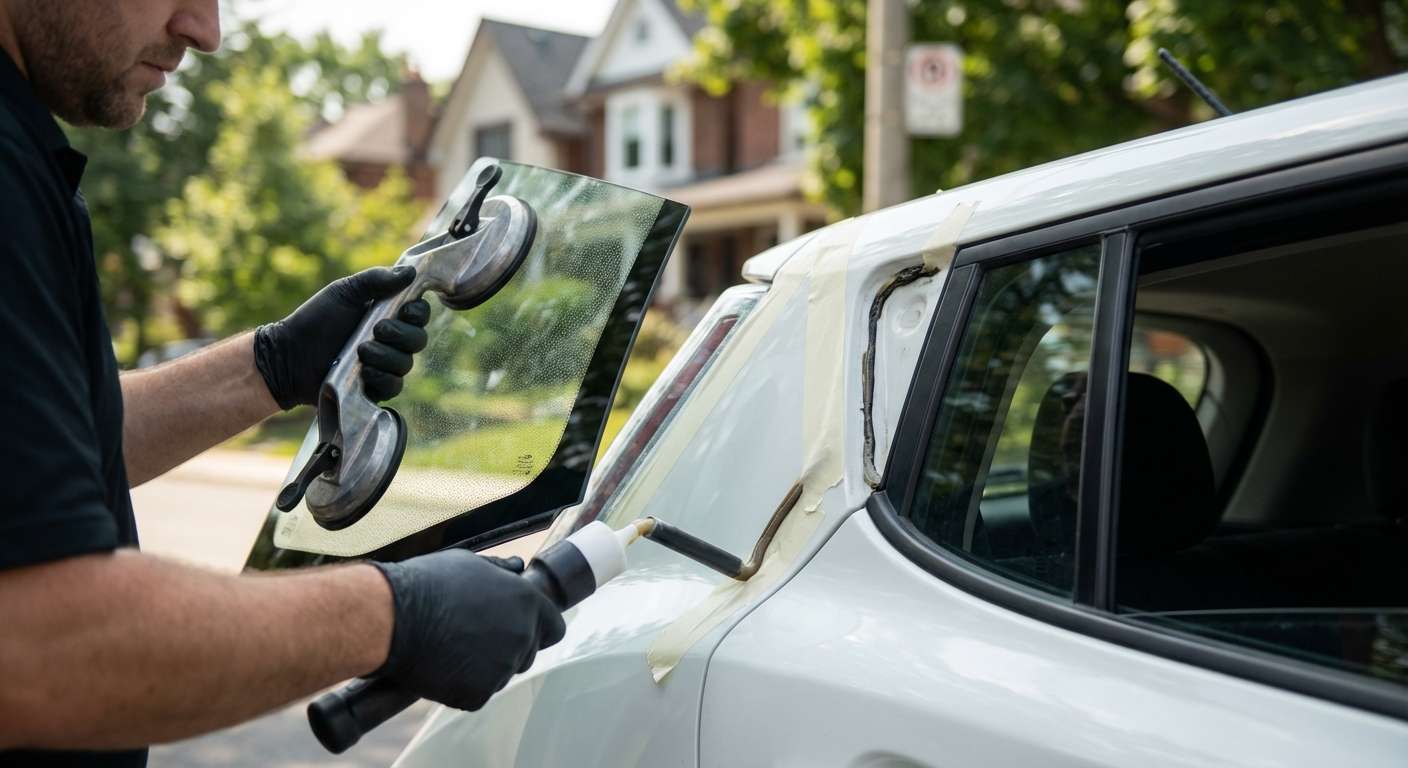
Vandalism Targets on the Rear Door Partition Vent
Break-ins account for almost every call I get to replace this specific pane. Thieves targeting the car often smash the stationary rear door vent glass under the mistaken impression that a smaller window costs less to replace or will slip past cabin shock sensors. Drivers are frequently blindsided afterward when sourcing replacement panes, discovering that this small triangular section often costs more than the larger roll-down pane right next to it. For this first-generation EV, the broken piece is not bonded to the rear quarter quarter-panel of the body; it is a door-encapsulated vent pane mounted directly inside the framed rear door assembly, separated from the drop glass by a dedicated vertical division bar channel.
When clearing the shattered tempered safety glass out of a door, matching the tint is critical. Nissan produced the right side under dealer part number 82220-3NA0A and the left side under 82221-3NA0A (which also interchanges with updated part 82221-3NF1A). While the glass lacks integrated defroster lines, antennas, or driver-assist electronics, the factory composition features an ultraviolet-absorbing green solar base. I bring aftermarket replacements directly to your driveway or workplace parking space across Toronto and the GTA so the car does not have to be driven with an exposed interior full of tempered fragments.
Eliminating Wind Noise and Water Intrusion Along the Division Bar
A frequent complaint on Leaf ownership forums involves a persistent cabin whistle or water leaking past the rear door card after a vent pane replacement. The rear stationary vent does not rely on polyurethane adhesives. Instead, it relies entirely on a mechanical lock between the outer rubber sash weatherstripping and the painted vertical division bar—part 82222-3NA0A on the right side and 82223-3NA0A on the left. If that division channel is re-secured even two millimeters out of alignment, highway airflow will pull around the rubber lip, creating an annoying rush of wind right at ear level for rear passengers.
Achieving a watertight seal requires stripping the door down properly rather than forcing the glass into the frame. The interior door trim panel and upper sash garnish must come off so the movable roll-down glass can be decoupled and lowered into the bottom of the door shell. This releases tension on the center division bar, allowing the rubber-moulded perimeter of the new vent pane to seat fully into the door frame channel. When I tighten the division bar back into its lower bracket, I verify that the rubber run channel has not pinched along the forward vertical edge, ensuring the main window slides up without binding and the cabin stays completely sealed against highway drafts and rain.


