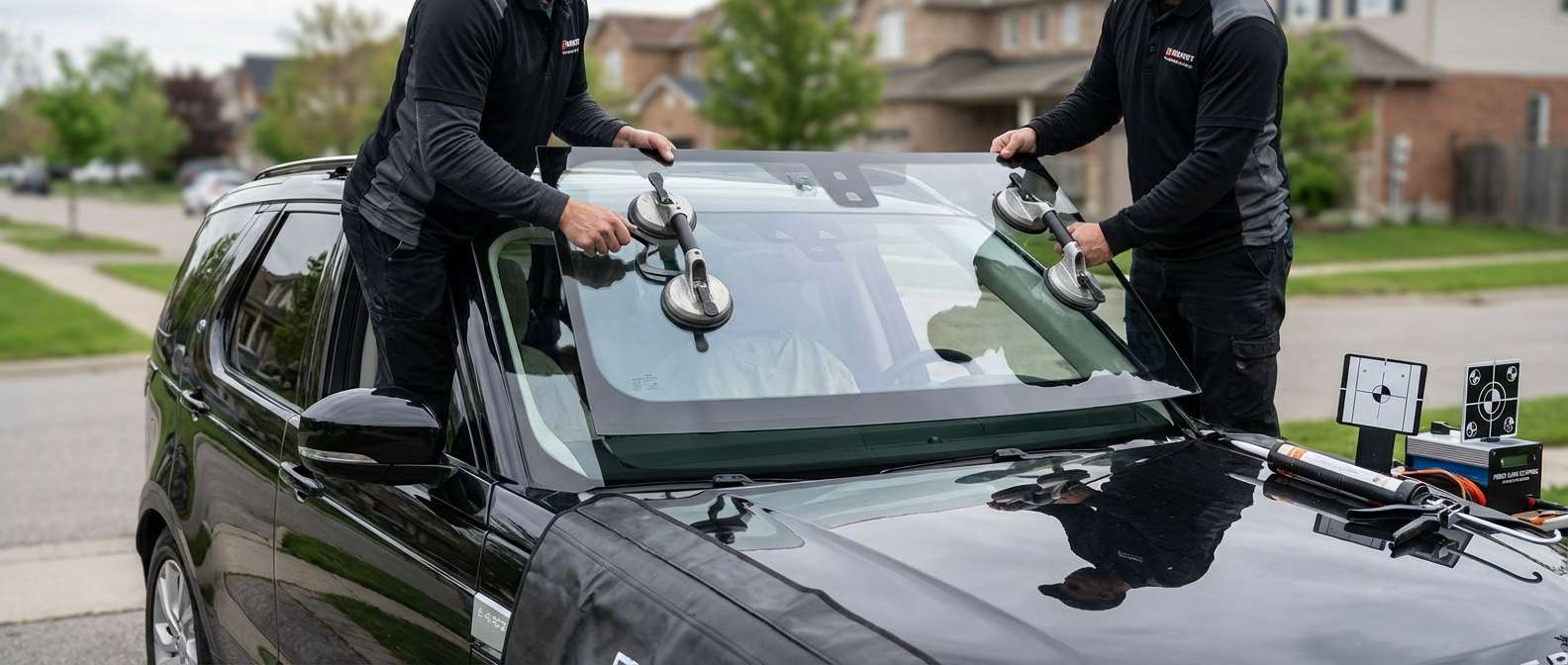
Water Leaks, Urethane Separation, and Electrical Risks
If you notice damp sun visors, moisture pooling inside the front roof console, or water trickling down the A-pillar into the passenger footwell, your windshield seal has likely failed. The factory glass installation on this vehicle has a well-documented history of bonding breakdown along the upper roofline seam. Jaguar Land Rover addressed this persistent separation through service bulletins like N221 and N56NAS1, but unaddressed leaks routinely soak the underlying harness, threatening the central Body Control Module, digital instrument cluster, and rotary transmission selector. Significant off-road axle articulation puts considerable torsional stress on the L462 monocoque, which accelerates the breakdown of poorly adhered factory urethane beads over time.
Resolving this issue permanently requires stripping the perimeter properly to lay down a solid, leak-free seal. The job involves removing the gloss black exterior A-pillar finisher trims, the plastic wiper cowl panel at the base, and the upper roofline reveal moulding. The retaining clips holding those gloss black pillar trims are notorious for snapping off upon disassembly, so keeping new clips on hand is mandatory to avoid wind whistling or loose trim once the vehicle is back on the road. Because these vehicles demand absolute sealing precision against moisture, I provide a lifetime warranty on my workmanship alongside a one-year warranty on the glass replacement itself.
Matching Heated Grids, Solar Attenuation, and HUD Optics
Pinpointing the correct replacement glass requires matching the exact feature bundle originally fitted at the factory. Unlike vehicles that only warm the resting zone for the wiper blades, this model utilizes an ultra-fine micro-wire heating element woven entirely throughout the viewing area. If your windshield features this defrosting grid, the lower cowl must come off completely so the dual wiring connectors beneath the glass can be disconnected and re-plugged without stressing the terminal tabs.
Factory variations multiply once optics and climate layers enter the equation. High-spec models equipped with the Head-Up Display require specific glass wedging within the acoustic vinyl interlayer to avoid double-vision ghosting, often tied to dealer part number reference LR183005 (which superseded LR143027, LR154940, and LR172666). Vehicles that pair the heated wire grid with infrared-reflecting solar attenuating glass but omit the HUD typically utilize glass tied to part reference LR183003, whereas standard heated variants without the solar treatment line up with part number LR184682 (replacing older references LR154739 and LR162755). Acoustic dampening film is standard across all of these variants, preserving quiet cabin acoustics regardless of whether your trim level carries the HUD projector cutout.


