Regulator Spool Failures and Shattered Glass on Taurus Doors
When the side window on this sedan drops suddenly into the door cavity, the failure usually traces back to the cable mechanism rather than an impact from the outside. The power window regulator uses plastic guide spools and tensioned steel cables that corrode or fatigue over years of daily cycling. When a spool snaps, the carrier plate loses tension immediately, allowing the glass to tilt sideways inside the framed door assembly. If someone hits the master window switch while the pane is cocked at an angle, the regulator motor pulls unevenly, twisting the bottom mounting clips and binding the glass against the vertical metal track until the panel fractures under the strain.
I frequently see this issue on the driver-side door, where switch contacts also wear down and cause erratic up-and-down movement. In winter, moisture seeping past the outer beltline weatherstrip moulding freezes inside the full perimeter rubber run channels. Forcing the motor to drop a frozen window pulls the bottom glass brackets right off the regulator carrier, leaving the panel suspended at the top or dropping it straight onto the steel crash beam inside the door shell.
Generational Splits Between Five Hundred Heritage and the Sixth Generation
Replacing the door glass on this model requires careful attention to the transition year, because parts do not interchange across the two distinct production runs. The 2008 and 2009 models carry over the roofline and door stampings from the Ford Five Hundred and Mercury Montego era. For these early cars, the rear right door glass uses NAGS DD08855, matching the older sedan's door shell geometry exactly. Attempting to fit later parts onto an early car fails because the curvature, height, and lower bracket spacing differ completely.
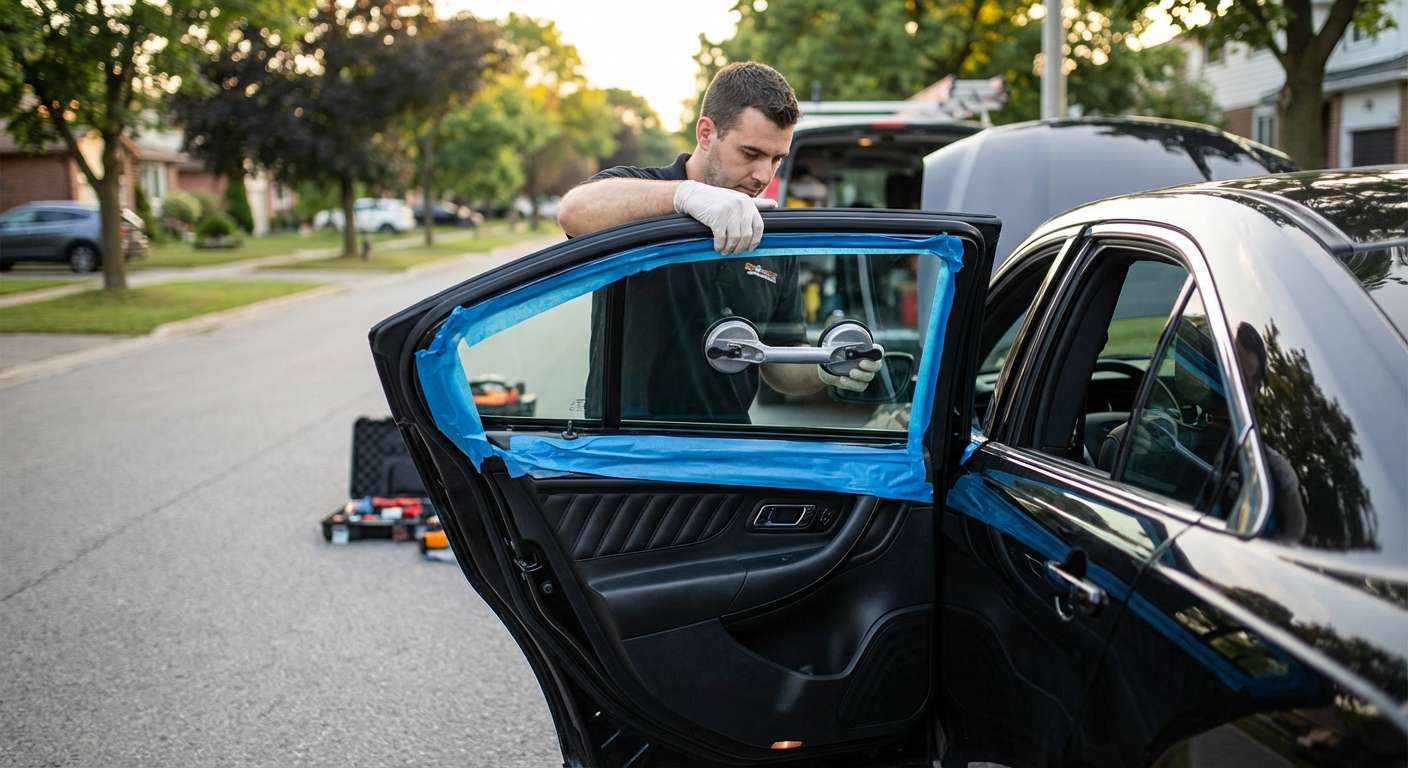
The overhaul starting in 2010 introduced a much thicker door skin and modified glass profiles across all four positions. On these later cars, the front passenger glass shifts to NAGS DD11651 (matching OEM reference AG1Z-5421410-A), while the front driver side requires NAGS DD11652 (OEM AG1Z-5421411-A). When a driver calls me with a shattered side window that leaves their interior open to the weather, I typically arrive at the car within roughly an hour of the call so the door is not left taped up with plastic.
Acoustic Laminate Front Panes Versus Tempered Rear Glass
Starting with the 2010 redesign, Ford specified laminated front door glass for retail trims like the SEL, Limited, and SHO to cut down wind roar and highway tire noise. These front panels carry the NAGS GTY suffix, indicating a dual-pane construction with a sound-dampening acoustic vinyl interlayer sandwiched between two sheets of solar-tinted glass. When struck by road debris or broken into, these laminated front windows crack like a miniature windshield instead of shattering into pebbles, staying held together by the plastic core. Fleet builds, including the Police Interceptor Sedan, often substituted solid tempered panes for durability and lower replacement overhead.
The rear doors are engineered differently across the entire 2010 to 2019 lineup. The rear operable glass, cataloged under NAGS DD11653 for the right rear and DD11654 for the left rear, uses standard single-pane tempered glass with a green solar tint, designated by the GTN suffix. When this glass breaks, it bursts into thousands of blunt fragments that fall into the door bottom. Replacing it means freeing the movable pane from the stationary vertical division bar that isolates it from the fixed rear quarter vent window, ensuring the new glass seats cleanly in the run channels without dragging against the felt sweeps.


