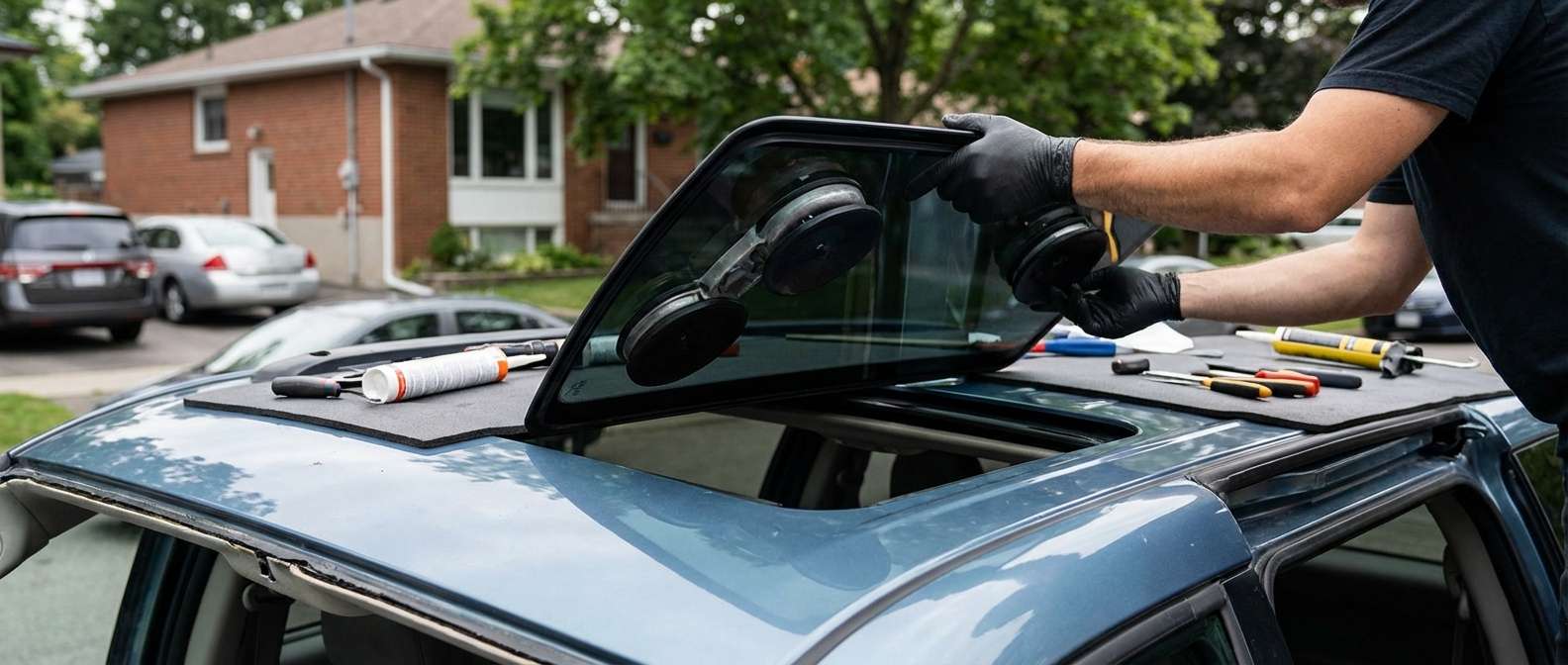
Dodge Grand Caravan Sunroof Glass Differences Between Model Years
If your minivan has a factory-installed power sunroof, it is an ES or SXT trim built between 2003 and 2007. Chrysler did not offer an electric sliding sunroof from the factory on the 2001 or 2002 model years. When I see an opening glass roof on a 2001 or 2002 van, it is inevitably an aftermarket retrofit, most commonly from Webasto or Inalfa, which relies on a completely different framework, cutout dimension, and switch harness than the factory Mopar assembly.
For the 2003 through 2007 models, the original assembly (Mopar part number 05093945AA) consists of a single-pane, dark-tinted tempered panel bonded directly to a steel perimeter subframe with an integrated rubber seal. It sits directly forward of the stamped roof ribs and longitudinal roof-rack tracks. The panel does not have integrated antennas, defroster traces, or laminated acoustic interlayers. Instead, it is purely a solar-control tempered unit engineered to seal flush against the painted sheet metal aperture above the sliding cloth sunshade.
Mechanical Hardware and Perimeter Fasteners
Replacing this panel requires dealing with the side mechanical carriages rather than perimeter adhesives. The glass assembly secures to the internal lift mechanism using side-mounted Torx retaining screws. These screws are fully concealed from the passenger cabin by flexible accordion-style side bellows that clip into the inner tracks below the overhead console rocker switch.
A failed drive motor (part 05093946AB) or cracked nylon drive shoes can prevent the carriage from reaching the service position. When the track jams cocked to one side, forcing the mechanism will shatter the tempered glass or strip the drive cables. I make sure the replacement panel is centered perfectly within the opening to eliminate wind whistle caused by gasket compression gaps; my glass installations include one year of product coverage alongside lifetime backing on my workmanship. Proper alignment also ensures that water flows naturally into the four corner catchment troughs rather than overflowing onto the headliner fabric.
Clearing the Internal Drain Pillars
The roof aperture relies on four distinct evacuation lines: two front tubes routed down inside the A-pillars behind the plastic trim, and two rear tubes directed down the C-pillars. The most common failure on these vans is not the glass itself failing to shed water, but rather standing water overflowing the internal catch tray because debris has settled into the upper hose nipples.
Whenever the glass panel is removed for replacement, these pathways must be inspected:
- Front A-Pillar Outlets: Run along the windshield frame into the lower cowl area. If pinched or blocked, water bypasses the sunroof cassette and pools in the front carpet footwells.
- Rear C-Pillar Outlets: Drain downward near the sliding door tracks. Detached hoses here allow water to soak directly into the rear headliner backing board, causing delamination of the cloth near the overhead console.
- Encapsulated Edge Seal: The rubber seal surrounding the replacement glass must sit evenly against the stamped sheet metal contour. Shrunk or degraded rubber allows excessive volume into the drain tray, overwhelming older, hardened drainage lines.
Can I put a factory 2003–2007 sunroof glass panel into my 2001 Grand Caravan?
No. The 2001 and 2002 models did not have the factory roof stamping, inner carriage brackets, or wiring for the Mopar sunroof assembly. Any sunroof in those earlier vans was cut into the roof panel by an aftermarket upfitter, meaning the replacement glass must match that specific aftermarket manufacturer's frame.
Why is there a loud whistling noise at highway speeds after a panel shift?
The dark-tinted tempered glass relies on a molded rubber perimeter seal that must compress uniformly against the minivan's roof opening. If the side Torx alignment screws have slipped or the track shoes are worn unevenly, the rear edge of the glass will sit lower than the roofline, creating negative pressure that pulls air past the gasket.
Do I have to remove the headliner to replace the sunroof glass?
No. Unlike replacing the entire track framework or the four corner drain hoses, the glass panel itself separates from the mechanism from inside the cabin simply by releasing the flexible side bellows and unbolting the Torx mounting hardware on each side of the carriage.


