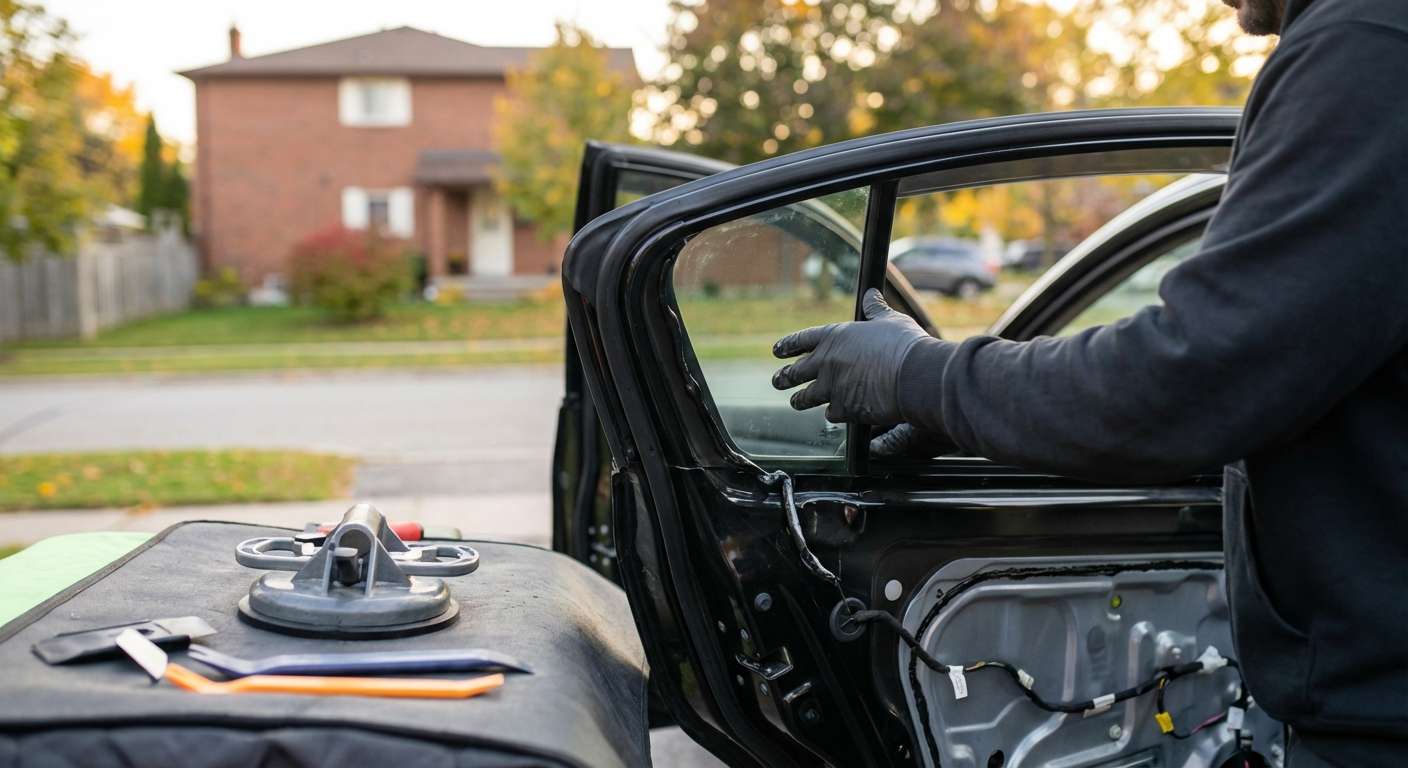
Addressing Rear Door Vent Rattles and Wind Whistles
Owners of this sedan regularly complain about a high-pitched air leak or an annoying vibration coming right behind the rear passenger headrests, particularly around the C-pillar. On these cars, the vent glass is situated entirely within the rear doors, seated directly beside the roll-up window rather than fixed onto the quarter body. The small triangular pane is held in place by a rubber channel rather than glued with urethane. Over years of sun exposure and seasonal temperature swings, the factory rubber sash channel hardens, shrinks, or splits. When that seal loses its flexibility, the glass loosens in its frame, vibrating against the metal door frame at highway speeds or letting turbulent air slip past the weatherstrip.
Replacing broken or loose glass on these rear doors means addressing the mechanical structure inside the door rather than cutting through structural adhesive. Separating the stationary vent pane from the main drop glass is a vertical steel division sash bar. The tension holding the glass secure comes entirely from this upright channel. Attempting to force the glass into the frame without disengaging the division bar binds the run channel, tearing the delicate corners of the rubber gasket and creating persistent air gaps that are impossible to silence afterward.
Navigating the Division Bar and B16 Door Frame
Whether you drive a base model, an SL, or an SE-R Spec V, the stationary quarter glass geometry on the B16 platform remains the same. The right passenger side carries NAGS number FV23375, while the left driver side uses FV23376. Each panel is made of green-tinted tempered solar safety glass, completely free of embedded antenna lines, defroster elements, or electrical connectors. The glass either arrives bare or pre-moulded with its outer perimeter channel, but the fit in the door depends entirely on freeing the lower sash channel.
Accessing the mounting points requires taking off the interior rear door panel and water vapor barrier to reach the lower retaining bolt on division channel 82222-ET000 on the right side or 82223-ET000 on the left. Once that fastener is out, the bar can tilt forward toward the center of the door shell, instantly releasing the pinch on the rubber run seal. I source my replacement glass exclusively from reliable aftermarket manufacturers like Pilkington, PGW, XYG, and FYG, which mirror the exact original contours so the glass slides smoothly into the factory rubber without distorting the outer waist belt moulding.
Avoiding Corner Breakage and Frame Distortions
The compact footprint of this stationary pane makes it deceptively difficult to align if the division channel is neglected. Trying to wedge a fresh pane into dry, tight door weatherstripping almost always snaps the pointed upper tip of the tempered glass or permanently warps the perimeter gasket. The division bar must be lowered slightly to seat the glass fully into the upper rear corner of the door window frame before the upright channel is swung back into its vertical track and bolted tight.
Before securing the lower mounting bolt inside the door shell, the run channel must be inspected to ensure the movable door window track remains parallel with the stationary pane. If the sash bar is tightened out of alignment, the drop glass will bind inside its channel, overloading the regulator while leaving the vent glass loose enough to leak water along the rear door edge.


