Cable Failures and Dropped Windows in Fourth-Gen Altima Doors
A sudden pop followed by the window sliding dead into the door shell is the most common reason owners reach out to me about side glass on this car. Inside the door, Nissan used a dual-cable regulator mechanism that spools onto a plastic drum. Over time, moisture gets past the outer beltline weatherstrip, causing the braided metal cables to bind, fray, and shear clean through. When those cables snap, the glass drops instantly into the bottom of the cavity. If the single-pane tempered safety glass hits the internal crash beam or bottom brackets at an angle, it shatters into thousands of blunt fragments, leaving the door empty.
Another frequent issue raised on Altima message boards involves the electric window motor struggling against aging rubber run channels. As the rubber dries out and gathers road dirt, friction spikes. The driver-side motor—often a 6-pin unit tied to the anti-pinch and one-touch auto up/down module on 2.5 S, 2.5 SL, and 3.5 SR trims—senses that resistance as an obstruction and sends the panel back down on its own. Repeated cycling against bound-up channels burns out the motor brushes or strips the regulator gears entirely, leaving the glass unbolted from its mechanical support.
Sedan Versus Coupe Window Configurations and Part Identifiers
Replacing the glass properly means distinguishing between the framed sedan setup and the frameless coupe styling introduced for 2008. On the four-door sedan, the side glass is fully framed inside perimeter channel rubber. The front doors use NAGS part number FD23388 for the driver side (equivalent to OEM reference 80301-JA000) and FD23387 for the front passenger side (80300-JA000). At the back of the sedan, movable glass panels run under NAGS FD23390 on the left and FD23389 on the right, which match Nissan numbers 82301-JA000 and 82300-JA000. These rear movable panes travel beside a fixed vertical division sash bar that separates them from the stationary corner quarter glass.
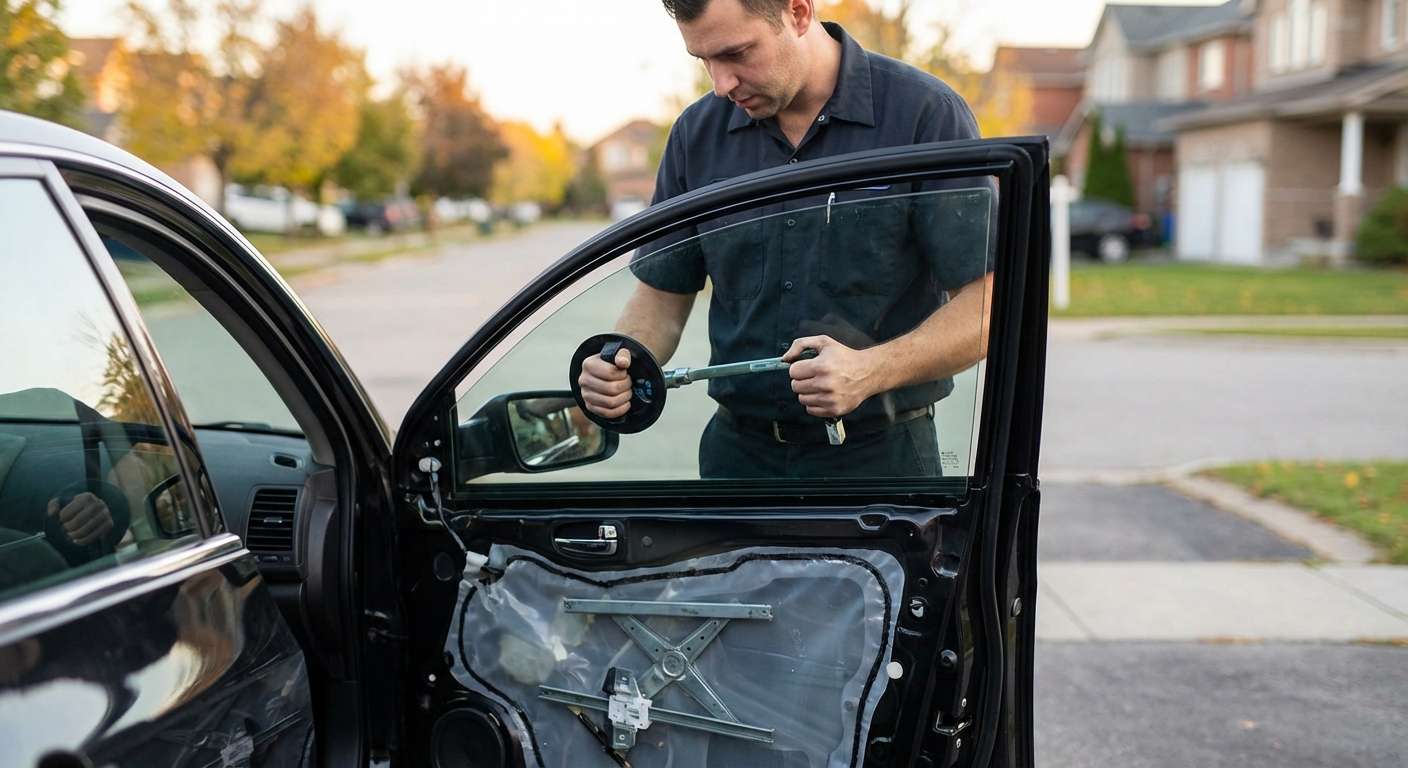
Because smashed side glass leaves an Altima open to weather and theft, I operate entirely as a mobile service, travelling directly to your driveway or workplace parking spot anywhere across Toronto and the surrounding GTA to replace broken glass on-site. The replacement panels I install use the factory-matched green solar tint embedded in the tempered glass, keeping the cabin shading uniform with the rear glass and windshield.
Inside the Door Cavity Mounting and Hardware Attachments
Both the front and rear Altima door panels hide their mechanical fastenings behind clean trim pieces. Reaching the window hardware requires releasing hidden Phillips fasteners behind the interior door handle trim bezel and the armrest pull pocket before unpopping the perimeter door clips. Beneath the interior trim panel sits a plastic vapor barrier sealing the inner sheet metal, giving access to the service cutouts.
The glass itself does not sit in a glued track; it uses two bottom mounting tabs with pass-through holes that secure directly to the regulator lift plates via retaining bolts. When clearing out a broken pane, all fragments packed inside the bottom door basin, the run channels, and the regulator guides must be thoroughly cleaned out before the new glass tabs can be seated into the carrier brackets. If stray tempered pellets remain trapped inside the lower run channels, they will bind against the replacement pane the moment the window switch is pressed, putting unnecessary strain on the regulator assembly.


