Rear Door Vent Glass Architecture on the Third-Gen Altima
Replacing the stationary rear door corner glass on the 2002 to 2006 Altima means dealing with a framed door assembly rather than glued-on quarter glass. Whether your car is an entry-level Base, a high-volume 2.5 S, a V6 SE, a luxury SL, or the performance-tuned SE-R introduced for 2005, the rear door window layout remains mechanically identical across the entire L31 production run. This fixed triangle sits right behind the movable roll-up glass, isolated by a rigid center sash known as the division bar.
Because this glass does not use glue or structural urethane, it relies entirely on a perimeter rubber weatherstrip to hold it secure against the metal door frame. The pane itself is solid tempered safety glass with a standard green solar tint, devoid of radio antennas, defroster grids, or acoustic laminates. Instead, the real complexity lies within the door cavity: the division bar channels the rear roll-up window on its front edge while sandwiching the stationary vent seal on its rear edge.
Division Bar Hardware and Weatherstrip Alignment
When this small window shatters or comes loose, the vertical division bar is the central component that dictates how the repair proceeds. It anchors deep inside the lower door shell with a dedicated mounting bolt and fastens at the top sash frame with upper screws. If an anchor bolt works itself loose over years of door slamming, you will hear an annoying high-speed rattle or notice highway wind whistling past the B-pillar and C-pillar seams.
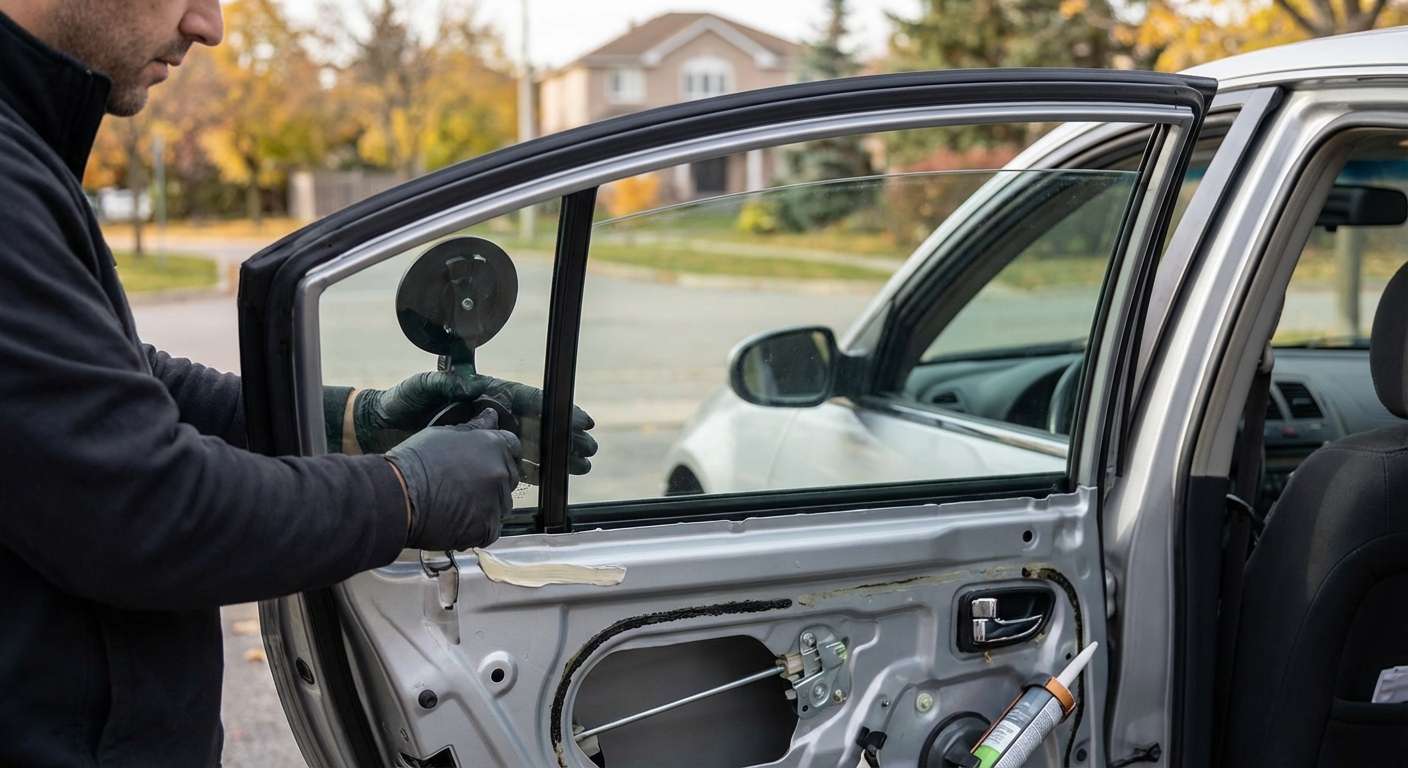
I typically pull up to your driveway roughly an hour after you set up the visit, bringing the correct aftermarket glass so you do not have to leave your car sitting open to rain or vandals. I take extra care around the factory rubber channel gasket (Nissan part 82272-8J000 on the passenger side). If an inexperienced hand attempts to force the glass out without unbolting and shifting the division channel inward, that fragile molded rubber will tear instantly, leading to permanent water leaks into the door panel.
| Component Description | Left Side (Driver) | Right Side (Passenger) |
|---|---|---|
| Factory Vent Glass Pane | 82263-8J000 | 82262-8J000 |
| Vertical Division Bar Assembly | 82223-8J000 | 82222-8J000 |
| Adjacent Window Regulator Unit | 82721-8J000 | 82720-8J000 |
Why Aging Seals Cause Water Leaks and Cab Whistles
The L31 cabin is susceptible to moisture ingress if the rear corner weatherstripping loses tension. Because the glass pane is non-encapsulated, it depends purely on the friction and compression of the surrounding rubber channel to keep out rainwater. Over time, heat cycles shrink this rubber, pulling it away from the sharp rear corner of the door frame.
- Division channel tension: The division bar (OEM 82223-8J000 on the left, 82222-8J000 on the right) must sit dead-plumb to guarantee the roll-up window glides smoothly without binding while clamping the vent rubber tightly.
- Vapor barrier integrity: Getting to the lower division anchor requires disengaging the interior door card and peeling back the plastic moisture barrier; resealing this barrier prevents rainwater from dampening the cabin floorboards.
- Beltline sweep alignment: The exterior horizontal window sweep mouldings meet the bottom edge of the vent rubber, and any gap at this joint sends water pouring straight toward the door latch assembly.


