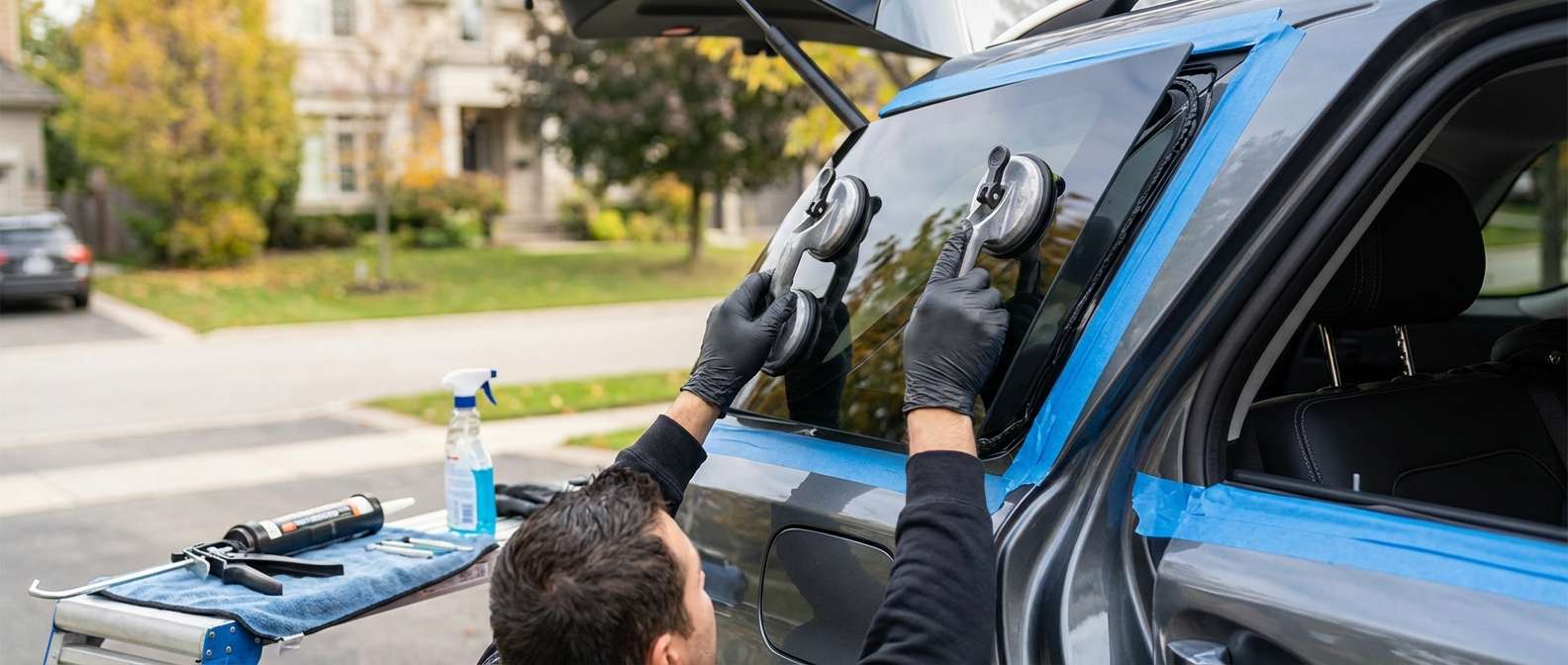
Identifying the Correct W166 Quarter Glass Assembly
The cargo-area side window on this vehicle serves a direct styling role by creating the signature forward-slanted C-pillar and wrap-around "floating roof" design leading into the rear liftgate. Because this is a fixed pane positioned entirely behind the rear passenger door frame, it uses no regulator or division bar. However, matching the replacement pane requires distinguishing the standard square-back SUV body from the swept-back C292 GLE Coupe. The SUV variant uses NAGS part numbers FQ25416 (Right Hand / Passenger side) and FQ25417 (Left Hand / Driver side), which cross-reference Mercedes-Benz factory catalogue numbers A1666702312 and A1666702412.
Most Canadian-market models arrive with the dark privacy tint and factory-bonded perimeter polyurethane moulding, designated under NAGS suffix FQ25416YP and FQ25417YP. Unlike the front windshield or rear tailgate, this side pane does not house heating grids, rain-sensing brackets, or forward-facing camera mounts. When sourcing the aftermarket glass, I confirm that the perimeter encapsulation moulding is completely intact out of the crate, as this pre-formed lip controls the exterior visual gap between the glass edge, the upper roof drip rail channel, and the rear D-pillar metal.
| Vehicle Variant | Position | NAGS Reference | Key Features |
|---|---|---|---|
| Standard SUV (W166) | Driver Side (LH) | FQ25417YP | Factory dark privacy tint, integrated encapsulation moulding |
| Standard SUV (W166) | Passenger Side (RH) | FQ25416YP | Factory dark privacy tint, integrated encapsulation moulding |
| Coupe Variant (C292) | Driver Side (LH) | FQ27042 | Shorter fastback profile, distinct aperture footprint |
| Coupe Variant (C292) | Passenger Side (RH) | FQ27041 | Shorter fastback profile, distinct aperture footprint |
Aperture Surroundings and Interior Clearances
The W166 rear quarter window is bordered by structural sheet metal that demands strict spatial awareness during glass removal and setting. Above the glass runs the roof rail channel; forward sits the wide, angled C-pillar; and rearward lies the D-pillar seam right at the liftgate shut-face. To access the perimeter aperture properly, the interior luggage compartment side trims and D-pillar upper garnish mouldings must be unclipped. Tucked immediately behind the upper edge of the headliner adjacent to this glass are the side-curtain airbag canisters, meaning interior clearances must be respected down to the millimetre so that no interior trim clips or mechanical tooling foul the safety equipment.
I also verify that the non-conductive properties of the adhesive match factory requirements, ensuring clean radio reception if your vehicle routes digital diversity or AM/FM signals near the rear pillars. Every replacement pane I supply carries a one-year defect warranty, paired with my personal lifetime guarantee on the installation workmanship. Owners sometimes confuse this generation with the subsequent V167 model, which suffered exterior trim detachment recalls under highway wind loads; the W166 design avoids this because its perimeter surround is an integral, unified polyurethane encapsulation rather than an add-on exterior cosmetic strip.
Post-Installation Inspection Points for Owners
Once the quarter glass is installed and cured, review the finished quarter panel to confirm the replacement aligns with the rest of your vehicle's factory trim lines:
- Encapsulation flushness: The integrated rubber outer edge should sit flat and uniform against the painted bodywork along the entire perimeter, leaving no pinched lips near the D-pillar or roof gutter.
- Floating-roof alignment: Step back five metres and view the vehicle's rear quarter; the dark privacy tint and the glass boundary should match the trailing edge of the rear passenger door glass and track smoothly into the tailgate window.
- Interior trim seating: The rear luggage area side panels and D-pillar interior garnish covers must sit fully snapped into their retainers, flush with the headliner and showing no gaps or loose plastic edges.
- Wind-noise check: At highway cruising speeds, there should be no whistling, flutter, or air leaks around the C-pillar frame seam.


