Inspecting the Rear Door Quarter Glass on Frua-Bodied Sedans
Each rear passenger door on this Pietro Frua-designed body features a stationary, triangular glass panel set behind the movable roll-down window rather than a body-mounted quarter light. Because Carrozzeria Vignale hand-built these steel door frames for the Tipo AM107, glass dimensions often exhibit fractional differences between the early Series I cars and the later Series II update that arrived in 1966. Before placing an aftermarket reproduction panel into the steel door sash, I lay the new tempered glass directly over the removed piece to trace the perimeter. Handcrafted coachwork means no two door frames are completely identical across the 776 cars built, so any replacement pane must match the exact height and trailing rake angle of your specific door.
The glass itself is completely passive, devoid of modern heating elements, embedded antennas, or acoustic interlayers. When examining replacement glass, I verify the edge grinding and polish along the exposed upper borders. Any rough tooling marks or micro-chips along the edge will focus stress once tightened against the steel frame. I also verify that the curvature matches the gentle sweep of the rear door aperture; a pane that is cut completely flat will bind against the perimeter brightwork rather than bedding evenly into the extruded rubber channel.
Framed Division Bar and Glazing Components
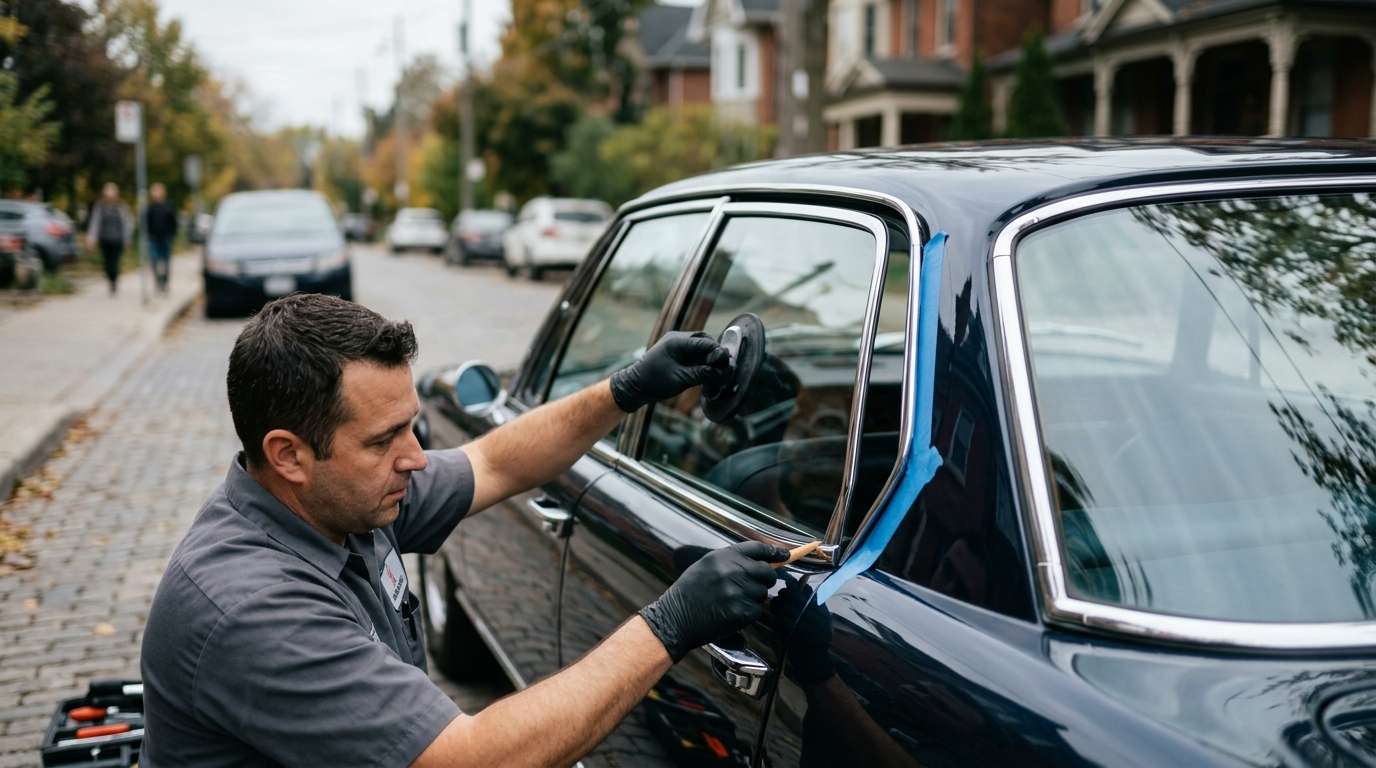
The stationary rear quarter light sits tightly against an interior vertical division bar that guides the adjacent roll-down glass. When addressing these rare Italian classics across Toronto and the GTA, I travel directly to your home or workspace with everything required to fit your glass on-site. Securing this glass involves several distinct hardware components within the door cavity that must be inspected prior to reassembly:
| Component | Function on Tipo AM107 | Inspection Priority |
|---|---|---|
| Vertical Division Bar | Separates drop glass from fixed quarter pane | Check for structural twist and straightness |
| Glazing Channel Rubber | Cushions the glass perimeter in the steel sash | Verify profile flexibility; replace hardened sections |
| Perimeter Chrome Garnish | External brightwork clamping the assembly | Inspect mounting screw tabs for metal fatigue |
| Division Bar Felt Track | Guides the descending main window | Check pile depth to avoid contact with quarter glass bracket |
Post-Installation Checks on Door Alignment and Weatherproofing
Once the quarter light is positioned within the door sash, testing must center on how the glass interacts with the neighboring components. I check the alignment of the vertical division bar before the interior door cards and vapor barriers are reattached. If the division bar is nudged even a millimeter out of true to accommodate a poorly sized quarter pane, the primary roll-down window will bind within its channel felt during operation. The division bar must stand dead plumb so that the main drop window glides past the fixed quarter light without resistance.
Exterior brightwork requires careful evaluation after the fasteners are cinched down. The chrome trim encasing the quarter glass must sit flush against the outer door frame with continuous, uniform compression along the rubber seal. Gaps between the chrome garnish, the rubber channel, and the glass pane allow rainwater to slip past the frame, draining straight into the lower door bottom where moisture risks attacking the internal door release linkages. Finally, I sight down the exterior door line to confirm the new quarter pane sits on the identical plane as the front vent window, preserving the continuous glass profile intended by Frua.


