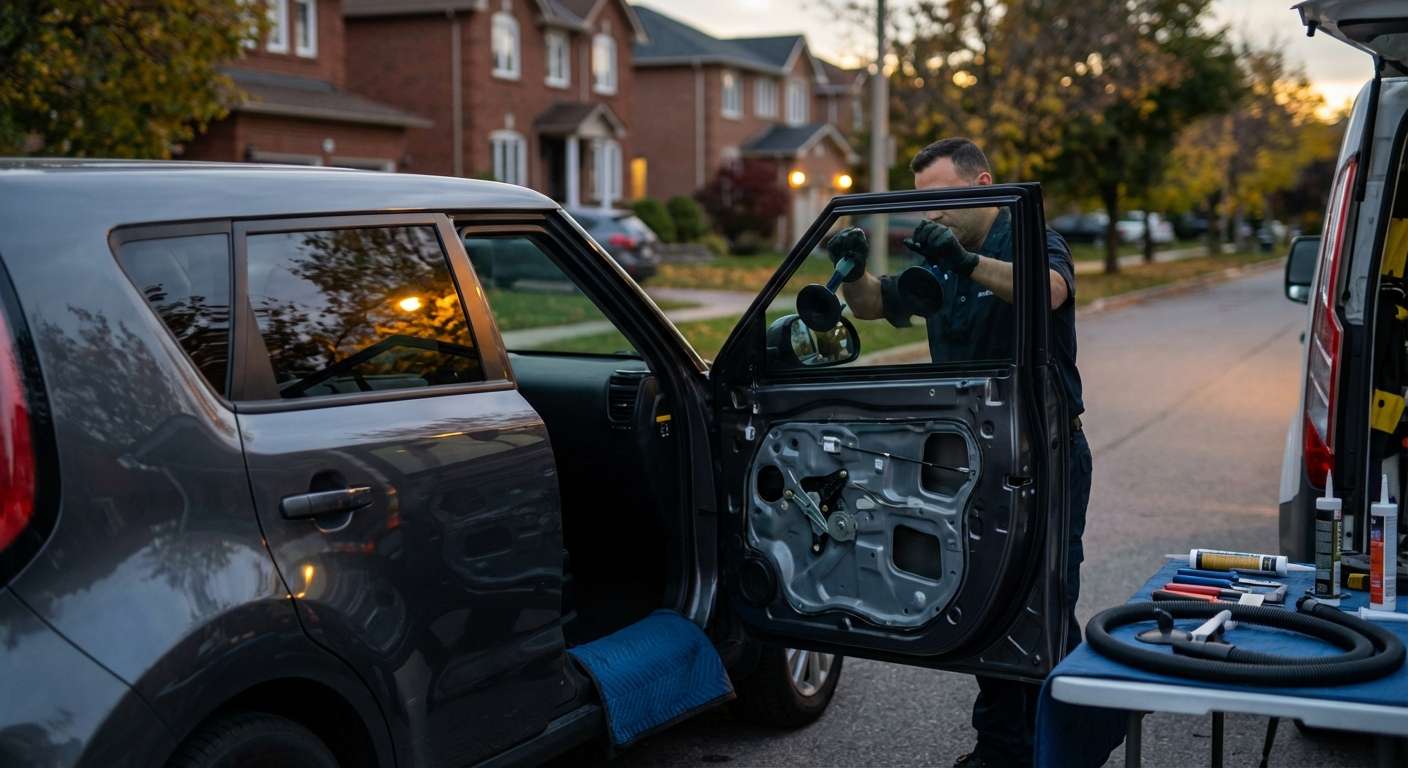
Tempered Side Glass Breakage and Regulator Drops on the Soul
Vandals target the side windows of the Soul frequently, leaving the cabin showered in pebble-sized tempered debris. Unlike the front windshield, the door glass on this boxy hatchback is single-pane tempered safety glass engineered to fracture completely upon impact. When dealing with a break-in or roadside projectile, you lose the entire panel instantly because there is no laminate interlayer holding it together.
I also regularly see owners who assume their window shattered when, in reality, it simply fell into the door shell. The cable-and-drum window regulator mechanism inside these doors uses plastic guide clips that become brittle over time. When a clip snaps or a cable derails, the door glass drops straight down inside the stamped steel door cavity. If the glass hits the bottom of the door frame at an angle, the tempered panel can shatter internally, making an awful grinding sound against the composite inner carrier plate.
Second-Generation Soul Door Glass Specifications
Whether you drive a standard Base model, step up to the Plus (+) or Exclaim (!), or drive an all-electric Soul EV, the glass cutouts and door dimensions remain consistent across the 2014 through 2019 production run. What differs is the glass tint: the front windows come in standard clear or solar-control green, while the rear passenger doors on higher trims feature factory dark smoke privacy glass.
| Glass Position | NAGS Part Number | Factory Tint Style | OEM Reference Numbers |
|---|---|---|---|
| Front Left (Driver) | FD26075 | Solar Green / Clear | 82410-B2020 / 82410-B2000 |
| Front Right (Passenger) | FD26074 | Solar Green / Clear | 82420-B2020 / 82420-B2000 |
| Rear Left (Driver Side) | FD26077 | Dark Privacy Smoke | 83410-B2020 |
| Rear Right (Passenger Side) | FD26076 | Dark Privacy Smoke | 83420-B2020 |
I usually pull up to your location about an hour after you book, ready to extract the shattered pieces and secure your Soul with a direct-fit aftermarket panel. Because these movable panels do not integrate defrosters, embedded radio antennas, or camera hardware, matching the original tint shade and mounting bracket profile is the primary technical objective.
Door Frame Architecture and Mechanical Clearances
The doors feature a rigid, stamped steel upper window frame lined with continuous rubber run channels, rather than a frameless design. The glass relies on specific clearances to slide freely without binding.
- Front Mirror Sail Angle: The front door glass mounts to lower carrier clamps through service holes in the inner module. When extracting broken glass or sliding a replacement in, the front edge must tilt diagonally forward down into the door cavity to clear the interior mirror sail trim and the upper rubber channel.
- Rear Division Bar Alignment: On the rear passenger doors, the movable window travels between the front door frame rubber and a vertical steel division bar that isolates it from the stationary quarter glass. If this division channel shifts or catches debris during a break-in, the replacement glass will pinch or trigger the auto-reverse safety feature.
- Beltline Moulding Traps: The exterior lower beltline weatherstrips have felt wipes that catch small tempered glass shards when a window breaks. Those glass fragments must be vacuumed out completely; otherwise, they score deep vertical scratches into the new glass the first time it lowers into the door.


