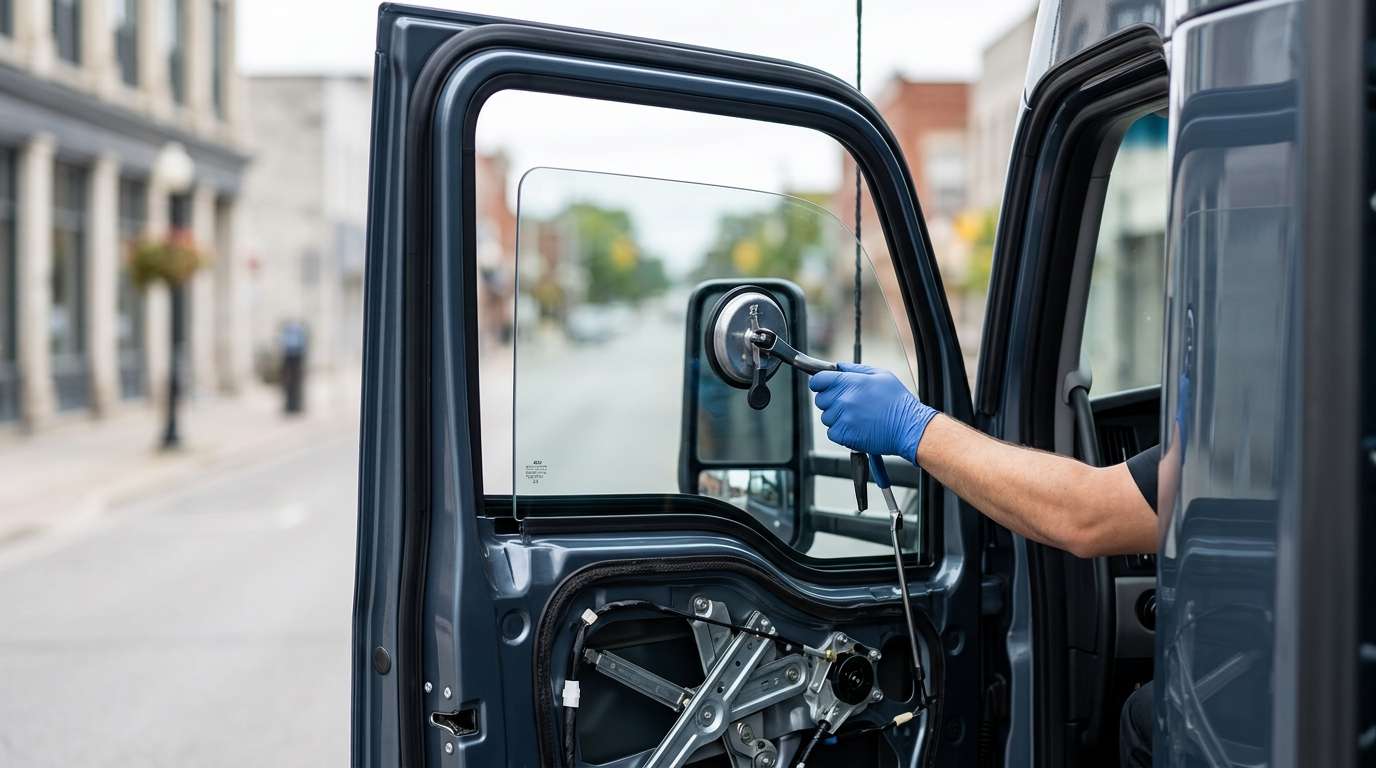
Inspecting Replacement Glass for the 2.1-Meter Kenworth Cab
Matching the curved side glass on this battery-electric rig starts with confirming the curvature and tint before stripping down the door assembly. The driver-side window corresponds to PACCAR R44-1110, while the passenger side is stamped R44-1110R, and you will routinely find the ECE regulatory stamp 43R-001237 embedded in the corner. When I set the aftermarket drop glass against the frame, I verify the subtle green solar tint profile; this window contains no integrated defroster grids, embedded radio antennas, or rain sensors, but the bottom edge profile must seat dead-flat across the regulator lifter plates.
A mismatch at the bottom clamps will prevent the glass from tracking squarely up the rigid, stamped aluminum door shell. I also inspect the edge grinding around the perimeter: because the glass travels inside a full window frame rather than a frameless door system, any sharp edge or rough bevel will immediately chew into the continuous PACCAR R42-1134 run-channel rubber seal.
Channel Tracking and Low-Voltage System Checks
Once the glass sits in the lift brackets, the alignment inside the door frame dictates whether the window moves freely or strains the motor. The T680E drives its glass via an electric cable regulator—the same assembly referenced under base part R21-1018 for the left door and R21-1018R for the right. Because this electric heavy-duty truck isolates its 650V high-voltage tractive powertrain from the cab, the window motor operates off the standard 12V low-voltage auxiliary circuitry governed through the cab multiplex door module (MUX).
When testing the movement, I hook up the low-voltage door controls to check that the pane slides into the top corner pocket without canting. If the panel drags on the inner or outer beltline weatherstrips, the MUX circuit can detect excessive resistance and halt travel. I protect every installation with a full year of coverage on the replacement glass itself alongside lifetime support for my workmanship, ensuring the hardware stays tight through thousands of road hours. After the replacement, I run the window completely up and down multiple times to confirm the glass edges remain fully buried in the rubber tracks from the bottom stops to the upper frame header.
Kenworth T680E Door Glass Hardware Reference
| Component | Identification / OEM Cross-Reference | Application Notes |
|---|---|---|
| LH Front Door Glass | R44-1110 / 43R-001237 | Curved drop glass, green solar tint, single piece |
| RH Front Door Glass | R44-1110R / 43R-001237 | Curved drop glass, green solar tint, single piece |
| Continuous Run Channel | R42-1134 | Perimeter rubber guide seated in stamped door frame |
| Cable Window Regulator | R21-1018 (LH) / R21-1018R (RH) | Cable-drive lifter driven by 12V MUX door controls |
Does the electric powertrain require special safety shutdowns before changing the door window?
No. The door functions on the T680E—including the cable-driven window regulator and the cab switchgear—operate entirely on the isolated 12-volt auxiliary electrical system managed by the cab multiplex module, completely separate from the 650-volt high-voltage traction drive.
Is the door glass different between the electric T680E and a diesel T680 or T880?
The glass is identical. Kenworth built the T680E around their shared 2.1-meter aluminum cab structure, which uses identical stamped door shells, PACCAR R42-1134 run channels, and window regulator mounting geometry as the standard diesel highway models.


