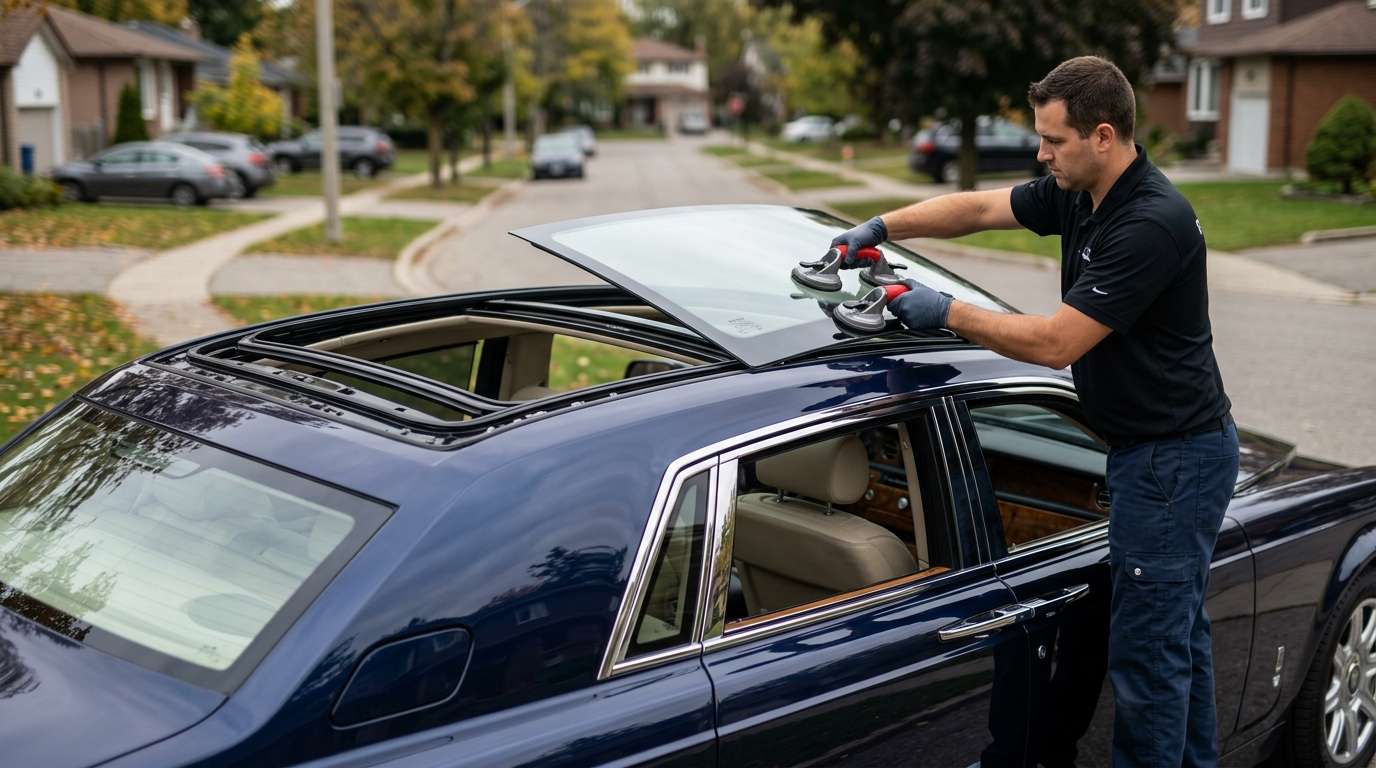
Identifying Your Phantom Roof Configuration and Glass Setup
Determining whether your saloon carries the tilt-and-slide glass sunroof starts by looking straight up at your headliner options. Rolls-Royce built the standard-wheelbase saloon and the Extended Wheelbase (EWB) with an optional factory glass panel, but if your cabin features the full-length fiber-optic Starlight Headliner, your car does not have a sunroof; the extensive wiring loom and optical strand bundles required for that ceiling display occupied the exact cavity where the mechanical roof cassette would slide. Furthermore, the Drophead Coupé and two-door Coupé were engineered without any glass roof option whatsoever.
For cars equipped with the aperture, the overhead console features bespoke chrome violin key switches that actuate the motor drive. Beneath the glass sits an upholstered sliding sunblind finished in the same hand-stitched cashmere-and-wool blend as the surrounding cabin ceiling. Because these vehicles were produced in limited quantities, you will not find a standard aftermarket NAGS code stamped on the unit. Instead, the assembly is tied to factory part number 54107159253, paired with the structural sliding cassette 54107198065.
| Phantom Body Style | Roof Glass Availability | Headliner Compatibility |
|---|---|---|
| Standard Saloon | Optional Tilt/Slide Glass | Cashmere/Wool (Incompatible with Full Starlight) |
| Extended Wheelbase (EWB) | Optional Tilt/Slide Glass | Cashmere/Wool (Incompatible with Full Starlight) |
| Two-Door Coupé | Not Available | Solid Headliner or Starlight Headliner |
| Drophead Coupé | Not Available | Tailored Fabric Soft Top |
Panel Composition and Structural Aluminum Integration
The panel itself is a single-pane, tempered safety glass unit infused with an integrated solar-reflective, heat-rejecting treatment to minimize cabin heat soak through that large horizontal surface. Unlike the front windshield, this roof glass carries no integrated radio aerials, rain sensor pads, or defroster elements. The edge is sealed with an encapsulated rubber perimeter weatherstrip engineered to compress directly against the hand-finished aluminum roof skin, which is notably smooth and free of any plastic water-channel mouldings or body seams.
Whenever I replace damaged overhead panels, I source solely aftermarket glass produced by established manufacturers like Pilkington, PGW, FYG, or XYG to ensure the tempered thickness and solar performance match the vehicle's thermal requirements. The glass fastens inside an internal aluminum cassette carrier that ties directly to the main aluminum spaceframe. When the panel tilts open, a spring-loaded mesh wind deflector rises from the leading edge to prevent cabin buffeting at highway speeds.
Addressing Wind Noise, Alignment, and Drain Channeling
Because the panel sits flush within an unbroken aluminum roof aperture, physical alignment is sensitive to minute fractions of a millimeter. When owners experience creaking noises or wind rush around the roof opening, the cause is rarely cracked glass; rather, it often stems from track friction, body flex against mounting hardware, or settling of the mechanical carrier. The glass panel mounts to the internal drive rails using dedicated Torx adjustment screws that allow me to alter the height and level at all four corners, bringing the glass perfectly planar with the exterior roof stamping.
- Drainage routing: Four rubber drain tubes run from the corners of the cassette tray down through the A-pillars and C-pillars; clearing debris from these lines prevents cabin water ingress that can pool under the thick lambswool floor rugs and threaten floor-mounted electrical modules.
- Cassette maintenance: Dry perimeter weatherstrips cause friction against the aluminum aperture, demanding clean rubber seals to stop creaking sounds during chassis articulation.
- Motor re-initialization: If the vehicle battery is disconnected or suffers a low-voltage drop, the drive motors can lose their closed-position memory, requiring a manual track re-synchronization cycle through the overhead violin switches.


