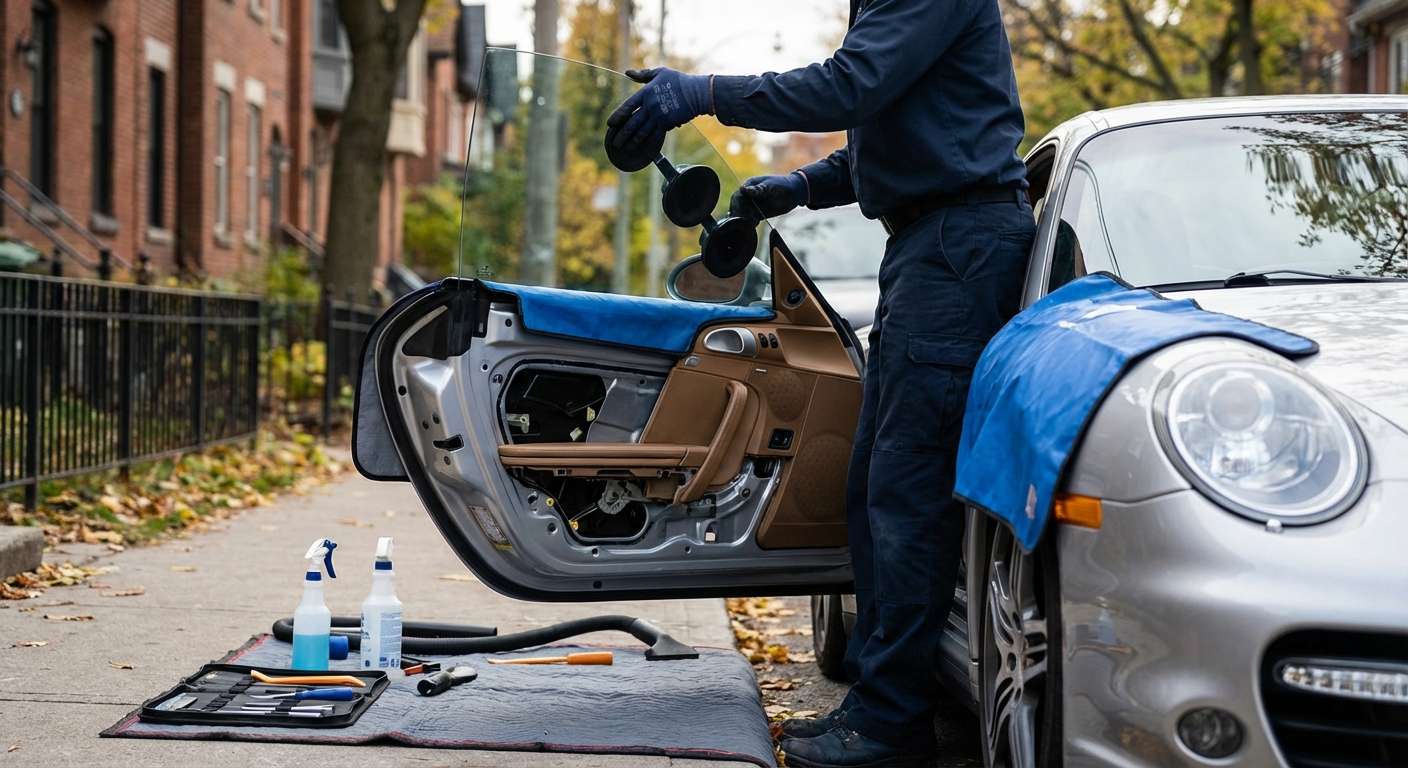
Frameless Door Glass Failures and Indexing Faults
A shattered side window on this vehicle often stems from issues unique to its frameless door construction rather than just an outside impact. The glass relies on an active indexing short-drop mechanism that lowers the pane roughly 10 to 12 millimeters the split second you pull either the exterior or interior door handle. This drop clears the top edge of the green solar tempered glass from the deep rubber weatherstripping channel along the roofline and A-pillar. When the microswitches inside the handle assembly or the door latch mechanism fail, the glass stays fully raised. Forcing the door open or slamming it shut against the rigid roof seal puts severe lateral bending stress on the curved tempered pane, which frequently leads to an instant blowout.
Mechanical fatigue inside the door cavity is another common culprit behind broken panes. The dual-rail, cable-driven power window regulator uses braided steel cables that fray over time and plastic pulleys that split under load. If a pulley snaps while the window is in motion, the glass drops unevenly, jams in the waist rail guides, and binds inside the door shell under the torque of the drive motor. If your side window shattered while driving or during a standard door closure, I typically reach your vehicle within about an hour of your booking so the exposed cabin isn't left open to the weather.
Coupe, Targa, and Cabriolet Profile Differences
Replacing the door glass on this 911 generation requires strictly matching the body style because the glass contours are not universal across the lineup. While the doors look similar from the outside, the upper curvature and edge taper differ significantly between roof designs to match the varying weatherstripping profiles.
| Body Style | Left Side (Driver) | Right Side (Passenger) | Factory Reference Baseline |
|---|---|---|---|
| Coupe & Targa | FD22605 | FD22604 | 997-542-511-00 through -13 |
| Cabriolet | FD22605 equivalent (Cabrio profile) | FD22604 equivalent (Cabrio profile) | 997-542-511-01 / -03 / -06 |
The Coupe and Targa use identical side glass that interfaces directly with the welded body frame channels. The Cabriolet uses a distinct cut—referenced by Porsche under base numbers like 997-542-511-01 and 997-542-512-01—to align with the folding soft-top fabric seals and different B-pillar angles. Installing a Coupe cut into a Cabriolet prevents the top from sealing, causing intense wind roar and water ingress, while attempting to force a Cabriolet pane into a Coupe hardtop risks fracturing the glass the moment the door latches.
Setting Alignment and Preload
Because there is no upper window frame to force the glass into position, the window's resting attitude depends entirely on the mechanical adjustment of the two bottom clamping brackets inside the door. If the inward tilt—often called the tumblehome—is off by even a millimeter, the glass will either chatter against the A-pillar seal at highway speeds or fail to create an airtight barrier.
Adjustment points located along the bottom edge of the door shell dictate glass height, fore-and-aft tilt, and the clamping angle against the upper weatherstripping. After replacing the pane and reconnecting the door harness, the power window motor must undergo an end-limit adaptation cycle. Without this relearning sequence, the control module loses track of the upper pinch-protection boundary, disabling both the automatic one-touch lift and the essential short-drop feature.
Post-Replacement Inspection Checklist
- Lift the exterior handle slowly: verify the glass drops 10–12 mm before the door latch pulls free from the striker pin.
- Release the handle with the door open: ensure the pane remains in its dropped position until the latch clicks closed against the B-pillar.
- Check the interior handle: verify the inner microswitch triggers the identical automatic drop without catching the top rubber lip.
- Examine the tumblehome seal: with the door closed and glass fully up, confirm the glass applies even inward pressure along the entire A-pillar and roof weatherstrip without gaps or visible puckering.
- Test one-touch operation: press the console window switch to ensure smooth travel without binding, squeaking along the waist rail seals, or false stops from the anti-pinch logic.


