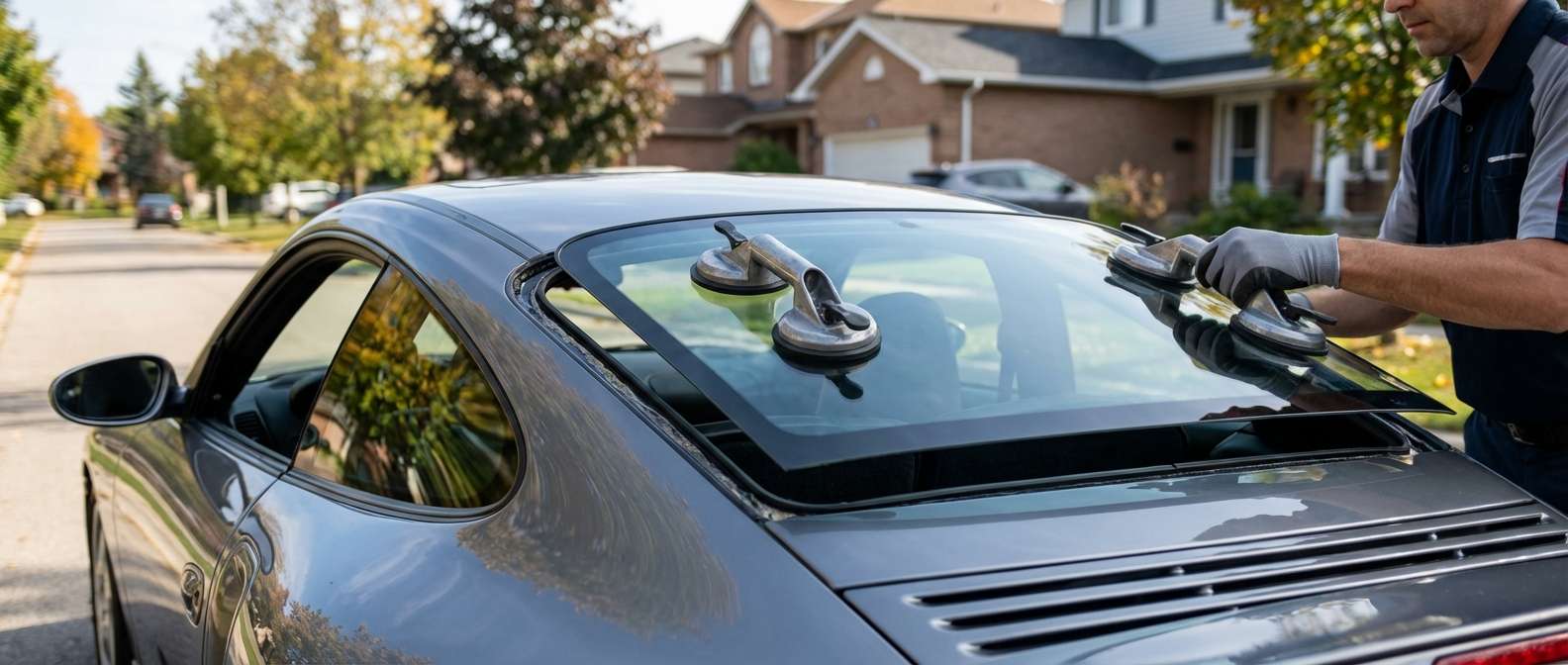
Coupe Rear Glass Bonding and Body Variant Nuances
Replacing the stationary back glass on a coupe requires navigating structural polyurethane bonding rather than the mechanical assemblies found on other body shapes of the same era. A coupe uses fixed perimeter glass bonded directly to the unibody aperture, while the open-air models operate under completely different hardware layouts. For instance, the Targa relies on a motorized lifting glass hatch, and the Cabriolet uses either a sewn-in plastic screen on early editions or a glass insert integrated into the canvas folding top on later production runs. On a coupe, the back window is an immovable structural member bordered by a wide black ceramic frit designed to shield the bonding urethane from solar breakdown and mask the underlying unibody pinchweld.
Because the window sits flush against the roofline and rear fenders, the surrounding seals bear the brunt of road grit and ultraviolet radiation. The original sealing frame—designated under factory number 996 545 521 03 and later superseded by 996 545 521 04—often hardens, shrinks, and cracks at the exterior corners. When moisture bypasses that outer channel, water travels past aged polyurethane and pools unseen into the rear parcel shelf or drips down toward the rear seat footwells. Replacing the back glass involves seating the replacement unit into a fresh perimeter rubber channel to restore an airtight barrier against road spray.
Production Splits, Heating Lines, and Exterior Trim
When sourcing aftermarket replacement glass, identifying the specific model year is necessary because Porsche updated the rear window design midway through the run. Early fixed coupes used glass mapped to dealer reference 996 545 901 02 up through 2001, whereas the facelifted 2002 to 2005 cars utilize 996 545 901 03. This mid-cycle update also corresponded to revisions in the exterior reveal moulding frame, which shifted from 996 545 545 01 to 996 545 545 02.
| Model Years | OEM Glass Reference | Outer Reveal Moulding | Key Features |
|---|---|---|---|
| 1998–2001 | 996 545 901 02 | 996 545 545 01 | Integrated defroster grid, wide frit border |
| 2002–2005 | 996 545 901 03 | 996 545 545 02 | Revised trim channel geometry, integrated defroster |
Every coupe rear window carries horizontal defroster grid lines silk-screened across the viewable area. Over time, these delicate conductive lines suffer breaks from aggressive interior tint removal or friction from luggage shoved into the rear luggage deck. Unlike the windshield, which houses the rear-view mirror bracket and rain sensors, the back glass is free of sensor hardware; the center high-mounted third brake light sits just forward of the top glass edge under the interior headliner trim rather than glued to the glass surface. I back all my glass installations with a one-year defect guarantee on the replacement panel paired with lifetime protection on my own workmanship so your rear shelf stays dry.
Can broken rear defroster grid lines be repaired without replacing the glass?
Minor breaks in a single grid trace can occasionally be bridged using conductive copper paint. However, if the grid has failed at the soldered wiring terminals near the C-pillars, or if the conductive elements have peeled across multiple broad sections from old window tint removal, replacing the complete back glass is the only way to restore clear rear vision in cold weather.
Do I need to replace the exterior rubber frame whenever the rear glass comes out?
Yes. The outer sealing frame (part 996 545 521 04) shrinks, loses its flexibility, and hardens after years of engine bay heat and sun exposure. Reusing an old perimeter seal prevents the snap-in outer reveal moulding from locking correctly into place and allows wind noise and dirt to collect around the glass edges.


