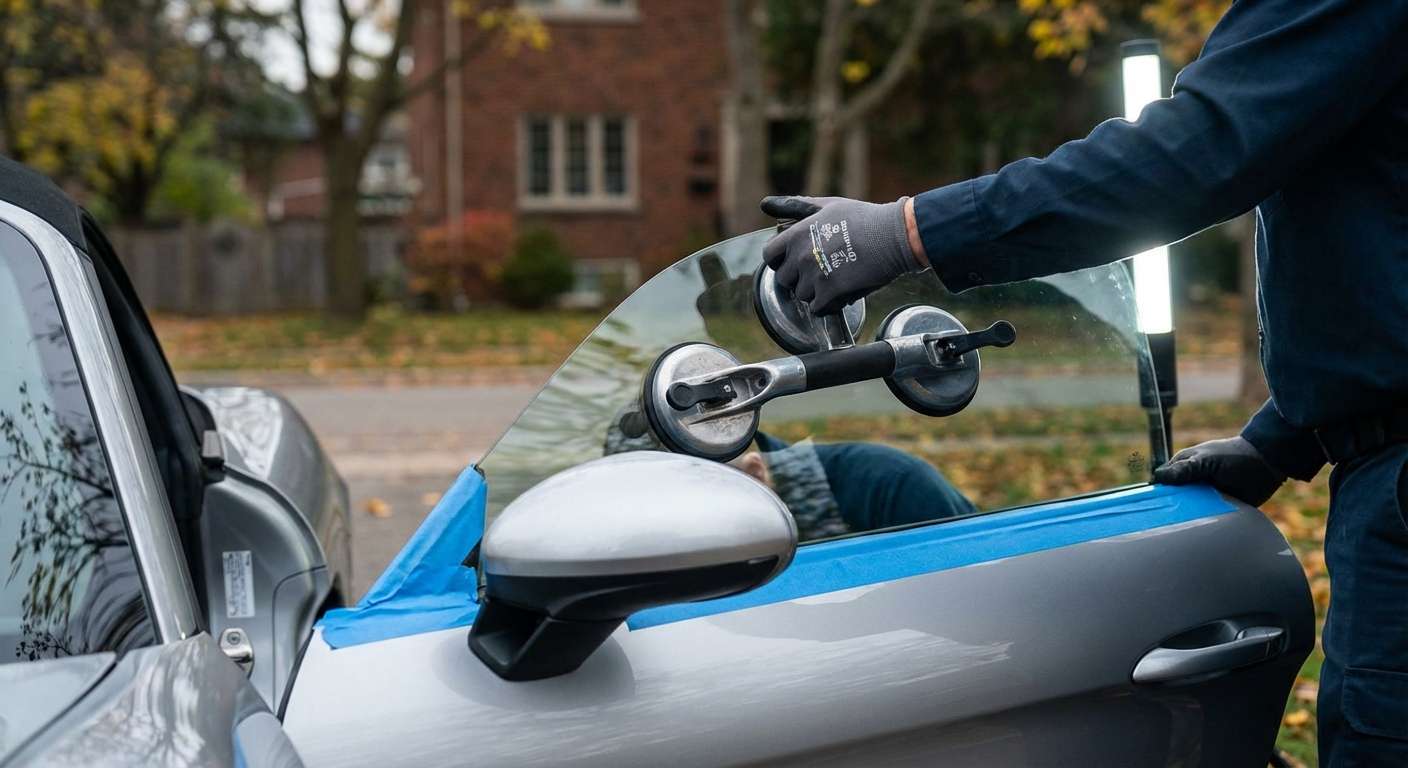
Frameless Door Glass Precision on the 718 Boxster and Cayman
Replacing the side window on a 718 requires working with a completely frameless design where the tempered glass pane acts as its own structural seal against the roofline. Because there is no upper window sash or metal division channel, the glass relies entirely on dual bottom clamp brackets mounted to a cable-driven regulator inside the door shell. When I pull the replacement pane out of the crate, I verify the subtle factory green solar tint to confirm it matches the opposite side. Unlike the windshield or rear glass on this car, the door window contains no defroster elements, radio antenna grids, or light sensors, but the mechanical fitment tolerances are razor thin.
Before securing the clamps, I inspect the bottom edge profile. Porsche shares core door glass geometry across the 981 and 982 platforms—often cataloged under base references like 981-542-511-01 / 982-542-511-01 for the left side and 981-542-512-01 / 982-542-512-01 for the right. The replacement aftermarket pane must duplicate the original curvature exactly. If the glass curvature is flat by even two millimeters, the top edge will either pinch the A-pillar weatherstrip run or bow outward away from the convertible fabric on a Boxster or the roof gutter channel on a Cayman.
Setting Camber, Pitch, and the Short-Drop Index
Every time you pull the exterior handle or the interior release lever, the door latch microswitch signals the vehicle module to drop the glass roughly 10 to 12 millimeters so the pane clears the upper weatherstrip channel. When the door latches shut, the glass drives back upward into the rubber recess. Setting the pane at the wrong angle ruins this sequence immediately. Torx adjusters located at the base of the lower door frame control the inward tilt (camber) and fore-aft pitch of the dual regulator guide rails. If the rear of the glass sits too high, it clips the B-pillar trim seal; if the camber is tilted too far outward, highway air rushes past the top seal.
Every pane I supply includes a one-year defect warranty, and I back my hands-on installation work for as long as you own the car. While dialing in the stops, I also inspect the inner waistline scraper seal. These 718 models frequently develop slight warping along the top edge of the interior door card trim, which can drag directly against the rising glass and cause the regulator's anti-pinch sensor to reverse the motor prematurely. Once the physical geometry is aligned, I run the master switch through the upper and lower hold cycles to relearn the top pinch boundaries so the indexing drop functions seamlessly.
Post-Replacement Inspection Checklist
Once the door card, speaker housing, and weather barriers are reassembled, run through these specific operational checks before driving:
- Short-drop clearance: Pull the door handle slowly and watch the glass drop 10–12 mm instantly before the door swings free, ensuring the top glass edge does not drag against the upper roof channel or convertible top seal.
- Indexing closure: Push the door shut to the first and second latch clicks; the glass must power upward smoothly and bed fully into the multi-chambered A-pillar weatherstrip without buckling the rubber lip.
- Waistline seal clearance: Lower and raise the window completely while watching the inner door trim pad to confirm the glass does not rub against warped interior panel edges.
- Travel smoothness: Listen for quiet, fluid cable movement without clicking, grinding, or hesitation that would point to a misaligned regulator clamp or frayed drive cable.
- High-speed seal compression: Verify from the cabin that the upper edge of the frameless pane sits flush against the exterior weatherstrip line with no visible gap or uneven rake from front to back.


