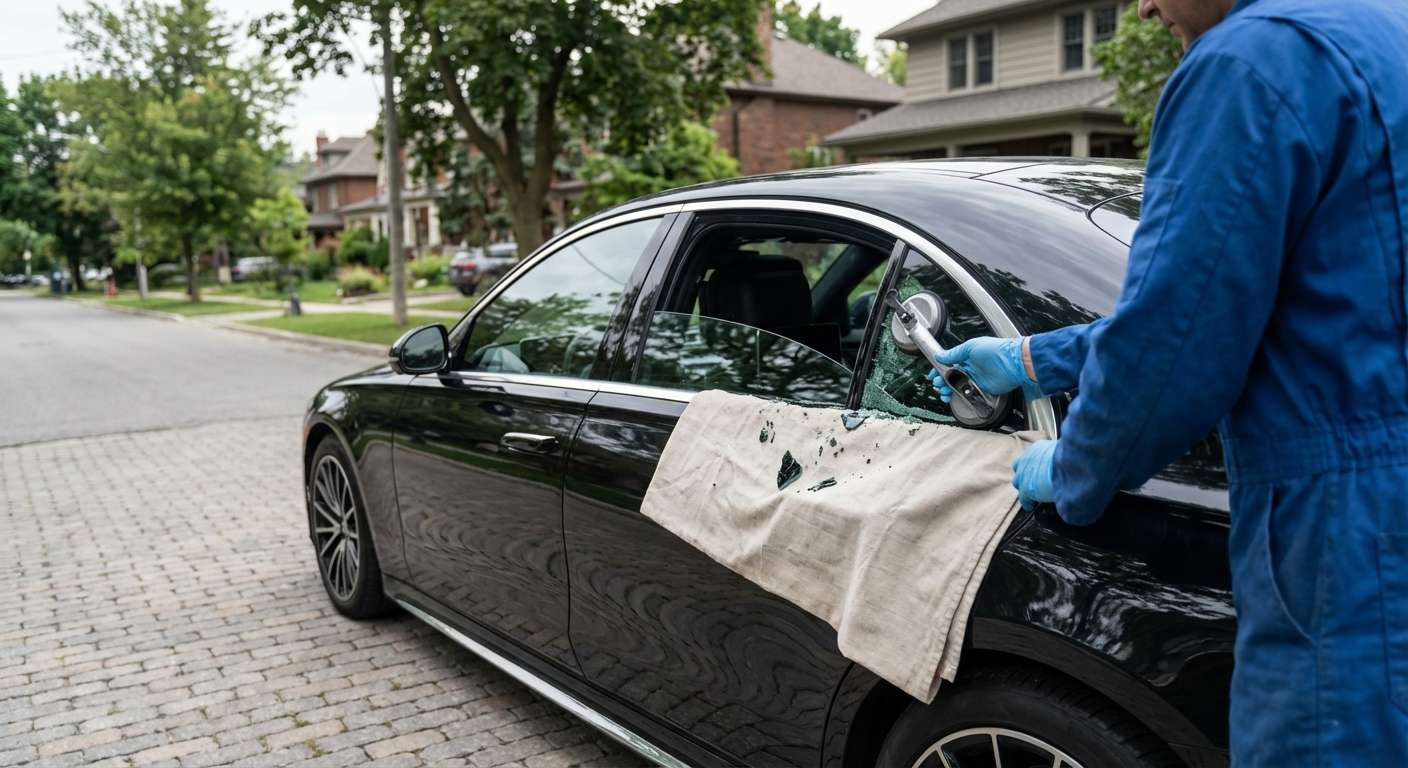
Inspecting the Rear Door Vent Glass Prior to Installation
Checking the stationary rear vent glass on this sedan requires verifying acoustic construction before it goes into the door frame. Unlike the extended Mercedes-Maybach (Z223) which houses its quarter glass back in the C-pillar bodywork, the standard W223 and long-wheelbase V223 carry this fixed glass directly inside the rear passenger door shell. I inspect the edge profile first to confirm it is true dual-pane laminated glass rather than single-ply tempered glass. Between the glass layers sits an acoustic PVB core engineered to stifle high-frequency wind buffeting. Skipping this check leads to an immediate mismatch in cabin isolation compared to the adjacent movable drop window.
The perimeter must be cross-referenced against the factory division bar setup. Left side assemblies correlate to base dealer reference A2237306000, while the right side corresponds to A2237306100 and A2237306101. When examining the replacement part on my bench, I also inspect the edge encapsulations:
- Perimeter encapsulation: The pre-molded rubber edge must sit completely flat with no distortions, matching the A2237303700 or A2237303800 profile series that slots into the door sash.
- Division bar mating channel: The forward leading edge must seat tightly against the vertical divider bar without pinching the felt channel that guides the main door glass.
- Factory finish match: The replacement must mirror the vehicle's equipment package, aligning either with standard solar green acoustic glass or the deeper rear privacy glass.
Post-Installation Checks: Division Bar Alignment and Acoustic Sealing
Once the replacement stationary pane is seated within the door channel, the vertical division bar dictates whether the repair succeeds. Because this glass is mechanically retained within the framed upper door rather than glued with urethane to an outer quarter panel, any misalignment of the divider channel creates an air path. I verify that the vertical bar sits parallel to the rear door drop glass travel path; even a half-millimeter twist can bind the regulator or cause aerodynamic whistling at highway speeds.
I back every replacement with a one-year warranty on the glass itself alongside a lifetime warranty on my workmanship, ensuring the installation remains rattle-free and watertight. Exterior trim alignment is the final critical review. Depending on whether the car carries the standard bright package or the Night Package, the surrounding beltline and upper arch mouldings (gloss black or polished brightwork) must sit flush against the glass base. If the outer trim does not seat fully into the bottom edge of the encapsulated seal, turbulent air gets scooped directly behind the division runner.
Diagnostic Checks for W223 Rear Door Glazing
| Component / Area | Pre-Fit Verification | Post-Fit Quality Standard |
|---|---|---|
| Laminated Acoustic Core | Visible dual-layer glass edge with sound-damping interlayer | Matches acoustic profile of drop glass; no optical distortion |
| Vertical Division Channel | Straight guide track, intact inner felt lining | Unrestricted travel of movable window; zero wind whistle |
| Molded Rubber Surround | Clean corners matching door frame casting profile | Uniform compression against metal frame; no lip folding |
| Exterior Frame Moulding | Correct finish: Chrome or Night Package high-gloss black | Even gaps to door frame; zero lip lift along lower sash |
Does the Maybach rear vent glass fit a standard S-Class door?
No. The Mercedes-Maybach (Z223) features a redesigned rear door where the quarter window is integrated into the structural C-pillar behind the door opening. The W223 and V223 sedans house the fixed vent window directly inside the rear door frame itself, separated from the drop window by an upright division bar. The parts do not interchange in shape, mounting, or location.
Why is my new rear door vent glass causing wind noise?
Wind rush around this window almost always points to an unseated division bar or a folded rubber edge. Because the glass relies on mechanical retention inside the door frame rather than liquid urethane, the encapsulated rubber surround must seat completely into the door channel tracks. If the vertical division bar is tightened at a slight angle, air will slip through the runner felt at highway speeds.
Are there defroster lines or antennas in this vent pane?
No electrical components, defroster grids, or antenna filaments are embedded in this specific rear door stationary window. It functions purely as an acoustic, solar-attenuating stationary viewing pane within the door assembly.


