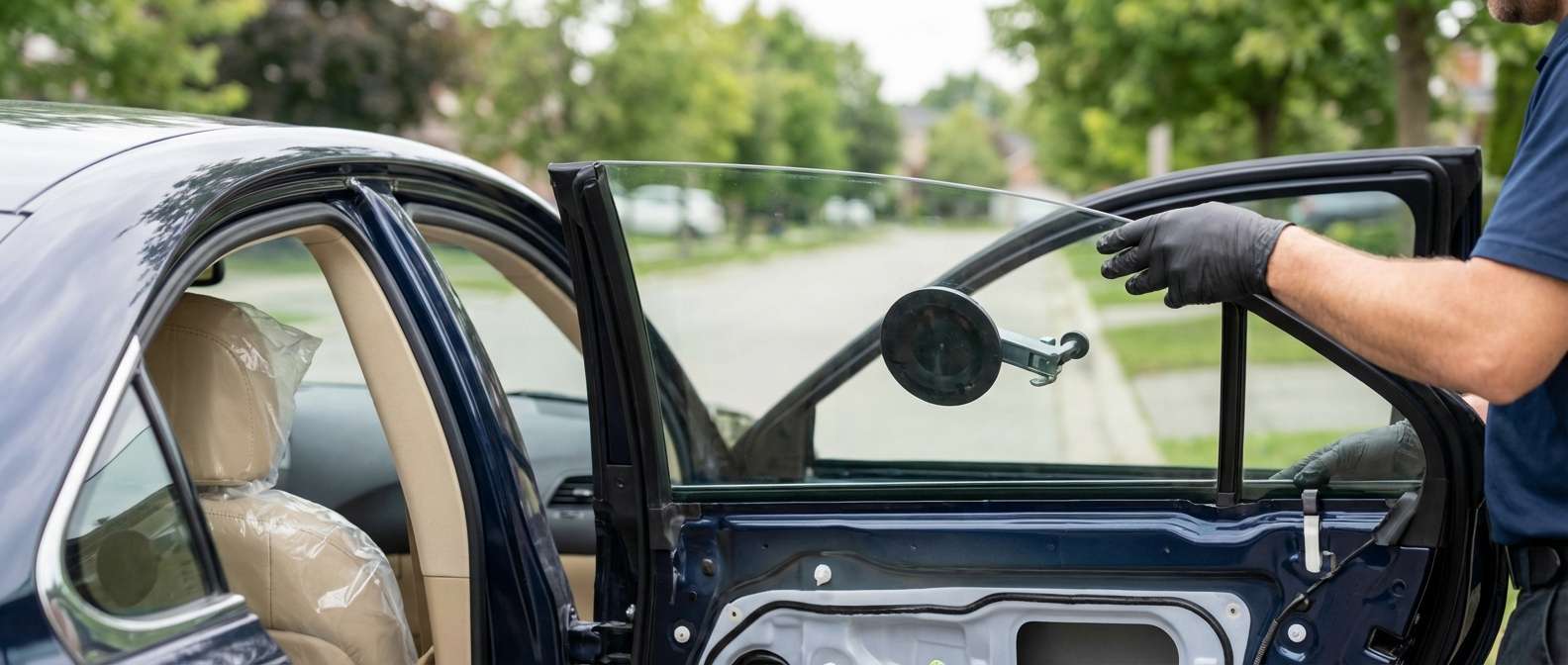
Why ES 350 Front Door Glass Drops and Binds
When the driver or passenger front window on this sedan suddenly tilts forward in the door frame and refuses to roll up, the issue is almost never a dead motor. Factory front glass on this vehicle relies on two molded plastic retention brackets bonded directly to the bottom edge of the glass panel. Over time, heat cycles and mechanical drag fatigue the rear bracket until it snaps clean off its mount. Once that clip separates from the glass, the window regulator loses its level lifting plane, driving the front edge down into the lower door cavity while the rear corner jams against the B-pillar rubber run channel.
Because the power window electronics monitor motor resistance to prevent trapped fingers, this mechanical binding instantly triggers the built-in anti-pinch logic. The window will hit the halfway mark, stop, and immediately bounce back down several inches into the door. Lexus recognized this clip separation failure and issued technical service bulletins during the warranty era, but because the factory mounting tabs were never sold as standalone replacement clips, fixing the drop requires replacing the entire door glass assembly to get brand-new factory-bonded bottom brackets.
Acoustic Lamination versus Rear Tempered Glass
The front and rear doors on the XV40 platform use entirely different glass constructions to balance Lexus cabin quietness with mechanical durability. Up front, replacement glass must match the original acoustic interlayer engineered into the vehicle:
| Position | NAGS Part Numbers | Glass Construction | Key Characteristics |
|---|---|---|---|
| Front Left (Driver) | FD22679 / FD23577 / FD23205 | Dual Laminated (5.0 mm nominal) | Sound-dampening acoustic PVB core, green solar tint, IR-cut |
| Front Right (Passenger) | FD22678 / FD23576 / FD23204 | Dual Laminated (5.0 mm nominal) | Sound-dampening acoustic PVB core, green solar tint, IR-cut |
| Rear Left | FD21674 | Single-layer Tempered | Green solar tint, guided by vertical division bar |
| Rear Right | FD21673 | Single-layer Tempered | Green solar tint, guided by vertical division bar |
If a broken clip or side impact takes out your front window, I typically arrive at your location within about an hour of booking to secure the door and set up the replacement. Installing the correct dual-laminated aftermarket front glass (matching OEM superseded numbers like 68102-33152 on the driver side or 68101-33152 on the passenger side) ensures the front cabin retains its original decibel isolation and thermal protection. In contrast, the rear door glass is standard tempered safety glass that runs inside a vertical metal division bar separating the movable pane from the small stationary rear quarter vent.
Window Initialization and Post-Service Checks
Any time the door glass is unbolted from the cable-driven regulator's 10mm fasteners or the electrical harness inside the door panel is disconnected, the door ECU loses its baseline memory for glass travel limits. Without an initialization reset, the one-touch auto-up and auto-down functions will not respond from the master driver switch, and the switch LED will often blink continuously. The initialization is completed directly at each individual door switch by holding the button up until the glass closes fully and continuing to hold it for three seconds, followed by running it down and holding it for another three seconds.
Once the replacement is complete and the memory is relearned, run through these specific checks before driving:
- Test one-touch auto-up and auto-down operation from the local door switch as well as the driver-side master control panel.
- Confirm the anti-pinch reverse function clears properly without false-tripping at the top of the window frame.
- Inspect the exterior belt moulding along the base of the sill to ensure the rubber lip sits flush against the outer glass face to shed water into the bottom drain holes.
- Check the rear vertical division bar channel on rear doors to verify the glass slides straight without binding against the vent seal.
- Verify that the green solar tint hue and cabin wind noise at highway speeds match the opposite side of the vehicle.


