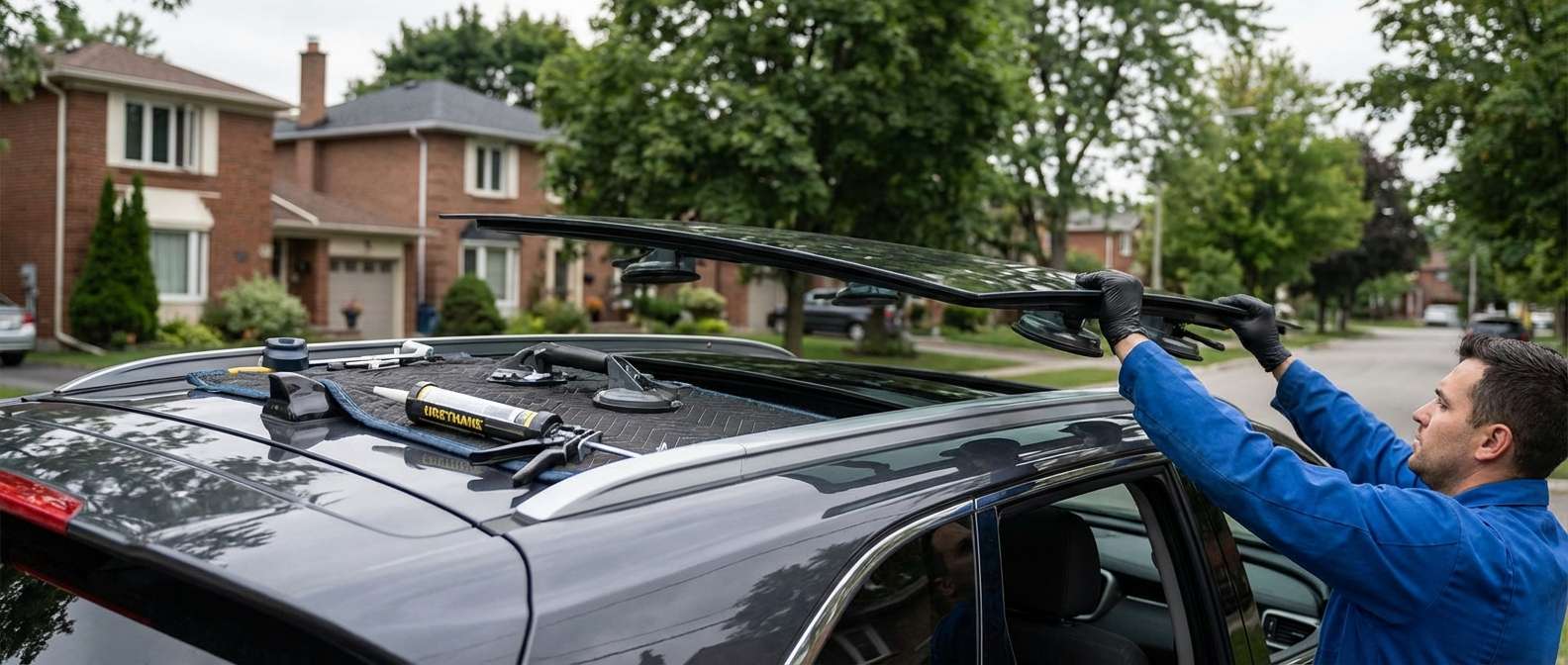
Dual-Pane Panoramic Architecture and Breakage Causes on the Sorento
The panoramic roof system on the 2016–2020 Kia Sorento uses a split two-panel arrangement where only the forward section moves while the rear panel remains permanently anchored over the second and third rows. Standard on the SX and SX Limited and bundled into option packages on the EX, this wide expanse of tempered safety glass has been the focus of widespread owner concerns, safety investigations, and class-action defect litigation over sudden glass shattering. Lawsuits focused on these Sorento roofs argue that localized mechanical stresses combine with thermal gradients around the dark perimeter ceramic frit band, weakening the tempered panel until it spontaneously pops under normal driving conditions. When this occurs, fragments often drop directly onto the motorized one-touch fabric roller sunshade that spans the cabin ceiling beneath both glass sections.
Replacing the damaged panel requires distinguishing between the two distinct glass units. The front movable panel corresponds to Kia factory reference 81611-C5000 for the 2016 through 2019 model years, which altered to 81611-C5001 for 2020 builds, whereas the stationary rear glass carries part number 81612-C5000 across the entire five-year run. Neither piece incorporates embedded electronics like rain sensors, heating grids, or antenna elements, but each pane relies on heavy deep solar tinting to control interior heat gain through the wide roof cutout.
Mechanical Hardware, Bracket Service, and Sealing Channels
Direct mechanical coupling distinguishes the front movable glass from stationary roof units. The forward panel secures directly to left and right tilt-slider mechanisms using bracket service assemblies under parts 81651-C5000 and 81652-C5000, fixed into place with dedicated Torx hardware along the lateral guide tracks. If a pane shatters or suffers structural cracks from road debris, these side brackets must be carefully inspected to verify they have not bent or sustained damage from the violent release of tempered tension. Because unexpected roof failure leaves the interior completely exposed to weather and debris, I aim to reach you roughly an hour after you schedule your appointment so the open roof frame can be secured without delay.
Surrounding the glass are critical rubber barriers that prevent wind noise and cabin moisture. A molded perimeter frame seal adheres directly around the edge of the glass itself, interfacing with the main frame weatherstrip (81630-C5000) and lower channel seal strip (81629-C5000). Drivers frequently report whistling, heavy wind buffeting at highway speeds, or cabin creaks over uneven pavement when these rubber boundaries degrade, dry out, or unseat from their retaining grooves along the painted roof perimeter.
Addressing Jammed Mechanisms and Sunroof Realignment
When replacing a broken or failed front panel, the drive linkage requires careful evaluation before the new glass is locked down. The electric motor drives the sliding cassette through twin internal lateral cables, which can bind if broken glass fragments drop down past the plastic track guards. Grit accumulation or shattered tempered beads inside the slider rails frequently trigger the vehicle's automatic pinch-protection system, causing the panel to stop mid-travel and reverse toward the open position.
Once the replacement glass is seated onto the slider brackets, panel height must be dialed in against the exterior roof skin to eliminate turbulence. If the leading edge sits proud of the steel roof deck, high-velocity airflow catches the underside of the panel, creating interior pressure thrumming and stressing the front mounting points. Ensuring the bracket fasteners are torqued precisely flush to factory depth restores the seal against the outer channel strip and prevents drag against the fabric sunshade roller assembly moving directly below.


