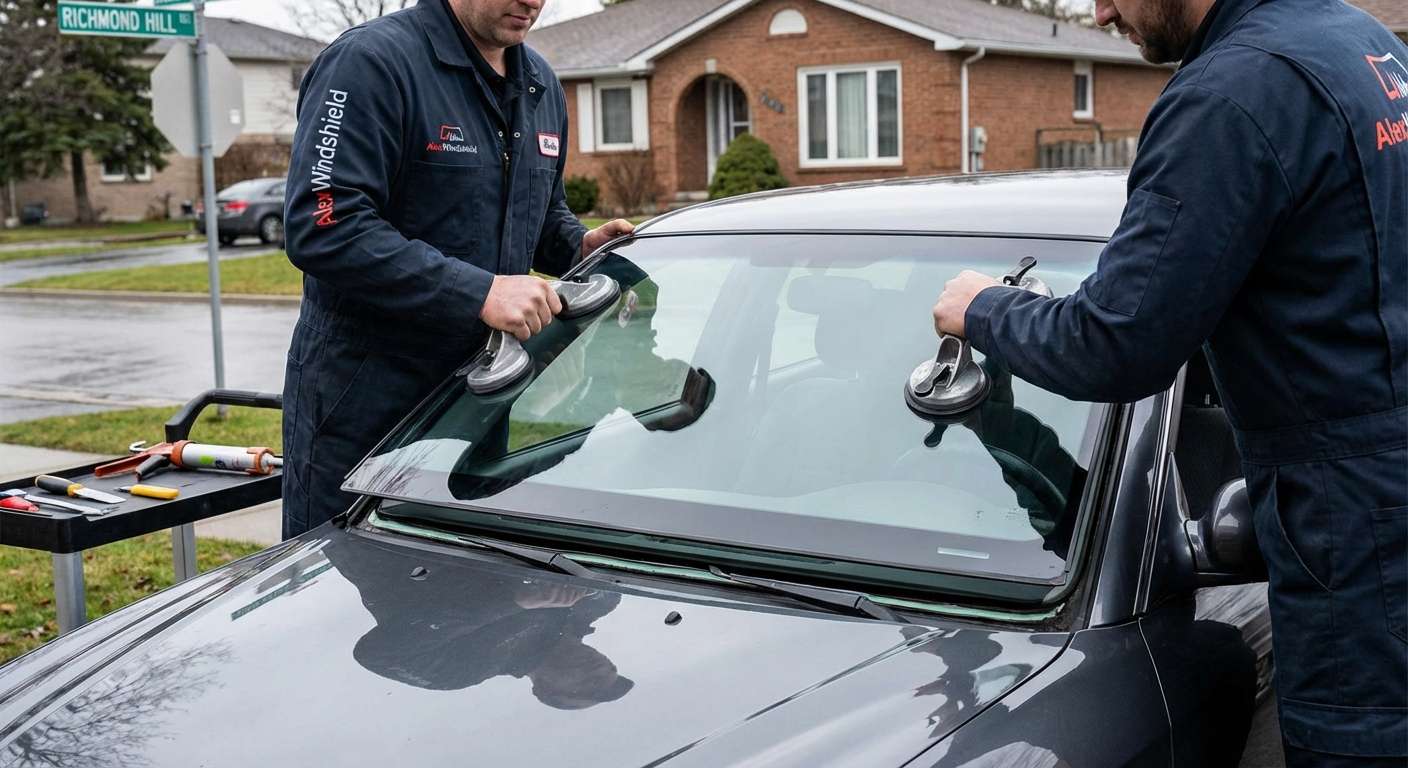
Road Debris and Stress Fractures on the First Optima Windshield
Highway stone strikes tend to crack the windshield on this car low down, right along the black ceramic frit boundary near the wiper park line. Because the front glass on these early models sits close to the trailing edge of the hood, rocks kicked up by traffic often bypass the metal entirely and hit the lower margin of the glass, starting small star breaks that quickly spread across the driver's view. Thermal stress does the rest: running maximum defrost on a frozen morning against glass that has already absorbed decades of road vibration will snap a dormant chip right across the center view.
Another frequent issue comes from the outer reveal moulding drying out and shrinking away from the welded pinchweld. When that perimeter seal deteriorates, wind gets underneath the top edge of the glass, introducing annoying high-speed whistling along the A-pillars and letting grit settle directly against the bonding perimeter. By the time many owners bring these cars in, water has begun seeping past the cracked, sun-baked rubber.
Glass Interchanges, NAGS Numbers, and Trim Differences
Kia built this car alongside the Hyundai Sonata EF, making it the only Optima to directly interchange its bare windshield glass shell with that platform mate. In the glass catalog, you will find this windshield under National Auto Glass Specifications (NAGS) as FW02114 or FW02118, corresponding to factory parts like 86110-38020 and 86110-38021. Most base LX cars use standard green-tinted glass without a top shade band (FW02114 GTN), whereas EX and SE V6 trims typically carry the green-tinted glass with the integrated blue solar shade band across the top (FW02114 GBN or FW02118 GBN).
When sourcing glass for this vehicle, I rely exclusively on trusted aftermarket manufacturers including PGW, FYG, Pilkington, and XYG to supply the correct tint match and factory mirror button placement. This glass is straightforward: there are no heads-up displays, rain sensors, or forward-facing camera brackets to consider, and the primary radio antenna is routed to the rear glass or rear fender rather than embedded in the windshield laminated layer.
The Cowl Panel and Lower Glass Perimeter
Below the bottom edge of the windshield rests a two-piece plastic cowl top grille panel that directs rain away from the cabin air intake and wiper linkage. The windshield washer nozzles are mounted directly into this cowl rather than onto the tandem wiper arms (which take a 22-inch driver blade and a 20-inch passenger blade). Decades of sun exposure make the cowl plastic and its mounting clips brittle; if that lower panel warps or lifts away from the glass, rainwater bypasses the drain channels and pours directly into the cabin blower motor housing, soaking the passenger-side carpet.
Around the outer perimeter, the glass relies on a three-sided rubber reveal profile. Using fresh aftermarket moulding—such as the Precision WFS F2114 RC or Gold Glass Group GGG 2114 V profiles—ensures the sides and top sit flush with the roofline, eliminating wind turbulence around the framed door glass and A-pillar channels.
Post-Replacement Inspection Checklist
- Confirm that the upper and side rubber reveal mouldings sit flush against the steel roof and A-pillars with no wavy edges or lifted corners.
- Check that the two-piece lower cowl grille sits flat against the bottom frit of the glass without gaps where water could run beneath the cabin air filter intake.
- Test the cowl-mounted washer sprayers to ensure both nozzles clear the lower windshield boundary and spray the center of the wipe paths.
- Ensure the 22-inch driver and 20-inch passenger wiper arms clear the lower ceramic edge smoothly without striking the cowl or the side glass moulding.
- Verify that the rear-view mirror is locked securely onto the pre-attached mounting button without wobble.
- Listen for any wind rush or whistling along the upper reveal strip during highway driving.


