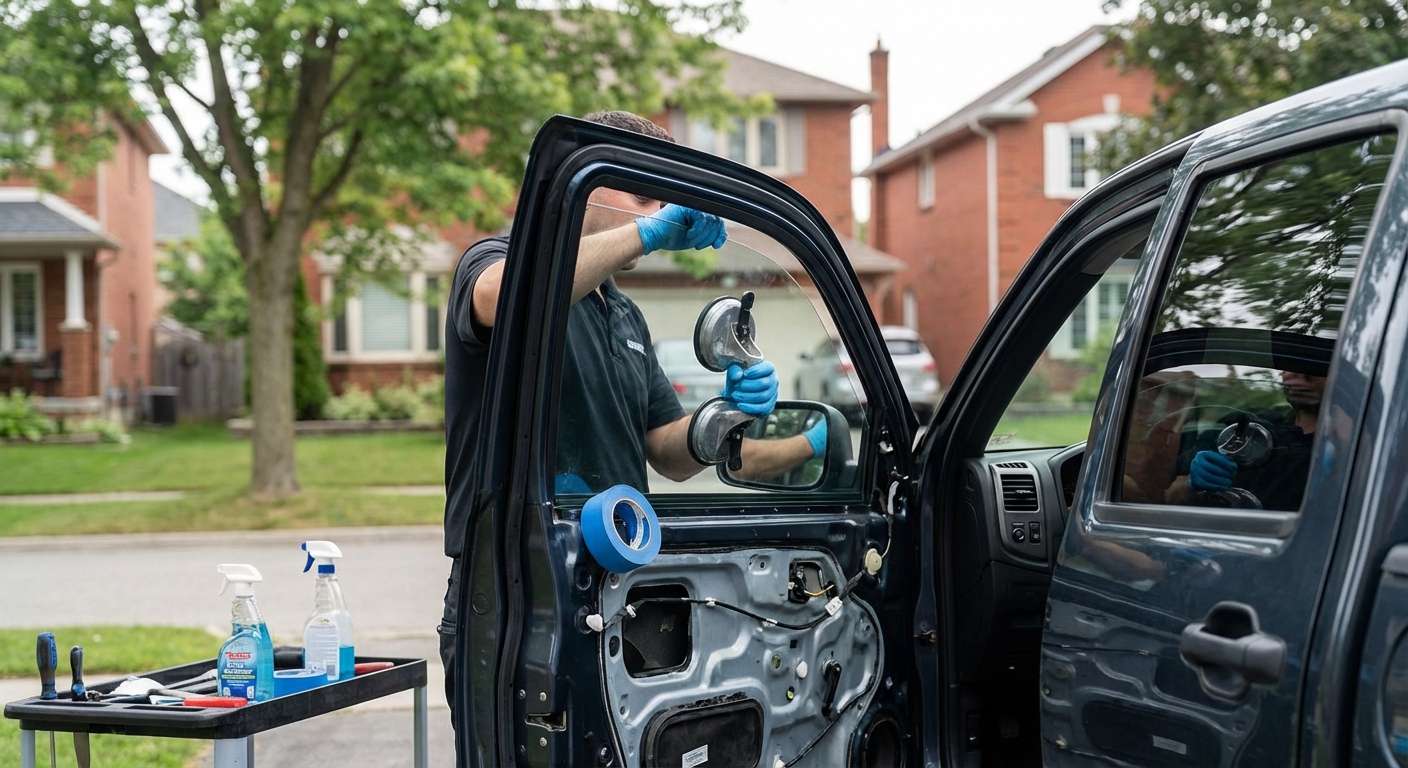
Replacing Framed Door Glass Across GMT355 Canyon Cabs
Whether your truck is a bare-bones Regular Cab work truck, an Extended Cab with reverse-opening rear access doors, or a four-door Crew Cab, the front door glass is identical and fully interchangeable across the board. The front doors use a framed window opening where the pane glides inside a continuous rubber run channel pressed into the upper steel door frame, rather than sealing against outer body pillars like a frameless design. On Crew Cab models, the rear roll-down door glass operates alongside an upright division bar channel that keeps the drop pane aligned as it lowers into the door shell.
Every roll-down side window on this pickup is single-pane tempered safety glass rather than laminated glass. When it suffers an impact from road debris or a break-in, it fractures entirely into small, blunt pellets. I see a lot of owners mistake electrical switch failures for broken mechanics; before replacing anything, it is worth noting that cold solder joints on the driver-side master switch module often mimic a seized regulator, whereas mechanical failure usually presents as a window that abruptly drops straight down or cocks sideways in the track.
Hardware Codes and Lower Regulator Mounting Tabs
The window glass connects to the mechanical lifting assembly through two factory-bonded friction clamp brackets mounted along the lower edge of the pane. These brackets bolt directly into the regulator lift plate through dedicated access holes inside the stamped inner door sheet metal. Over years of seasonal temperature shifts, the adhesive securing these lower clips can fail, causing the glass to break free from the brackets and plunge into the bottom of the door. When I replace side windows, the replacement glass is covered against material flaws for a year, and my labor installing and setting the hardware is backed for as long as you own the truck.
I reference the National Auto Glass Specifications (NAGS) to pull the correct profile and tint level for each door:
- Front Doors (All Cabs): Driver-side LH uses NAGS part DD10430, while the passenger-side RH uses DD10429. Both come standard in a light green solar-absorbing tint.
- Crew Cab Rear Doors: Passenger-side rear uses DD10437 and the driver-side rear uses DD10438. These are most commonly ordered in the factory deep-tint privacy glass (matched to RPO code AJ1), though non-tinted clear-green glass was also produced.
Common Track Bindings and Weatherstrip Wear
Whenever side glass shatters, shards collect in the lower bottom well of the door cavity and get stuck inside the horizontal dew wipes—the inner and outer beltline weatherstrips clipped to the door sheet metal flange. Leaving glass fragments caught in those wipes will immediately scratch a new window the first time you roll it down. Dried, shrunken rubber in the upper window channels is another frequent culprit on this platform; if the run channel pulls away from the steel frame, the regulator motor strains against excessive friction, which regularly snaps the plastic cable pulleys on the lift rail.
Can I swap front door glass from a Chevrolet Colorado into my Canyon?
Yes. The GMC Canyon, Chevrolet Colorado, and Isuzu i-Series from these years share identical door stampings, window regulators, and front glass profiles. A driver or passenger front door pane from a donor GMT355 vehicle will drop straight into your Canyon's tracks without modification.
Why won't my rear glass drop all the way down on the Crew Cab?
The rear door glass on the Crew Cab is shaped to clear the rear wheel well cut-out in the door shell. It drops down along the vertical division bar, but the lower curve of the door prevents it from retracting completely flush with the beltline weatherstrip, which is normal operating behavior for this cab configuration.
Do these door glasses have any embedded electronic sensors?
No. The side glass on this truck has no electrical components built into or glued against the glass. There are no rain sensors, defrost elements, or integrated antennas on any of the drop glass panels; only the two mechanical mounting brackets are attached to the lower edge.


