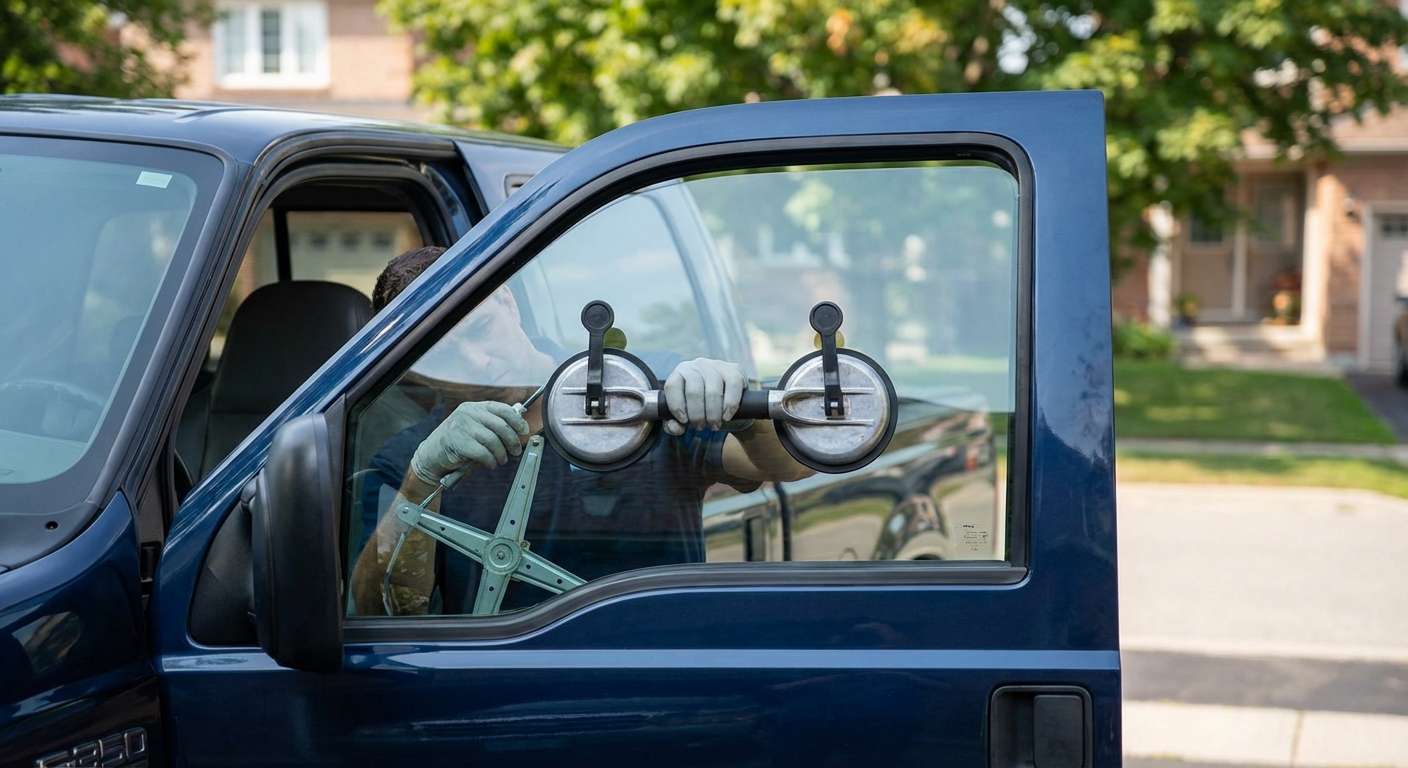
Framed Cab Architecture and Drop-In Glass Hardware
Replacing the front door glass on these trucks requires working around Ford’s heavy, fully framed steel door design. Whether you are running a base XL work truck with crank windows or a Lariat, King Ranch, or Harley-Davidson edition with power accessories, the front side glass uses single-layer tempered safety glass finished with a standard green solar tint. The glass pane does not contain embedded electronics, antenna wires, or integrated mirror sensors, but it depends entirely on factory-bonded mounting clips permanently fixed along its lower edge. These clips mate the glass directly into the lift brackets of the regulator assembly inside the door shell.
When sourcing glass for these cabs, the front driver side corresponds to NAGS number DD09326 and the passenger side is DD09327. Ford originally cataloged these under prefixes like F81Z and XC3Z, which were later consolidated into service part numbers AC3Z-2521411-A for the left door and AC3Z-2521410-A for the right. If you drive a Crew Cab, the rear doors step away from the front profile to use dedicated roll-down panes (OEM base numbers F81Z-2625713 on the left and F81Z-2625712 on the right), which were supplied from the factory in either standard clear green or deep dark privacy tint. These parts cross-reference directly between the heavy-duty pickup line (F-250 through F-550) and the 2000–2005 Ford Excursion, but they will never fit the 1999 "Light Duty" F-250, which used the smaller, rounded F-150 cab and completely different door shells.
| Position | NAGS Glass ID | Ford Superseded Reference | Glass Construction |
|---|---|---|---|
| Front Left (Driver) | DD09326 | AC3Z-2521411-A | Tempered Solar Green |
| Front Right (Passenger) | DD09327 | AC3Z-2521410-A | Tempered Solar Green |
| Crew Cab Rear Left | DD09328 / DD09756 | F81Z-2625713-AA / BA | Tempered (Solar or Privacy) |
| Crew Cab Rear Right | DD09329 / DD09757 | F81Z-2625712-AA / BA | Tempered (Solar or Privacy) |
Regulator Failures, Run Channels, and Binding
When the window drops into the bottom of the door with a sudden bang, the tempered glass is usually intact while the cable-driven regulator has snapped or stripped its drive spool. Conversely, when severe impact shatters the window, shards collect in the lower bottom well of the door and choke the tracks. For every replacement I perform on these trucks, I fit aftermarket door glass manufactured by reputable glassmakers like PGW, FYG, XYG, or Pilkington, ensuring the pane meets identical thickness and curvature profiles so it seats squarely inside the original lift clips.
A frequent complication on this generation involves the pressed-in rubber run channel (OEM CC3Z-2521596-B). Over years of weather exposure, the rubber inside the upper metal window frame dries out, hardens, or gathers road grit. This added drag puts immense strain on the electric motor brushes and the brittle plastic drive gear bushings. The motor will begin groaning, lift slowly, or stall out completely when its internal thermal breaker trips. When new glass goes into the door, the glass edges must align smoothly inside the front and rear vertical guide tracks without pinching against the inner and outer beltline weatherstrip felts at the base of the opening.
Post-Replacement Inspection Checklist
- Beltline Felt Alignment: Inspect the horizontal inner and outer rubber/felt strips along the lower sill to ensure they sit flat against the glass surface without folding inward when the window descends.
- Run Channel Seating: Check that the upper rubber track (CC3Z-2521596-B) remains fully seated in the metal frame corners and does not bunch up or push out as the top edge of the glass seats into the upper frame.
- Bottom Clip Engagement: Verify that the window glass does not tilt forward or tip backward during travel, which indicates an unseated or improperly fastened bottom retention clip on the regulator lift rail.
- Travel Resistance: Run the glass through full upward and downward strokes to confirm there is no excessive motor drag, binding in the vertical tracks, or shuddering along the path.
- Full Sill Clearance: Lower the glass completely to confirm it drops flush or just below the beltline weatherstrip without catching on lower door wiring or moisture barrier remnants.


