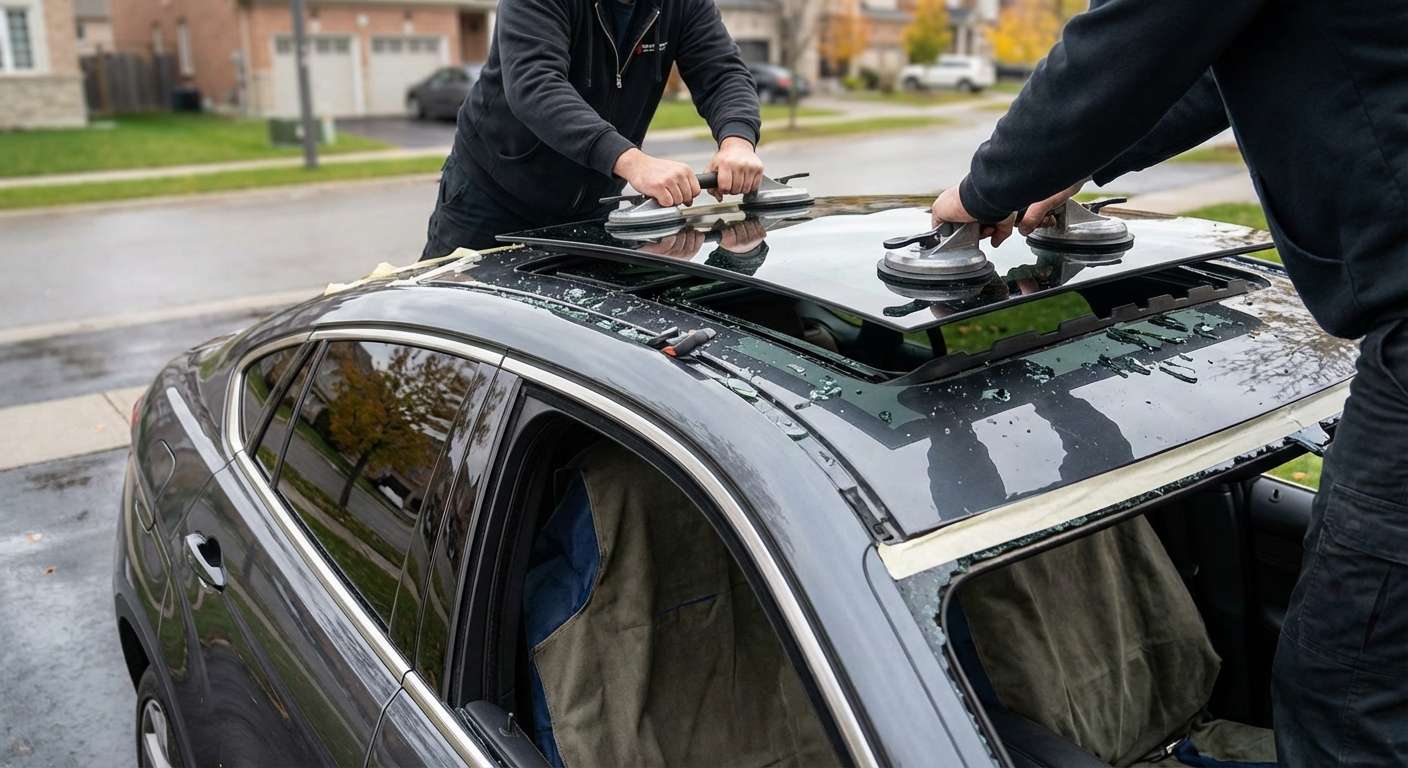
Identifying the Single-Pane Moonroof on Your X6
Unlike its mechanical sibling the X5, which carries a sprawling dual-pane panoramic glass assembly, your vehicle uses a traditional single-panel tilt-and-slide moonroof due to the sharply sloping rear coupe roofline. Whether you drive an sDrive35i, an xDrive50i, or the twin-turbo V8 F86 X6 M, every trim across this production cycle relies on the exact same roof aperture design. If you look at the factory build sheet, this setup is designated as option code S403A (Glass Roof, Electric).
You can identify the correct glass panel by verifying the stamp in the corner of the existing pane. The glass is a factory-tinted tempered safety unit stamped with AS3 and 43R designations, featuring an integrated solar control tint designed to block thermal load. The panel is built with a permanently bonded encapsulation perimeter frame, but carries no embedded defroster wires, rain sensor prisms, or aerial antennas. The complete moving glass panel corresponds to BMW part number 54107382990, which matches across all six-cylinder and V8 configurations from 2015 through 2019.
Track Lifters, Seals, and Drive Mechanism
Instead of being glued into the vehicle body with urethane, the moonroof glass is secured mechanically. It bolts directly to the left and right mechanical lifters inside the cassette guide rails using Torx fasteners concealed behind flexible lateral accordion bellows. When shattering or deep scratching occurs, only the moving panel needs to come out, leaving the underlying cassette and interior headliner intact.
A critical component tied to the glass panel is the perimeter EPDM rubber weatherstrip, corresponding to part number 54107245551. This 2,883 mm self-adhesive seal wraps tightly around the exterior glass edge. Over time, road grime, thermal cycles, and shrinkage cause this rubber to harden, creating friction against the painted roof opening that results in persistent creaking or high-speed wind buffeting. When a customer contacts me about a shattered or defective roof, I generally pull up to their location roughly an hour after booking to assess the guide rails and begin the swap.
Water management relies on a cassette drainage tray hidden below the panel, equipped with four corner drain tubes routing down the front A-pillars and rear C-pillars. If the perimeter seal degrades or debris enters the tracks, excess water bypasses the seals and relies entirely on these drain paths. Blockages here cause water to pool directly above the front roof function center (FZD) overhead console, leading to moisture inside the map lights and microphone grilles.
Post-Replacement Inspection Checklist
Once the replacement panel is mechanically secured to the drive brackets and adjusted, confirm these vehicle-specific points before putting the car back into regular service:
- Panel flushness to the roof skin: Check that the leading edge of the glass sits roughly 1 mm below the front painted roofline to prevent wind noise, while the trailing edge sits flush or up to 1 mm above the rear roofline to ensure laminar airflow.
- EPDM seal uniform seating: Inspect the 54107245551 perimeter rubber to ensure it is not pinched, buckled, or folded under the metal edge at any point along its 2,883 mm run.
- Accordion bellows alignment: Confirm that the flexible side rubber bellows conceal the Torx mounting hardware and flex smoothly without binding when moving into the vent tilt position.
- Wind deflector bar deployment: Open the roof into the fully retracted slide position and ensure the spring-loaded front aerodynamic wind deflector pops up along the front aperture edge.
- Motor anti-pinch and travel limits: Verify the glass operates smoothly through one-touch open, close, and tilt. If the motor hesitates or reverses prematurely, the drive actuator needs an initialization cycle by holding the center tilt switch upward until the mechanism completes a full diagnostic loop.
- Interior sunshade clearance: Slide the dual-section interior headliner shade forward and back by hand to confirm it clears the lower edge of the new glass frame without snagging.


