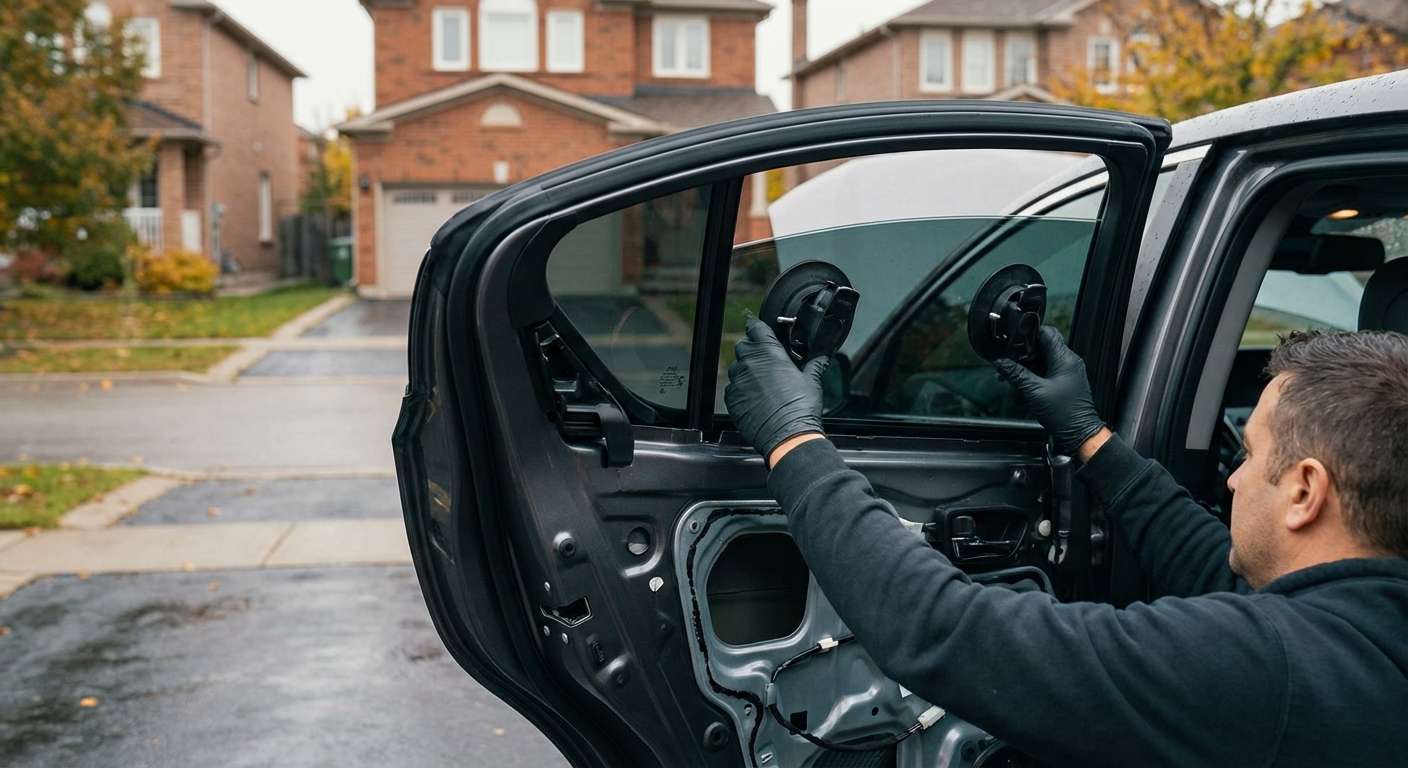
Rear Door Division Bars and Framed Vent Glass Construction
The stationary rear door vent window on this compact luxury sedan sits fixed inside the framed door sash directly behind the rear roll-down window. Rather than bonding to an open quarter panel with urethane, this triangular pane is seated within full-perimeter run-channel weatherstripping and secured against a structural vertical division bar. That central metal division post serves dual duty: it clamps the forward edge of the stationary vent window in place while acting as the rear guide track for the descending roll-down door glass.
Because the division bar locks the front edge of the vent unit, accessing or freeing the glass requires dropping inside the door structure. I have to strip the interior door panel, peel the inner plastic vapor barrier, loosen the bottom division bar fasteners inside the door cavity, and unseat the main roll-down glass from its track to slide the assembly out of the door frame. The surrounding hardware—including the outer door reveal moulding, inner door belt moulding, and the lower sash guides—must remain completely unbent during the teardown to prevent high-speed air leaks along the C-pillar seam.
Glass Engineering Across the 2016 Mid-Cycle Refresh
Acura issued a mid-cycle update for the 2016 model year that altered acoustic dampening across all trims, increasing overall cabin insulation and side glass mass. However, the outer perimeter footprint, frame channels, and physical mounting channels for the rear vent windows remained identical from the early models right through the final 2022 run. Factory parts carry base dealer numbers 73405-TX6-305 (superseding the older 73405-TX6-A00) for the passenger right side and 73455-TX6-305 (superseding 73455-TX6-A00) for the driver left side.
When sourcing these replacement side panes, I supply aftermarket glass manufactured by major fabricators like Pilkington, PGW, FYG, or XYG rather than paying dealer markups. The replacement glass matches the factory green solar tinting and tempered safety profile precisely, seating neatly into the standard door channels.
| Component Feature | Acura ILX Rear Vent Specifications |
|---|---|
| Glass Type | Tempered safety glass with green solar tint |
| Frame Design | Full-perimeter framed sash door construction |
| Attached Electronics | None (no defroster lines, antennas, or break sensors) |
| Interfacing Track | Vertical metal division channel sharing the primary window run |
| Right Glass Part | 73405-TX6-305 |
| Left Glass Part | 73455-TX6-305 |
Resolving Post-Breakage Noise and Seal Alignment
This stationary rear pane contains zero electrical grids, defroster lines, integrated radio antennas, or embedded security loops. It is purely passive tempered solar glass. Despite its simplicity, poor fitment leads directly to owner complaints regarding high-pitched whistling at highway speeds or water leaking onto the rear seat cushions. The leak path is almost always tied to the division bar rubber seal.
If the division bar channel is misaligned by even a couple of millimeters when bolted back to the inner door shell, the rubber weatherstrip fails to compress flush against the outer reveal moulding. Tempered fragments also tend to drop directly into the bottom of the door shell and wedge inside the window regulator tracks when this pane is broken. Clearing every loose shard out of the bottom cavity and reseating the weatherstrip along the division post ensures the main window glides freely without grinding against residual debris.
Can this vent glass be replaced without taking off the rear interior door panel?
No. The stationary glass is held securely by a vertical division track bolted to the inner door framework beneath the window line. Loosening the division channel, shifting the run weatherstripping, and reaching the lower retention hardware requires removing the interior trim panel and the protective moisture barrier.
Are there embedded defrost lines or radio antennas in this side window?
No. The rear door vent pane on this vehicle has no electrical connections, embedded antenna grids, or heating wires. It consists solely of tempered safety glass designed to fit inside the rubber division moulding.


