Identifying Your Impreza Sunroof Glass and Factory Options
When the sunroof panel breaks on a GD or GG body Impreza, the first hurdle is figuring out whether you have a factory Subaru moonroof or an aftermarket dealer unit. Subaru did not offer a standard factory glass moonroof on North American base models during the early bugeye run. Factory-installed electric tilt-and-slide assemblies appeared reliably on 2004 to 2007 trims, including the 2.5 RS, 2.5i Premium, and the turbocharged WRX. If you drive a 2002 or 2003 model with a glass roof, or an early wagon, there is a strong probability the car received a port- or dealer-installed Webasto system instead of the genuine assembly. Standard WRX STI models completely skipped the moonroof to preserve body rigidity and shave high-center-of-gravity weight, leaving the 2007 STI Limited as the sole factory exception in that performance tier.
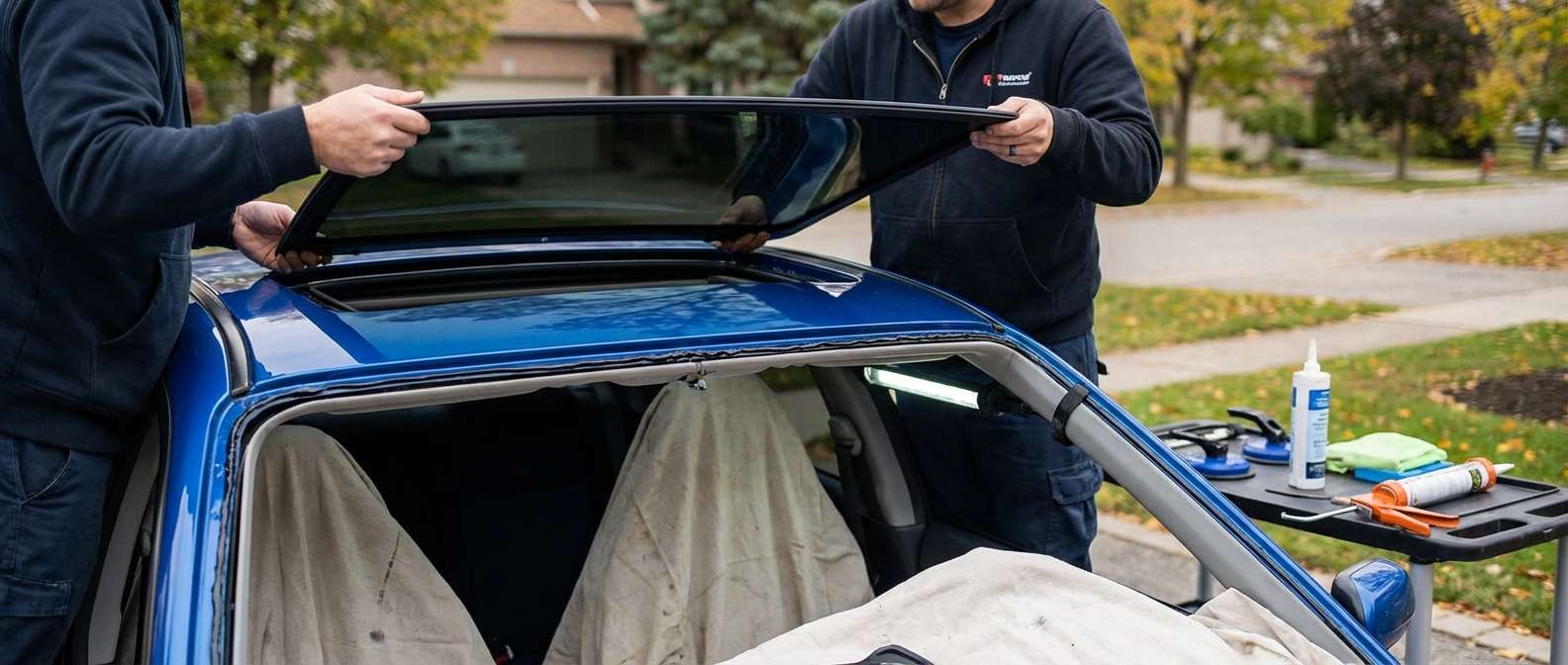
For factory-equipped cars, the bare glass lid corresponds to OEM part number 65430FE000, which Subaru later updated under 65430FE010. The panel itself measures roughly 31 inches across by 15.25 inches deep. Because factory stock for these older GD panels has dried up at dealerships, I supply and install aftermarket glass sourced through major manufacturers like Pilkington, PGW, XYG, or FYG. The replacement panel consists of dark-tinted tempered safety glass complete with its bonded encapsulation edge seal, remaining completely free of embedded defroster grids, radio antennas, or ADAS hardware.
Mechanical Binding, Jammed Sunshades, and Track Alignment
The Impreza moonroof operates by tilting upward at the rear and retracting directly inside the roof cavity between the steel outer skin and the interior headliner. A frequent reason the glass shatters or refuses to close squarely involves the manual sliding sunshade riding underneath the panel. When the fabric-wrapped sunshade is forced or pulled unevenly, its small guide sliders can derail inside the aluminum rails. Once derailed, the shade binds against the retreating glass panel or the front spring-loaded pop-up wind deflector, torquing the glass brackets under electric motor pressure.
Securing the panel correctly requires setting the fasteners hidden behind the plastic side trim finishers inside the cabin. Subaru utilized factory adjustment shims between the glass mounting brackets and the mechanical drive links. If these shims are missing, mixed up, or unevenly torqued, the tempered glass will sit proud or sunken relative to the roofline. A panel sitting too high catches highway airflow, generating severe cabin buffeting and stressing the outer edge encapsulation, while a sunken panel creates pooling water directly over the track edges.
Water Leaks and Perimeter Weatherstrip Failures
The molded rubber weatherstrip wrapped around the glass lid functions as a primary water and wind barrier, but it is not completely watertight by design. As this rubber ages, shrinks, and hardens under UV exposure, significantly more rainwater bypasses the seal and drops into the surrounding metal cassette tray. That runoff is engineered to exit via four flexible internal drain tubes: two running forward through the A-pillars to discharge near the front fenders, and two trailing through the C-pillars into the rear wheel arch and rocker cavities.
When debris or decaying pine needles block those narrow drains, excess water spills over the cassette lip rather than flowing out of the car. Owners usually discover this when water stains appear along the front sun visors, the map light console drips during acceleration, or standing water saturates the carpet under the front seats. Clearing these drain lines and ensuring the perimeter edge molding sits flush against the roof aperture is essential to stop repeat water damage after a broken panel has been replaced.


