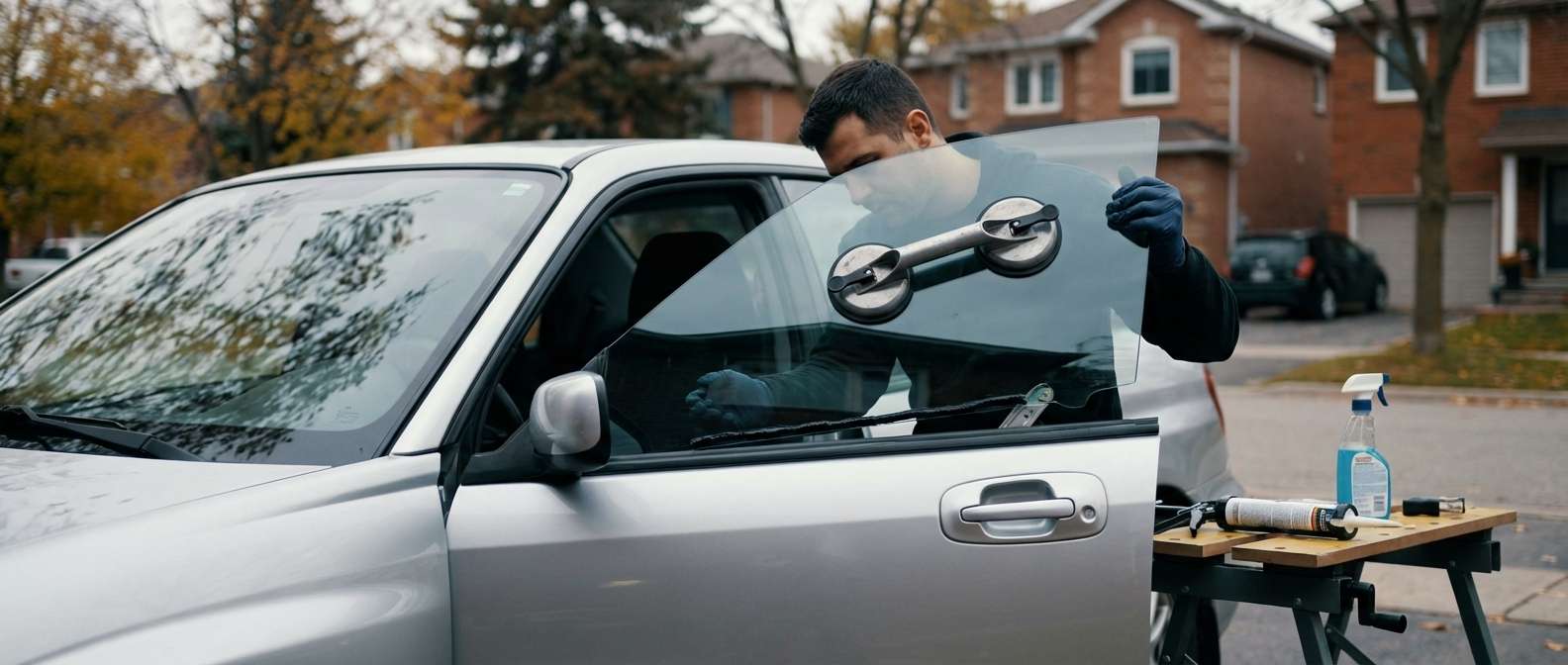
Frameless Door Glass Mechanics on GD Sedans and GG Wagons
Frameless side windows require an entirely different approach than framed automotive glass, and this era of Impreza relies entirely on internal door geometry to seal the cabin. Because there is no metal upper sash surrounding the pane, the tempered green-tinted solar glass seats directly against the rubber roofline molding and pillar weatherstripping when fully raised. The glass pane (originally cataloged under Subaru numbers 61011FE040/61011FE051 for the driver side and 61012FE040/61012FE050 for the passenger side) fastens straight into lower mounting brackets driven by the window regulator mechanism.
Without an outer frame to steady the glass, the structural door shell houses internal felt-lined stabilizer pads and adjustable stop brackets. These components dictate three axes of movement: tilt (camber against the roof seal), fore-and-aft position, and vertical glass travel. If passengers habitually shut these doors by shoving the upper edge of the bare glass pane instead of the painted metal exterior, the internal stabilizer tracks shift. This leads to slow window movement, chattering during power operation, or water dripping over the top weatherstrip into the cabin footwells.
Mirror Gusset Degradation and Door Glass Alignment
At the front edge of the front door glass sits a triangular rubber corner gusset (OEM 61158FE012 for left, 61158FE002 for right) right behind the side mirror base. As these cars age, the rubber channel of this corner gusset spreads outward, creating a small triangular void that lets intense wind noise rush in at highway speeds. Whenever I install replacement side glass at a customer's home or workplace across Toronto and the GTA, I examine this gusset closely, as misaligned glass or a fatigued gusset will leave an audible air leak regardless of how intact the new pane is.
The interior guide felt also collects fine road grit over the years. When the power regulator slides the window up and down against dirty felt, deep vertical scuffs form along the tempered glass surface. Replacing the pane requires pulling the door card, peeling back the inner vapor barrier, and accessing the mechanical stops to ensure the replacement aftermarket glass glides smoothly into the A-pillar track without binding against the regulator motor.
Sedan Versus Sport Wagon Rear Door Differences
While the front doors interchange freely across the lineup, the rear glass setup separates the body styles. Impreza sport wagons utilize a distinct rear door profile that complements a fixed body quarter glass mounted further back in the D-pillar cargo area. GD sedans, on the other hand, carry their rear quarter glass built directly into the rear door assembly, separated from the dropping main pane by a slim vertical divider track. Both styles use bare tempered glass that needs careful height indexing so the trailing glass edge meets the B-pillar and C-pillar seals uniformly.
Why does my frameless glass freeze shut in cold weather?
Because the bare glass edge presses directly against thick body-mounted weatherstripping along the roof arch, moisture easily gets trapped and freezes the glass to the rubber. Forcing the power window switch when the glass is iced solid can snap the regulator cable, strip the motor drive gear, or pull the glass pane right out of its lower bottom mounting clamps.
Can wind noise at the front mirror be cured by replacing the door glass?
Replacing broken or scratched door glass restores the smooth sealing surface, but persistent wind rush around the mirror is almost always caused by a widened rubber mirror gusset. If the rubber lips have spread apart, the new glass will still have an air gap until the gusset assembly is squeezed back together, packed with backer tubing, or replaced.


