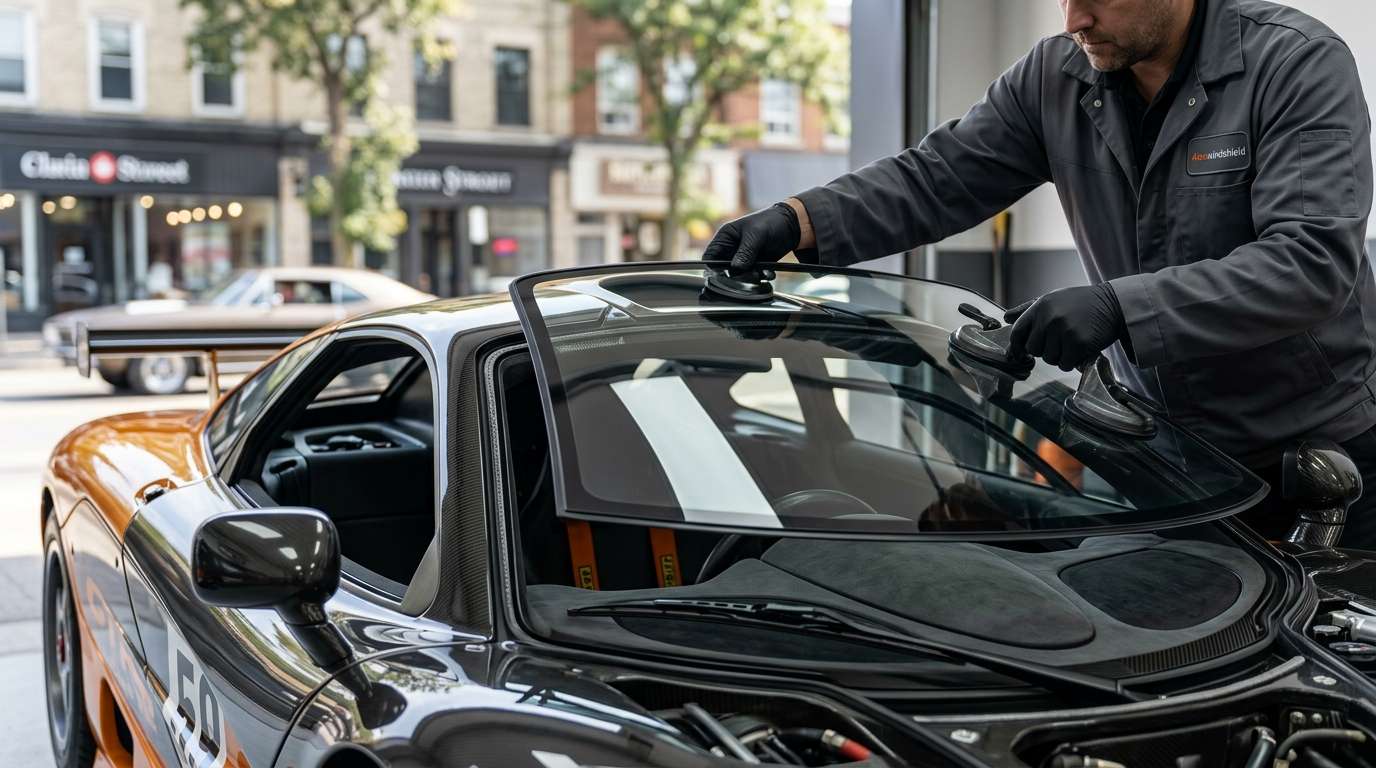
Direct Bonding to the Carbon-Fiber Monocoque Tub
Replacing the front glass on Gordon Murray's three-seater requires addressing a structural member rather than a simple cosmetic pane. The windshield bonds directly into the composite channel of the structural carbon-fiber reinforced polymer (CFRP) monocoque tub, where it contributes measurable torsional stiffness to the central cabin. Because the dihedral butterfly doors hinge forward and upward directly adjacent to the composite A-pillars, panel tolerances leave zero margin for improper glass depth or shifting. The composite roof header immediately above the glass features the central engine air-intake snorkel—configured with a low-drag profile on standard road cars, an aggressive raised scoop on the F1 LM, or the extended ducting seen on the longtail F1 GT. Protecting the integrity of the bare carbon weave along this recessed perimeter dictates the entire approach to clearing the frame.
Embedded Micro-Wire Defrosting and Pantograph Wiper Geometry
To keep the curb weight strictly minimized and purge the cabin of heavy HVAC blower boxes and plastic ductwork, Murray eliminated traditional front defroster vents entirely. The glass incorporates an invisible network of embedded micro-wire electrical heating elements suspended between the inner and outer laminated plies. This setup provides rapid, uniform defogging across the curved surface via direct electrical leads routed into the tub wiring harness. At the glass exterior, clearing rain falls to a solitary, centrally mounted pantograph wiper mechanism seated deep within the composite cowl. The pantograph arm maintains a horizontal sweep across the glass face and features integrated fluid delivery lines that feed washer nozzles mounted straight to the wiper arm, avoiding cowl-mounted sprayers that would disrupt airflow over the nose.
I operate entirely as a mobile service, travelling directly to your private garage or workplace across Toronto and the GTA to assess and handle specialized composite-body glass work on-site. The interior setup of the cockpit is just as unique as the exterior: the driver commands the road from a central bucket seat flanked by two recessed passenger positions, meaning the interior rearview mirror bracket is bonded directly to the high-center interior face of the laminate rather than biased toward one side. Because the car relies on analog mechanical purity, you will find no forward-facing driver-assist cameras, rain sensors, or electrochromic light sensors attached to the upper frit.
Cowl Stress Vulnerabilities and Glazing Integrity
The aerodynamic curvature of this windshield slopes steeply back from a low front nose, exposing the bottom edge to intense aerodynamic downforce and track vibrations. High-speed running and circuit curb strikes commonly transfer stress directly into the lower edge of the laminate near the driver-side wiper motor recess, creating tension fractures that spread upward through the viewing area. While the F1 LM and the homologation F1 GT share the core structural aperture of the standard road car, their distinct aerodynamic nose sections channel high-velocity air directly across the lower ceramic frit line. Sourcing correct replacement units requires custom aftermarket batch runs built to match the original curvature and laminate heating grids, ensuring the structural carbon tub retains its engineered rigidity without distorting the driver's forward sightlines.


