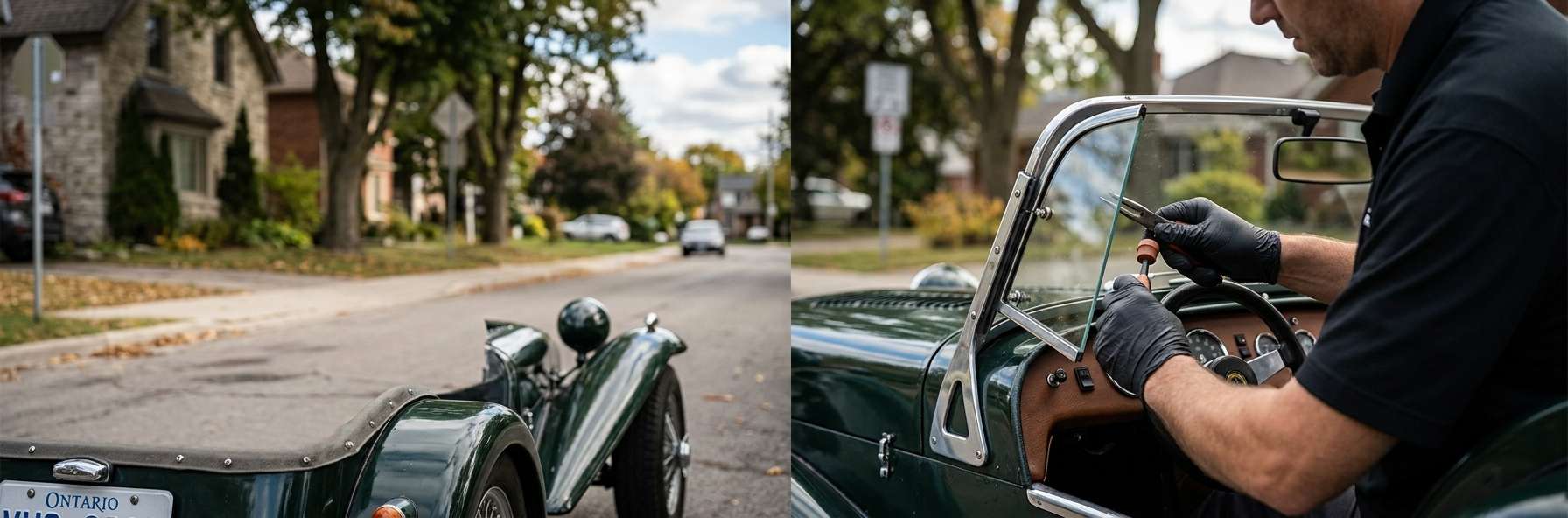
The Reality of Side Glazing on Colin Chapman’s Roadster
If you are looking for a conventional drop-in replacement vent window for your Seven, you will quickly discover that neither Lotus nor any automotive glass registry ever produced an automotive safety glass vent pane for these cars. Colin Chapman’s philosophy of extreme weight reduction eliminated traditional steel doors, roll-up mechanisms, division bars, and heavy glass quarter lights entirely. What owners commonly refer to as vent glass or wing vents are actually detachable clear Perspex deflectors or side screen assemblies.
Across the production span, weather gear evolved across four distinct variants, none of which utilize perimeter-bonded or regulator-driven glass:
- Series 1, Series 2, and Series 3: Weather protection relies on removable side curtains framed in thin tubular steel wire. The clear sight apertures are constructed from clear vinyl or rigid Perspex stitched into leathercloth and anchored to the body with Tenax or Lift-the-Dot studs.
- Series 4 (Type 60): Introduced a squared-off aesthetic with vacuum-formed fiberglass/plastic door shells. These carry extruded aluminium top frames fitted with horizontal sliding plastic panes rather than automotive safety glass.
- Wind Wings / Stanchion Deflectors: Popular period-correct and modern deflector blades clamping straight to the polished aluminium windscreen pillar stanchions via two-bolt friction hinges.
Addressing Cockpit Turbulence, Hazing, and Mount Failures
Because these cars lack full-height door headers and window channels, driving above 50 mph creates intense low-pressure cockpit vortices. A damaged or missing deflector turns highway driving into a grueling chore, while an improperly secured side screen can balloon outward and tear free from its chassis sockets.
When original Perspex or acrylic wing deflectors fail, it is rarely a shattered break like tempered safety glass. Instead, decades of road vibrations and engine harmonics cause radial stress cracks outward from the mounting holes clamped against the brass or alloy windscreen pillars. Surface hazing and yellowing from UV exposure will also blind your view of the side mirrors mounted out on the front wings. When I replace roadster side glazing and windshield systems, I rely purely on aftermarket components from trusted glass producers like Pilkington, FYG, PGW, and XYG, matching the specific hardware setup of your car rather than attempting to hunt down fragile, warped original plastics.
For custom deflector fabrications, high-impact polycarbonate or cast acrylic cut to match original patterns provides significantly better longevity than aged acetate or thin Perspex, resisting the flex that leads to high-speed fluttering.
Checking Your Wind Wings and Side Assemblies Post-Replacement
Once a replacement deflector panel or fabricated side screen is fitted to the roadster, inspect these vehicle-specific points before taking the car up to speed:
- Check the friction hinges on the windscreen pillar stanchions to ensure the deflector holds its angle against hand pressure without binding into the windscreen frame rubber.
- Verify that the mounting holes in the clear sheet feature rubber or nylon isolator washers between the metal clamp brackets and the acrylic surface to prevent immediate spider-cracking under torque.
- Confirm clearance between the trailing edge of the wind wing and the chassis scuttle edge when steering lock-to-lock or when reaching for the exterior cockpit latch.
- Inspect the fitment of side screen bottom pegs into their chassis sleeve sockets; loose pegs cause the frame to pivot out under crosswinds.
- On Series 4 (Type 60) sliding assemblies, test that the twin plastic panes slide smoothly across the felt-lined lower track without binding or popping outward from the upper aluminium frame.


