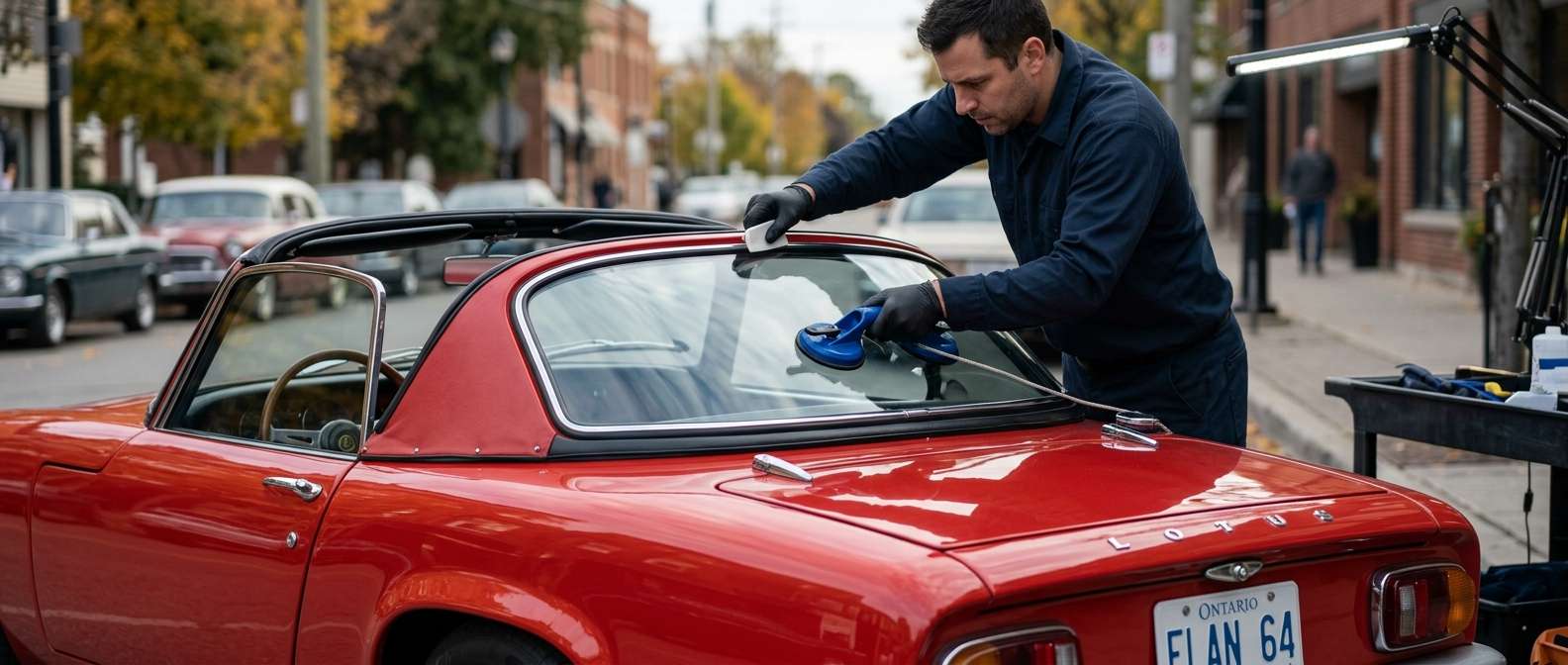
Hand-Laid Fiberglass Variations and the Elan Fixed Head Coupé Rear Screen
Replacing the curved toughened back glass on an Elan requires an immediate understanding of how Colin Chapman’s factory actually built these cars. Solid rear glass was never used on the open-top roadsters or Drop Head Coupés (DHC), which relied on flexible plastic sewn into the canvas. Instead, genuine back glass is strictly confined to the Fixed Head Coupé (FHC)—designated as Type 36, introduced during the S3 production run in 1965—alongside a handful of period hardtops. Because the entire body shell was moulded from hand-laid glass-reinforced plastic (GRP), the rear aperture dimensions drift noticeably from one body shell to another. A factory-tempered pane made to Pilkington reference 9113 will not sit in two consecutive FHC shells in the exact same manner.
On vintage Lotus forums, the dominant concern among FHC and Sprint owners is corner breakage during glass fitting. Because there is zero sheet metal pinchweld to provide rigid, uniform symmetry, any thick gelcoat runs or uneven fiberglass layup around the roof aperture create severe pressure points against the glass perimeter. If you drive a vintage Elan with a shattered rear pane, you can typically expect me on site within an hour of your call, ready to inspect the delicate GRP flange before new glass ever touches the aperture.
Glazing Channel Dynamics and the Locking Filler Bead
The rear screen relies on a deep wrap-around elastomeric rubber gasket retained by an external central locking strip, rather than modern structural polyurethane. The health of the cabin depends entirely on the tension this locking strip exerts against the glass edge and the fiberglass lip:
- Perimeter Gasket Degradation: Original rubber channels bake dry, shrink, and pull away from the tight upper radii of the roof, dumping rainwater straight onto the rear luggage shelf and inner wheel arches.
- Reproduction Seal Stiffness: Many modern reproduction profiles are extruded from high-durometer rubber that refuses to conform to the hand-finished GRP corners, creating localized stress that can snap tempered glass instantly when the locking strip is driven home.
- Locking Key Options: The glass channel is expanded and locked using either a chrome-mylar foil insert or an extruded black bead. Once installed, it must be seated without distorting the outer rubber lip away from the fiberglass edge.
- Absence of Glass Hardware: The single-piece curved rear glass carries no wiper spindles, no high-mount brake lamp brackets, no integrated radio aerials, and no bonded mounting studs.
For historic racing or track-focused S4 and Sprint builds, owners frequently swap fragile tempered glass for thermoformed clear polycarbonate panels to save weight high on the chassis. For road-going restorations, however, maintaining authentic curved safety glass ensures optical clarity that does not scuff or haze over time.
Does my Elan Drop Head Coupé have a replaceable rear glass?
No. Factory S1 through S4 roadsters and DHC models use a flexible vinyl clear plastic rear window stitched directly into the folding roof material. Rigid automotive safety glass was only installed on the factory Type 36 Fixed Head Coupé and select period aftermarket hardtops.
Can I install a rear screen with an integrated defroster grid?
The factory production cars left the Hethel and Cheshunt facilities without standard heated rear defroster lines on the glass. While aftermarket suppliers have occasionally produced short runs of heated glass using modern fine wire grids, standard vintage-spec replacements remain entirely clear, unheated toughened glass.
Why does water collect in the boot area after a heavy wash?
Because the rear glass sits in a fixed rubber profile directly above the boot drainage path, any shrinkage in the plastic chrome locking strip relieves tension on the rubber lip. Water bypasses the outer flange of the fiberglass aperture, drips past the parcel shelf, and pools inside the trunk floor.


