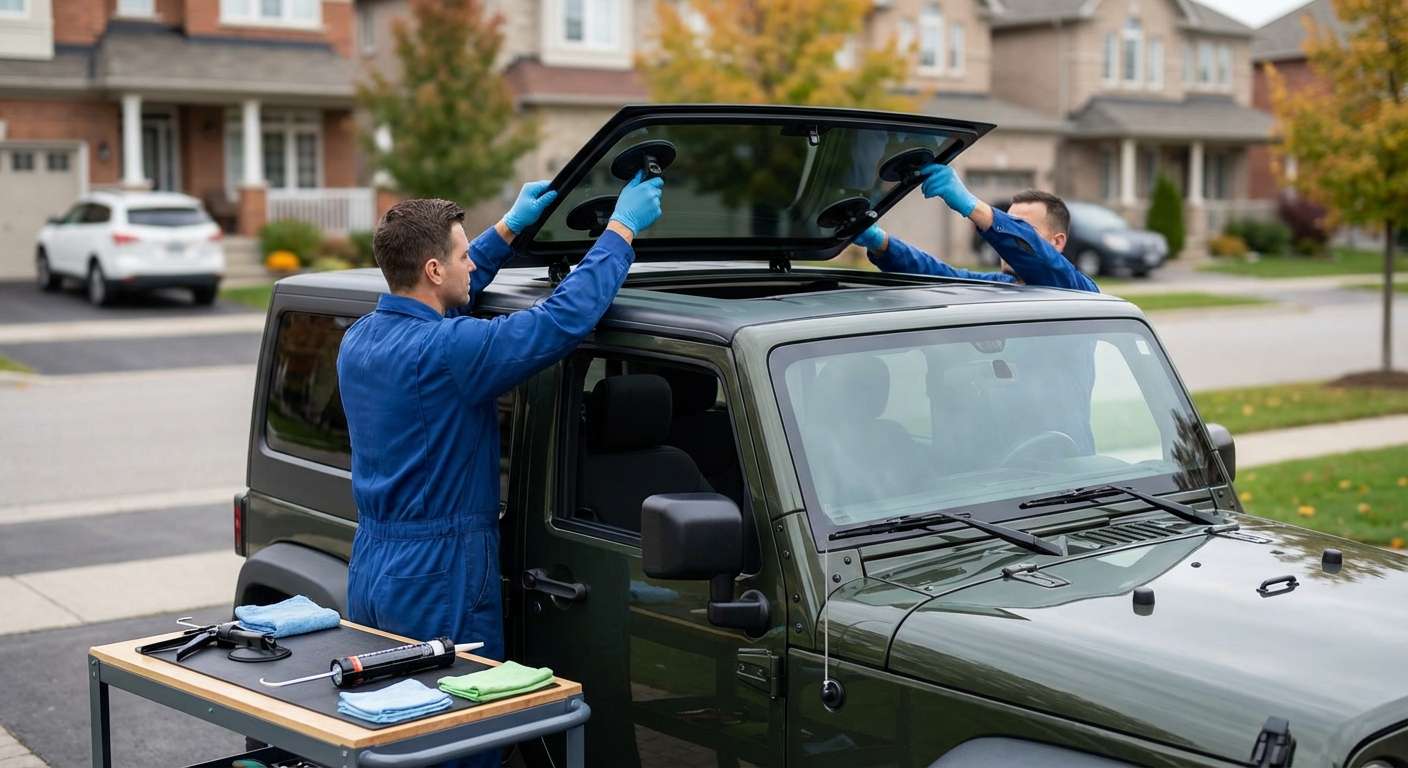
Custom Glass and Clear Panel Options for the JK Modular Roof
Every JK rolling off the assembly line between 2007 and 2018 left Toledo with either a folding soft top or a three-piece modular composite Freedom Top—never a factory-installed sliding glass sunroof. Because no assembly line glass existed, you will never find an official NAGS part code for a factory JK sunroof unit. When an owner brings me one of these vehicles with a transparent roof, I am looking at either a custom composite conversion or an aftermarket panel assembly.
The most common setups I inspect or replace fall into two categories:
| System Style | Primary Material | Mounting Hardware Interface |
|---|---|---|
| Licensed Panoramic Panel (e.g., ClearLidz 68679574AA) | Tinted UV-filtering polycarbonate | Front header latches, B-pillar turn locks, soundbar mushroom knobs |
| Bonded Freedom Conversions (e.g., JeeTops style) | Molded tempered or laminated glass | Directly bonded into cutout OE fiberglass driver/passenger panels |
Unlike conventional SUVs, this cab design lacks motorized track assemblies, integrated defroster wiring, roof wiring harnesses, or glass-mounted rain sensors. Everything sits directly over the front-row sport bar crossmember and outer door surrounds, depending entirely on perimeter clamping tension to hold out wind and rain.
Pre-Installation Checks on JK Transparent Roof Assemblies
Before fitting any replacement transparent panel or bonded glass unit onto a Sport, Sahara, or Rubicon, I inspect the bare components on my workbench. For bonded glass inserts in cut-out fiberglass shells, I scrutinize the edge perimeter to confirm the glass retains an unbroken, flexible polyurethane joint capable of withstanding the frame twist common on trails.
If you are swapping to the Mopar-cataloged ClearLidz panel (part 68679574AA), I examine the polycarbonate for interior hazing and test the action of the integrated mechanical latch clamps. Once you schedule a service, I typically arrive at your location within about an hour of the call to assess whether a leaking transparent panel needs hardware realignment or a complete unit replacement.
I also inspect the vehicle body mating surfaces. The windshield header weatherstrip, the center seam foam blocks, and the rubber mucket seals situated at the top of the A-pillars must be completely free of flattening, grit, or tears. If these rubber profiles are flattened from years of heavy torquing on the rear soundbar mushroom knobs, a brand-new panel will leak water the moment it rains.
Post-Replacement Inspection Checklist
Once the transparent panel or custom-glass Freedom section is seated and locked, evaluate these critical areas before taking the vehicle back on the road:
- Header Latch Tension: Ensure the front clamping latches pull down smoothly against the windshield frame loop without forcing the header rubber out of its channel.
- A-Pillar Mucket Alignment: Verify the front exterior corners seat cleanly into the mucket seals above the door hinge line without pinching the rubber tips.
- Center Seam Compression: On dual-panel custom glass setups, confirm the passenger panel overlap rests flat against the driver-side gasket without bowing upward in the middle.
- Rear Fastener Engagement: Check that the vertical soundbar mushroom knobs thread straight into the roll bar crossmember without cross-threading or crushing the composite housing.
- Wind Deflection Profile: Sight along the roofline from the side to confirm the front edge of the panel sits flush or slightly recessed below the windshield frame header to prevent whistling between 55 and 70 mph.
Controlling Interior Heat and Seal Fatigue
Because transparent panels on this platform sit directly above the driver without an interior sliding headliner, solar heat gain is dramatically higher than with factory insulated fiberglass. I always check that replacement glass panels feature high-performance infrared-rejecting laminate, while polycarbonate panels require surface-applied UV barriers to keep the front cabin bearable in direct sun.
Routine removal is part of owning a Wrangler, but constantly cycling the roof hardware wears down perimeter rubber quickly. Every time a transparent panel comes off for open-air driving, inspect the perimeter gaskets for deformation before latching it back over the windshield header.


