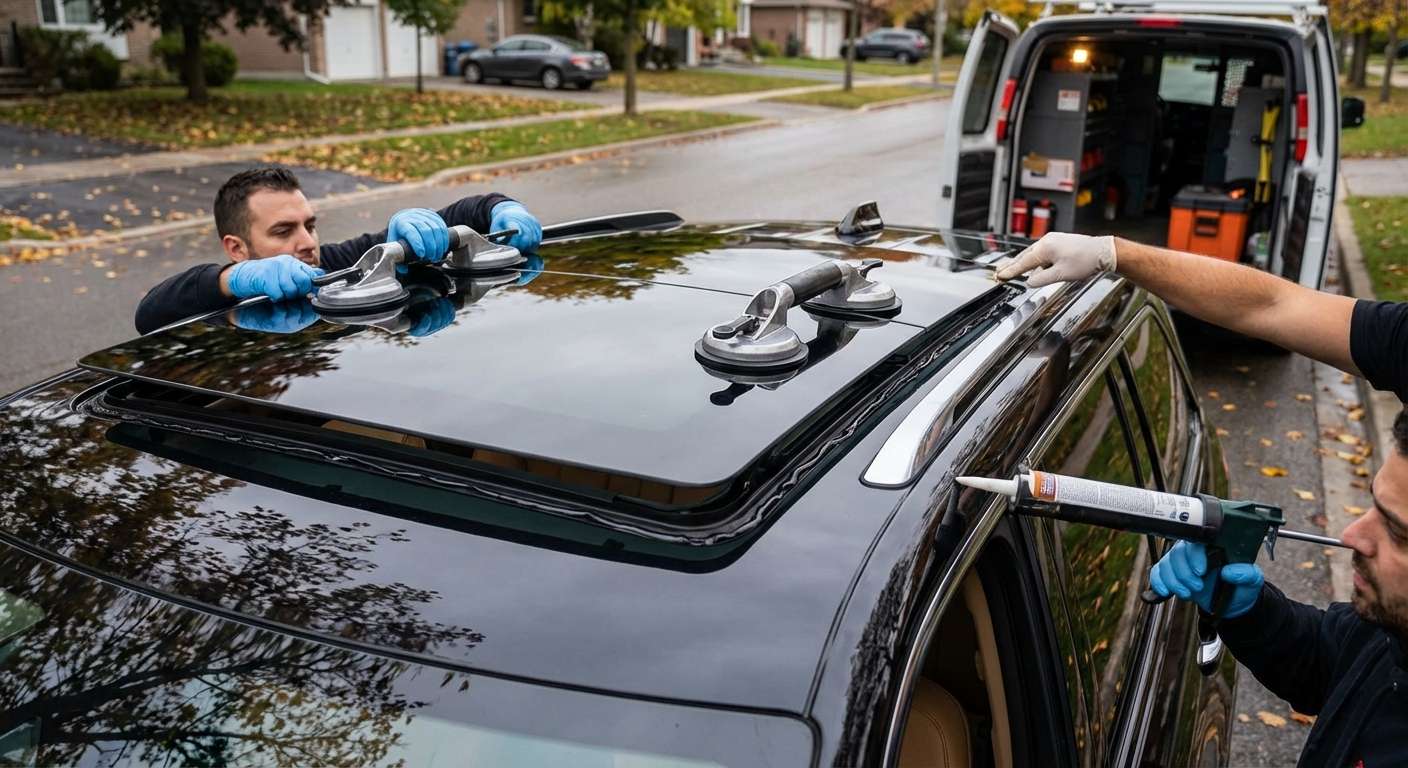
CommandView Dual-Pane Panoramic Roof Glass Breakage on the Grand Cherokee
A shattered overhead panel on the Grand Cherokee leaves the cabin completely exposed to weather and sends tempered safety glass fragments into the interior roller sunshade track. Most of these models come equipped with the CommandView Dual-Pane Power Panoramic Sunroof (sales code GWJ), an assembly built around two separate panels: an electrically sliding front glass panel that vents and retracts, and a stationary fixed rear glass lite mounted directly behind it. The movable front panel corresponds to Mopar part number 68518684AA, which superseded 68518684AB, while the fixed rear glass sits encapsulated over the rear passenger compartment.
Both panels use heavy solar-control privacy glass designed to reject ultraviolet radiation, bordered by an integrated perimeter rubber seal. Neither glass lite carries electronics, defroster traces, or driver-assist hardware—the forward-facing cameras sit behind the windshield bracket and satellite antennas rest on the painted roof metal. However, shattered glass will drop directly into the cassette frame mechanism, jamming the cable-driven lifter arms and threatening the fabric roller shade underneath. When an overhead panel shatters, I generally pull up to your driveway roughly an hour after you get in touch to secure the vehicle and inspect the mechanism.
Water Leaks, Pillar Drains, and Track Binding
Replacing the glass on the WL platform requires addressing the surrounding water management channels and guide rails. The sunroof cassette relies on four dedicated corner drain lines routed through structural pillars:
- Front drain tubes: Run down both A-pillars, passing behind the interior kick-panel insulation before discharging through lower body grommets. If debris from broken glass enters these funnels, water quickly overflows into the overhead console, down the rearview mirror wiring harness, and onto the front floor carpet.
- Rear drain tubes: Route rearward along the ceiling contours, running in close proximity to the side-curtain airbag modules before dropping behind the rear quarter trim panels.
- Wind deflector assembly: The spring-loaded mesh air deflector at the leading edge of the roof opening must seat cleanly into its pocket. Stellantis addressed this specifically in TSB 23-102-23, noting that a deflector snagged under the closing front edge will deform the perimeter weatherstrip and cause interior dripping.
- Drain disconnections: Factory bulletins, including STAR Case S1623000034, highlight that pinched or loose drain hoses at the cassette spouts will saturate the headliner without warning.
If only the front moving panel is broken, I remove the shattered panel remnants directly from the side lifter brackets without tearing apart the cabin ceiling. If impact damage cracks the rear stationary glass or fractures the cassette frame itself, the job expands significantly: the side pillar plastics must come off and the one-piece molded interior headliner must be dropped clear of the roof crossmembers to access the retaining hardware.
Track Noise and Panel Alignment Tolerances
Installing replacement aftermarket glass requires precise mechanical height adjustments along the sliding rails. The WL Grand Cherokee roofline is sensitive to aerodynamic turbulence. If the leading edge of the front panel sits even two millimeters higher than the roof sheet metal, highway speeds generate noticeable whistling and wind hissing in the passenger cabin. Conversely, if it drops too low, air buffeting shakes the glass against its seals.
Stellantis STAR Case S1523000016 (NHTSA #10214585) documents track rattle, ticking, and creaking within the dual-pane sunroof cassette on these vehicles. When fitting replacement glass, I clean the guide tracks completely of broken glass debris, verify that the lifter arms slide smoothly along the cable drive, and align the glass flush with the roofline to prevent seal friction and binding against the deflector arms.
Can I drive if only the outer seal is torn but the glass is intact?
The encapsulated perimeter rubber on the CommandView panel is the primary defense against bulk water entry. While the internal tray and four pillar drain tubes can handle minor seepage, a torn or deformed seal allows large volumes of rainwater to overwhelm the drain troughs during a storm, risking headliner saturation and water intrusion into the overhead electronics.
Do you have to drop the headliner to replace the front sliding glass?
No. The movable front panel fastens directly to the mechanical guide brackets located inside the track channel. I can unbolt the damaged panel, clean the slide tracks, and install the new aftermarket front glass from outside the vehicle. Lowering the molded headliner is only necessary if the fixed rear glass panel is shattered or if the internal cassette tray is cracked.
Why is water dripping from my rearview mirror after the sunroof broke?
When the front glass shatters or misaligns, water bypasses the seals and drops straight onto the forward cassette trough. If falling glass fragments plug the front drain spouts at the top of the A-pillars, the captured water pools forward and drains out through the lowest interior opening, which is the harness cutout behind the overhead console and rearview mirror.


