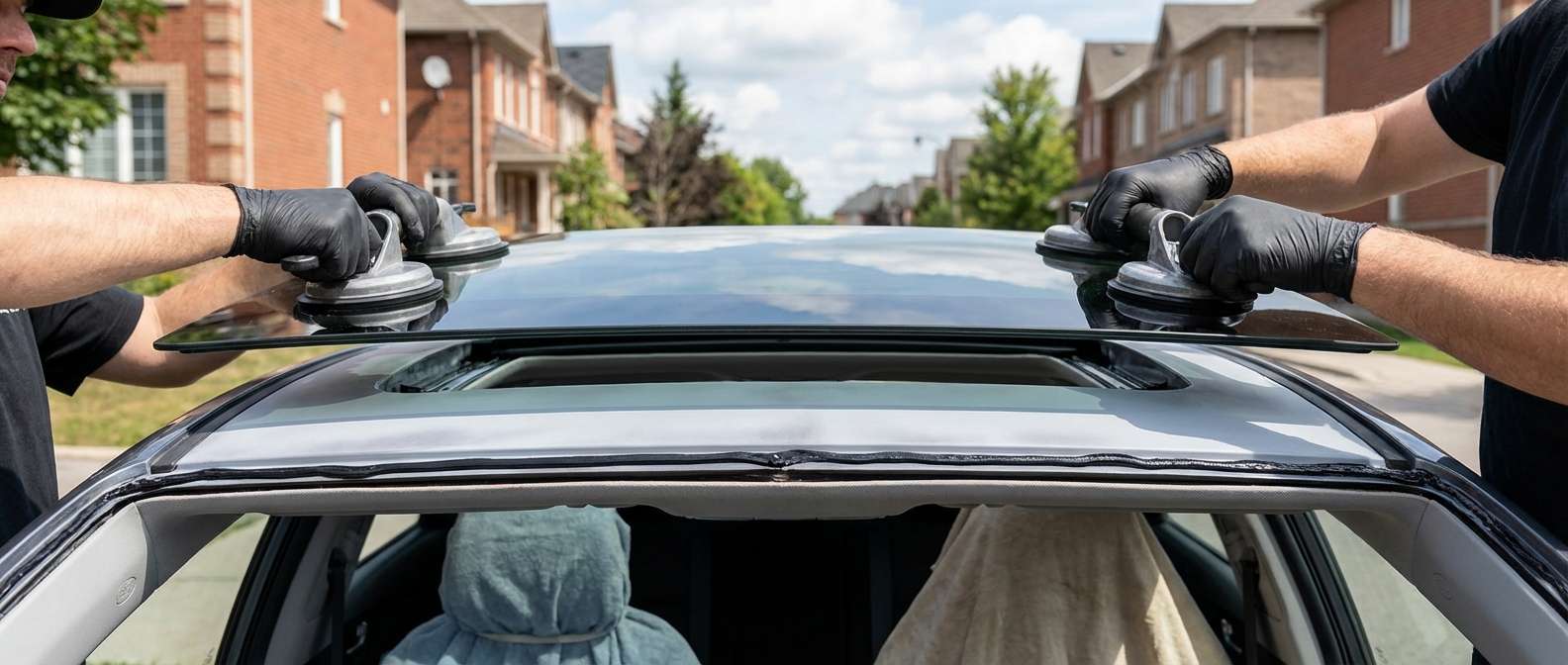
Limited Trim Sunroof Glass Rattle and Impact Breakage
Accent drivers frequently mention a persistent buzzing or light knocking right above their ears over washboard asphalt. In this car, the factory tilt-and-slide roof panel utilizes underside steel mounting brackets clamped directly to the motorized lifter guide arms with Torx hardware. Over thousands of kilometers, vibration loosens those side fasteners, allowing the glass panel to chatter against the roof opening. If road gravel or severe thermal stress strikes that pre-stressed panel, the single-pane tempered safety glass with dark factory solar tint can fracture instantly into thousands of small pebble fragments, dropping straight down onto the manual interior sunshade.
Unlike earlier Hyundai models notorious for exploding panoramic roofs spanning the whole cabin, this subcompact uses a compact, traditional single-pane cassette. The replacement panel matches the factory 81610-F9000 specification, featuring encapsulated polyurethane edge moulding that seals the aperture without requiring any mess on the paint. I run a fully mobile service across Toronto and the GTA, replacing broken sunroof panels on site at your driveway or office parking spot so you never have to navigate traffic with an open roof opening.
Water Leaks, Wind Deflector Binding, and Drain Routing
When owners find soaked carpet around the front kick panels or damp headliner corners near the overhead console map lights, the culprit is often mistaken for broken glass. Hyundai routed four independent rubber drain tubes from the cassette corners: two down the A-pillars behind the plastic trim and two rearward through the C-pillars to dump below the floor pan. Fine road silt washes past the perimeter weatherstrip seal—original reference 81613-F2000—and plugs the tiny forward drain elbows, forcing captured water over the plastic collection trough during heavy rain.
Whenever I replace this glass, I clear the forward collection drains and inspect the front pop-up mesh wind deflector. This spring-loaded deflector pops up along the leading sheet metal edge when the overhead console switch is pushed rearward to slide the roof open. If road grit fouls the side hinges of that deflector, it fails to fold flat as the glass moves forward, jamming the motor drive cables or cocking the panel sideways in the roof channel.
Securing and Aligning the Replacement Glass Panel
Replacing the glass itself does not involve dropping the full cassette assembly—part 81600-J0000-TTX—which would otherwise require stripping the sun visors, grab handles, and the entire molded interior headliner. Instead, the job is handled from inside the cabin by pulling back the lateral plastic accordion gaiters to access the mounting brackets. Because the panel carries no embedded antennas, rain sensors, defroster lines, or forward driver assist hardware, mechanical alignment is the primary technical objective.
Proper height indexing against the roof sheet metal requires fine adjustment at the bracket slots. If the leading glass edge sits even a millimeter proud of the front roof lip, buffeting wind noise penetrates the cabin at highway speeds. Conversely, a rear trailing edge set too low allows runoff water to pool heavily directly above the rear gutter, overwhelming the drain channels. Setting the glass flush to just slightly below the front edge and a fraction of a millimeter above the rear lip eliminates cabin whistling and keeps the perimeter weatherstrip seated squarely.


