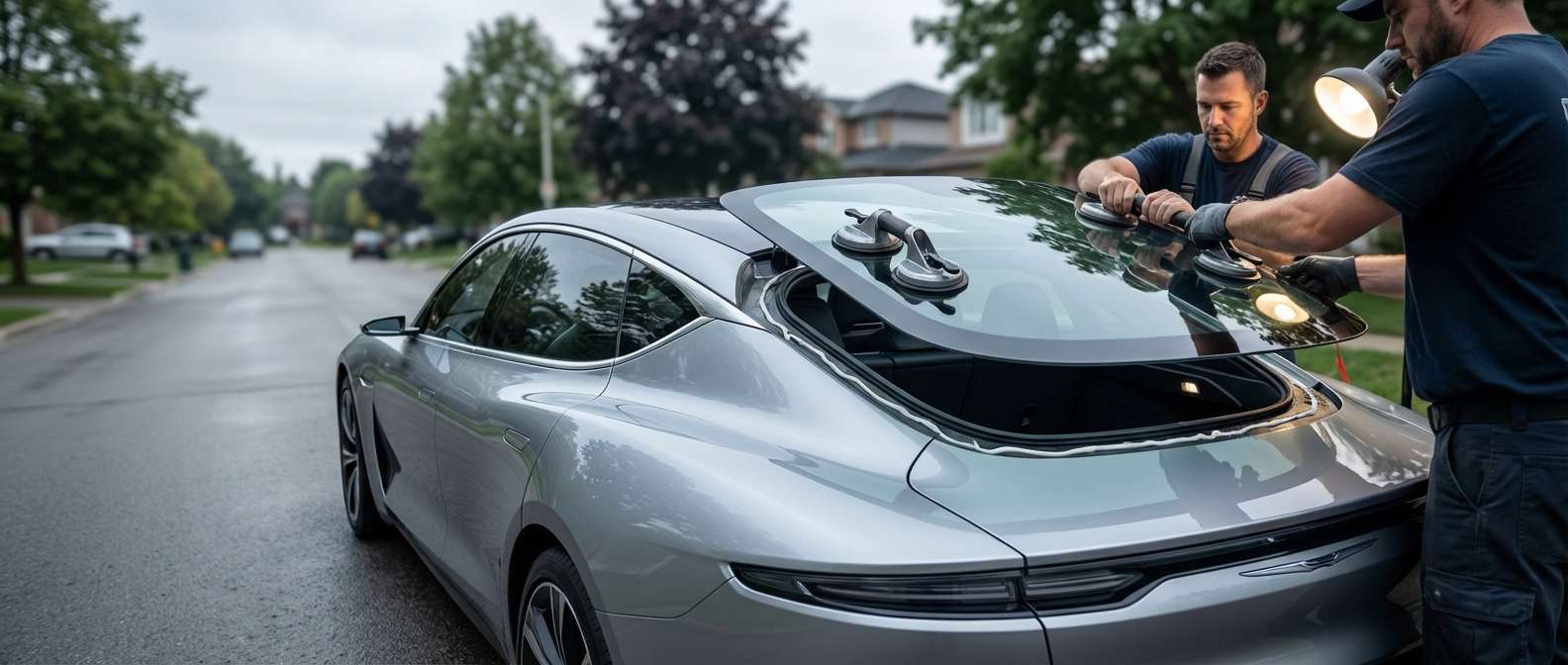
Identifying the Fastback Canopy and Glazing Setup
Determining which rear panel assembly sits on this concept design comes down to inspecting the unbroken arch of the fastback canopy and how it meets the butterfly-hinged roof panels. The back glass does not sit in a traditional frame; it flows directly from the middle roof apex down to the deck lid without conventional exterior rubber mouldings or encapsulation seams. Instead, the rearward structure combines the rear vision surface directly into an active aerodynamic rear hatch, ending just above the thin, full-width illuminated LED rear light bar with its backlit Chrysler wing emblem.
You can identify whether the canopy features the active electrochromic film layers by checking the glass response during the cabin's autonomous Stargazing Mode. When activated, the electrochromic laminate transitions dynamically across its surface, shifting from crystal clear to complete privacy opacity. If you look at the interior surface of the hatch glass, there is no integrated rearview mirror tab bonded to the inner laminate. Rear vision relies entirely on an exterior rear-facing video camera projecting to the instrument panel, leaving the upper center area of the glass completely clean.
| Glazing Characteristic | Fastback Electrochromic Canopy | Standard Solid Concept Glazing |
|---|---|---|
| Stargazing Mode Tint Control | Dynamic variable opacity (clear to dark) | Fixed tint level |
| Roof Canopy Boundary | Articulates with butterfly canopy sections | Fixed flush-bonded perimeter |
| Heating & Antenna Traces | Sub-laminate concealed wiring | Non-conductive single-pane layup |
| Rear Vision Integration | Digital display feed; mirror tab omitted | Digital display feed; mirror tab omitted |
Structural Layout Around the Rear Hatch Area
The layout below the glass is unlike any standard Chrysler liftgate because it must accommodate the next-generation motorized Stow 'n Go rear seating geometry. The glass canopy sits directly over the storage well where the rear seat bottoms fold down into the floor. Because the panel terminates right against the active aerodynamic spoiler and diffuser assembly at the rear deck, physical clearance along the lower pinchweld is exceptionally tight.
Whenever high-end concept architectures eventually filter down to accessible replacement scenarios, I fit strictly aftermarket glass sourced from established manufacturers like PGW, Pilkington, FYG, and XYG to ensure the structural curvature matches the vehicle lines precisely. The lower boundary requires absolute alignment with the illumination blade across the tail, as any variation in panel height will misalign the unbroken LED lighting strip running underneath the glass.
Diagnostic Differences in Rear Glazing Electronics
Telling these concept canopy panels apart involves looking closely at the power feeds concealed at the upper hinges. A dimmable canopy uses high-voltage control bus pigtails run alongside the articulated hinges of the butterfly roof sections, which power the dimming particles inside the laminate. A display-only show shell lacks these discrete low-profile busbars entirely.
There are also no visible surface-printed defroster grids running horizontally across the viewing area. If heated elements are present, they are embedded microscopic tungsten lines layered between the inner PVB acoustic membrane and the outer sheet, keeping the glass looking entirely transparent. You will also notice the complete absence of a rear wiper arm cutout, drive spindle hole, or third brake light pod fastened against the upper glass perimeter, as secondary brake signaling is engineered straight into the sheet metal water line below the hatch seam.


