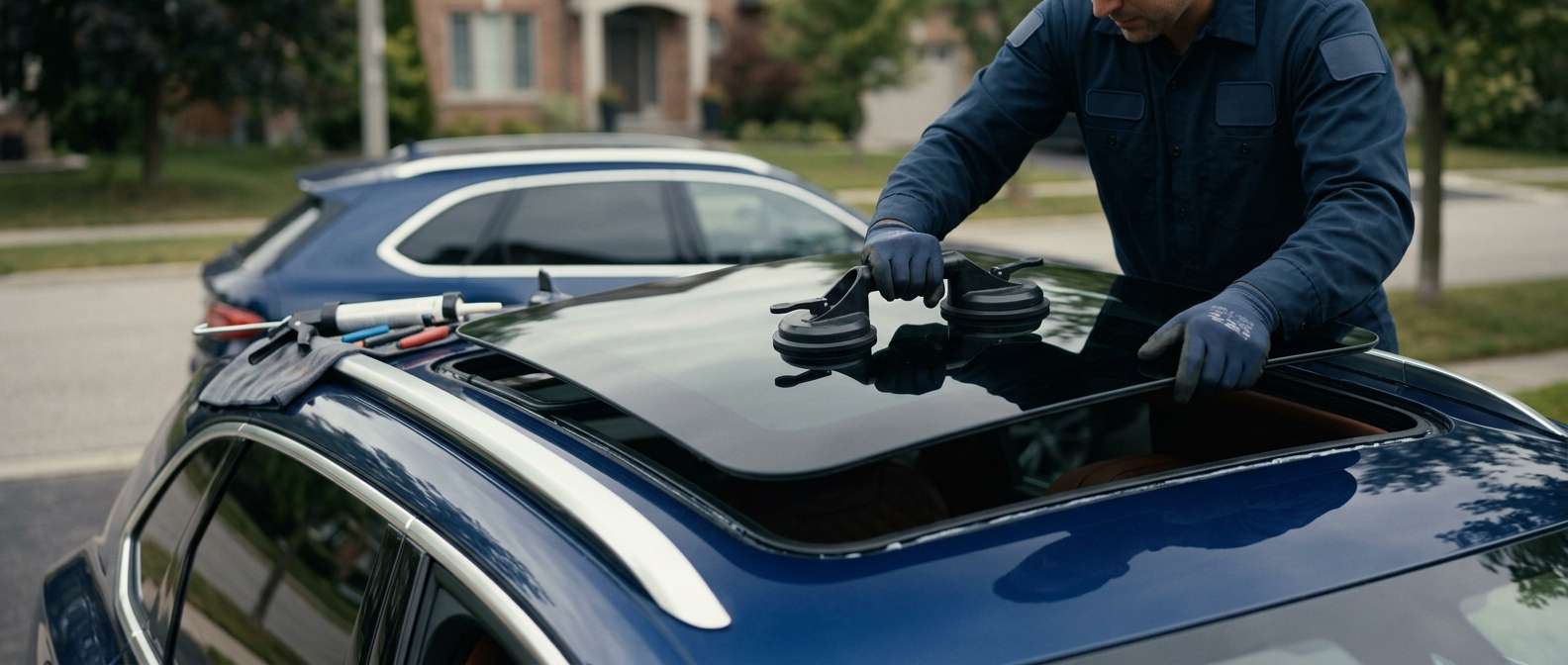
The Shifted Panoramic Roof Architecture on the Bentayga EWB
When the dual-pane panoramic glass fractures on an extended-wheelbase Bentayga, standard-wheelbase glass cannot replace it. Bentley re-engineered the roof stamped structure for this lengthened cabin, moving the entire panoramic sunroof cassette and its aperture rearward by 125 mm (4.9 inches). This deliberate displacement shifts the boundary between the tilt-and-slide front glass and the fixed rear pane, ensuring natural light floods the rear footwell rather than terminating behind the front headrests.
Because the panoramic frame sits further back over the rear axle line, the relationship between the exterior glass and the interior cabin trim is unique to this stretched profile. The front movable panel vents upwards and slides backward over the stationary rear sheet, operating under tight factory tolerances against the surrounding roof rails—whether your vehicle is trimmed with bright chrome or the gloss black finishers of the Blackline package. The glass itself integrates deep solar-control and acoustic filtering layers to block radiant thermal gain across the extended cabin volume, protecting delicate interior veneers and bespoke rear seating consoles from UV exposure.
Interior Lining and Mechanism Disassembly
Replacing shattered or stressed roof glass on this long-wheelbase setup requires careful decoupling from the inside out. The mechanical slide cassette, drainage channels, and mounting fasteners cannot be reached without systematically dropping the handcrafted headliner away from the roof shell. I unclip and remove the delicate leather or Alcantara-wrapped trims running along the A-pillars, B-pillars, C-pillars, and D-pillars, taking care around concealed wiring harnesses.
The integrated full-length motorized sunblind sits directly beneath the dual glass panels. Its fabric and motor assembly must be detached cleanly from the sliding tracks so it remains isolated while damaged glass is unbolted and removed. I provide complete on-site service across Toronto and the GTA, coming directly to your home or office garage to handle this intricate teardown where the vehicle is already parked. Once new glass is mechanically squared within the cassette, the front drive motor and the shade motor require an electronic adaptation sequence. This ensures anti-pinch sensors read resistance correctly and stops the motor travel at the exact factory seal compression points.
Bentayga EWB Sunroof Hardware Overview
| Component / Feature | EWB Configuration Details |
|---|---|
| Glass Layout | Dual-pane system: front power tilt/slide section, rear fixed panoramic section |
| Aperture Position | Shifted 125 mm rearward compared to standard-wheelbase Bentayga |
| Glass Properties | Acoustic-laminated construction with high-performance solar-control tint |
| Interior Shade | Full-length power roller blind color-matched to cabin headliner |
| Control Interfaces | Front overhead console buttons plus the detachable 5-inch Rear Touchscreen Remote |
Can I open the sunroof from the back seat after the glass is swapped?
Yes. Both the tilt/slide front glass and the full-length roller blind remain fully accessible via the detachable 5-inch Rear Touchscreen Remote (TSR) mounted in the rear console, as well as the driver's overhead switches. Once I run the electronic adaptation procedure to relearn motor end-stops, all remote digital commands from the TSR work immediately.
What happens to the four internal corner drain tubes during glass replacement?
The panoramic cassette uses four dedicated corner drainage outlets that guide rain away through downspouts hidden within the pillars. Whenever I replace cracked panoramic glass, I clear these channels of any fine glass fragments or ambient debris before bolting in the replacement panel, preventing water from backing up and overflowing onto the rear passenger modules or headliner.
Does replacing the sunroof require removing the exterior roof rails?
The full-length aluminium roof rails run parallel to the outer perimeter seals of the glass. While the rails themselves remain attached to the outer roof skin during glass panel swaps, the encapsulated perimeter rubber seals on the new glass must be aligned precisely alongside them to ensure a weather-tight fit and eliminate wind buffeting at highway speeds.


