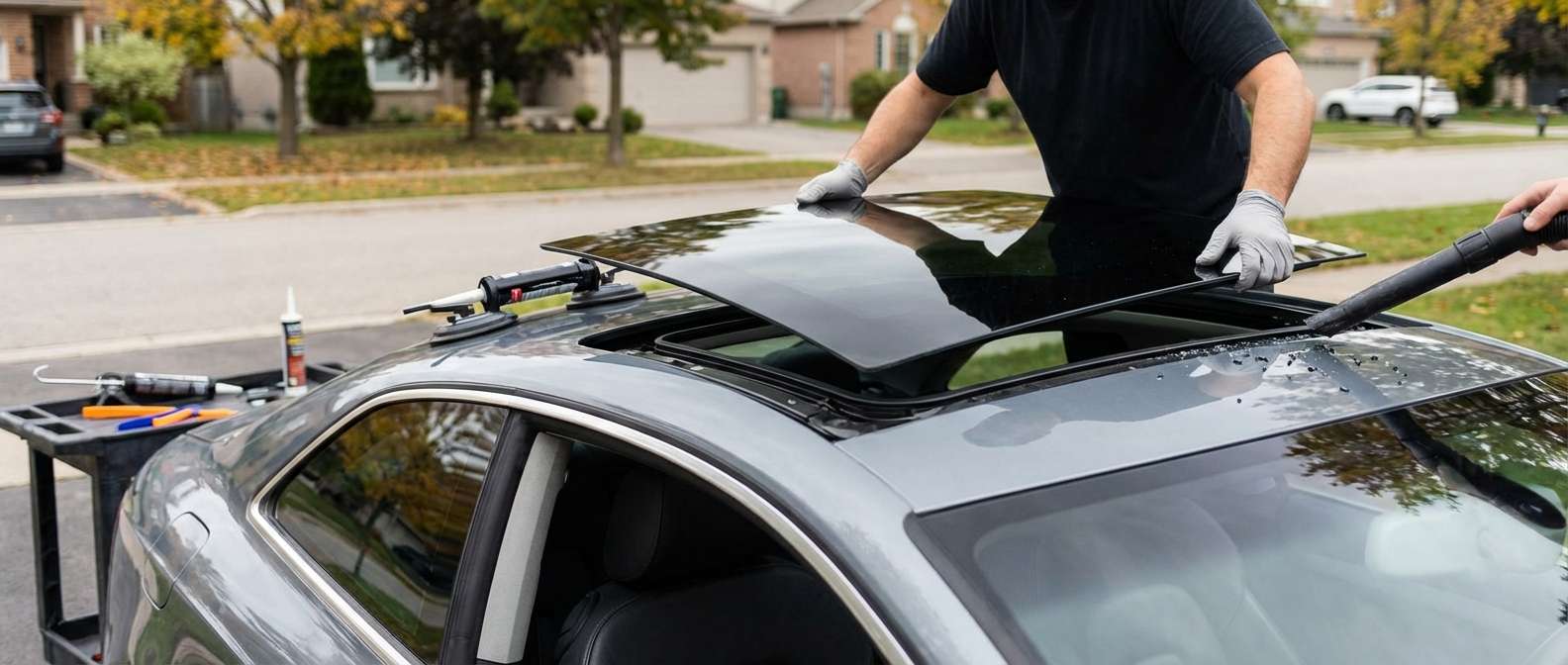
Why the Audi A5 Panoramic Roof Only Tilts
Unlike standard slide-back moonroofs found on other luxury models, the oversized panoramic panel on the two-door coupe was engineered strictly as a pop-up vent. Audi curved the exterior steel roof skin aggressively downward toward the rear glass to create that sweeping coupe profile, leaving zero physical clearance above or below the sheet metal for an oversized glass panel to retract rearward. Under OEM base part number 8T0877071 (and its revisions like 8T0877071A and 8T0877071B), this unit consists of a single massive piece of factory dark-tinted, heat-insulating tempered safety glass with a vulcanized rubber perimeter seal bonded directly around its perimeter.
Because it operates solely on an upward pivoting axis, the mechanical design avoids the bulky exterior deflector arms that cause drag on sliding roofs. Instead, an overhead electric drive motor turns dual mechanical lifter cables that push the rear trailing edge of the glass into the slipstream. While this design keeps the profile sleek, the mechanical carrier brackets beneath the interior side accordion trim pieces take on significant leverage during daily operation, making correct physical alignment critical during any glass swap.
Differences Across the B8 and B8.5 Body Styles
Navigating glass replacement on this platform requires paying close attention to which body variant you drive, as the hardware does not interchange across the board:
- Two-Door Coupe (2008–2017): Uses the classic tilt-only panel assembly spanning nearly the entire front passenger compartment, paired with an interior manual fabric sunshade blind that slides on lower track runners.
- Five-Door Sportback: Features a dedicated roof setup with distinct carrier bracket geometry and part variations tailored to the longer, four-door roofline.
- Two-Door Cabriolet: Completely omitted from sunroof catalogs, as all convertible models utilize an insulated folding fabric soft top without an overhead glass aperture.
Because these large overhead units leave your interior exposed to the weather when damaged or removed, I run a strictly mobile operation where I handle every job directly at your home or workplace across Toronto and the GTA. This ensures your vehicle never has to sit out in a shop yard or be driven through traffic with compromised overhead glass.
Mechanical Jamming and Drainage Pitfalls
The vast majority of failures on these panels involve the pinch-protection system or track binding rather than outright motor death. The carrier guides rely on close tolerances along the painted roof aperture. When road grime enters the guide rails or the factory track lubricant dries out, friction spikes as the lifters try to pull the panel flush. The overhead control module interprets that physical drag as an obstruction and automatically kicks the glass back open into the tilt position.
The drainage system is another sensitive area. The metal cassette below the encapsulated perimeter seal directs water to four individual drain tubes routed through the A-pillars and C-pillars. If dirt settles in the upper tray basins, moisture backs up quickly. Left unaddressed, overflow tracks behind the headliner, soaking the front footwells or seeping into the rear quarter compartments where sensitive comfort modules and audio amplifiers reside.
Why does my sunroof bounce back open when I try to close it?
The overhead drive motor monitors electrical resistance to prevent fingers from being trapped. If the guide tracks are dry, debris is caught in the side lifters, or the carrier brackets are misaligned against the frame, the motor senses resistance and reopens the glass to the vent position. Thorough cleaning of the runners and lubrication with Krytox grease typically resolves the issue.
Can this panoramic roof be converted to slide open completely?
No. The structural sheet metal of the coupe's roof lacks the cavity depth and internal track length required for a sliding cartridge. The entire mechanism, carrier system, and body cutout are built strictly for the tilting vent function.
Is the windshield rain sensor connected to this roof panel?
No. The combination rain and light sensor is mounted directly behind the rearview mirror on the front windshield. The sunroof glass panel contains no wiring, heating grids, antennas, or optical sensors; it is purely a tempered glass unit secured by Torx fasteners to the lifting frame.


