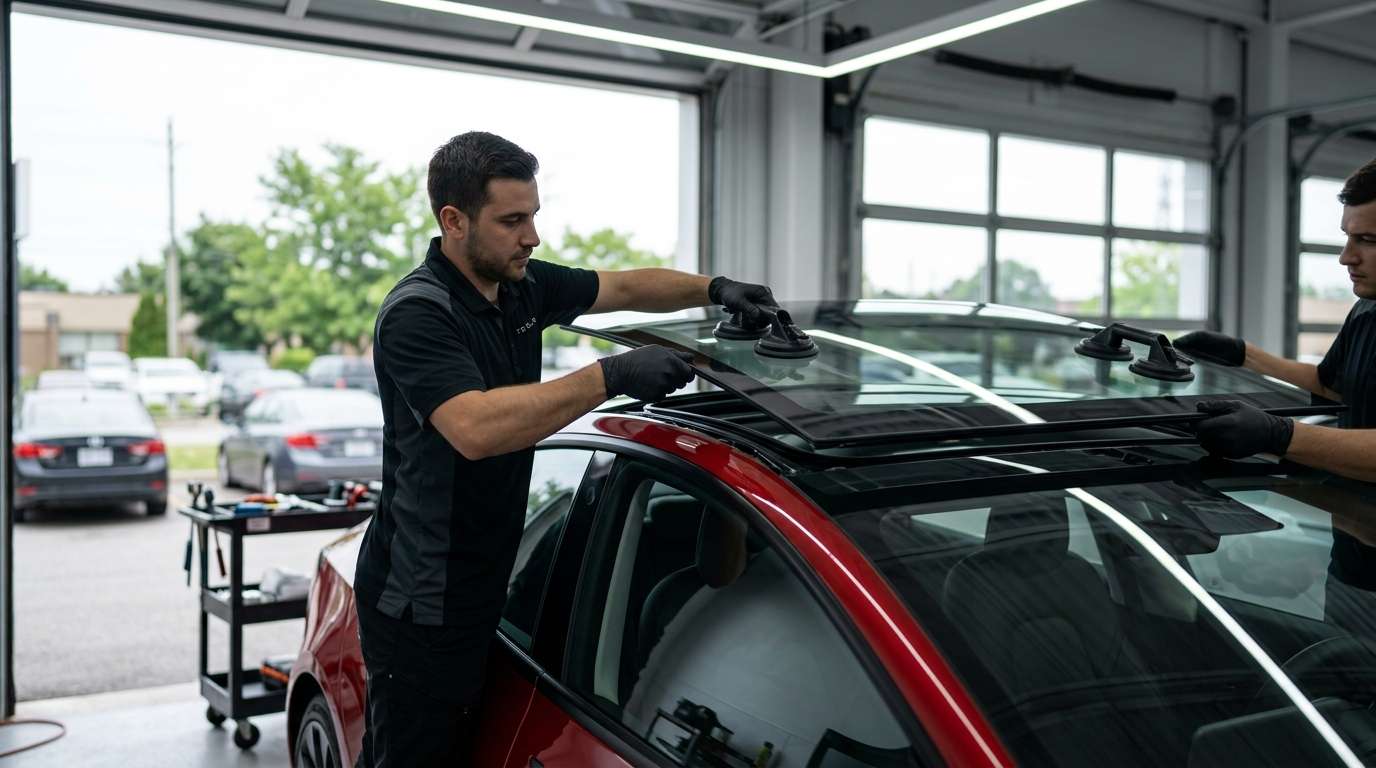
Highland Fixed Glass Roof Structural Layout and Edge Hardware
The front overhead glass on the refreshed Model 3 Highland is designated by Tesla as the Fixed Roof Glass Assembly (OEM part 1587892-00-A, superseding the legacy 1086927-98-D). Unlike conventional sunroof assemblies, this unit contains no motorized tracks, drains, or mechanical tilt-slide mechanisms. It is a stationary, acoustic-laminated panel made with an internal polyvinyl butyral (PVB) interlayer that directly bridges the gap between the top edge of the windshield and the central B-pillar structural roof bow.
The panel sits flush against the left and right upper body side roof cant rails. Because the Highland cabin does not utilize external plastic or metal reveal mouldings, the exterior interface relies on precise alignment with internal gap buffers. Tesla utilizes dedicated perimeter net pads and edge spacers (such as parts 1125691-00-A and 1111258-00-B) to establish the necessary perimeter clearances before bonding. Beneath the glass, the perimeter is surrounded by the molded interior headliner, A-pillar trim garnishes, and upper B-pillar covers, while the structural urethane beneath bonds directly to the stamped steel and aluminum body frame to preserve rollover integrity.
Thermal Stress, Impact Risks, and Highland Roof Protection
Highway stone strikes represent the most common cause of roof failures on this vehicle. The aerodynamic drop of the Highland nose directs highway debris upward across the low-rake windshield, impacting the exposed leading perimeter of the roof panel. A small chip along that front edge quickly propagates into structural stress cracks across the driver or passenger viewing area.
Thermal shock is an equally significant risk factor for this glass. The factory laminated panel contains integrated infrared and ultraviolet reflective coatings alongside deep privacy tinting, eliminating the need for a mechanical sliding sunshade. When owners apply thick, dark aftermarket ceramic window films directly over this factory glass, radiant heat builds up between the film and the inner PVB safety layer. Under intense summer sun or rapid temperature swings, that trapped heat can induce spontaneous stress fractures originating at the edge seal.
I operate entirely as a mobile service, replacing fractured Highland roof panels on-site at your home or workplace throughout Toronto and the GTA. Every replacement panel I fit is an aftermarket assembly engineered to replicate the original acoustic dampening, optical clarity, and solar rejection values.
Replacing Highland Front Glass vs. Rear Backlite
Understanding which systems reside within the Highland roof glass prevents confusion during replacement diagnostics:
- Forward Roof Glass (1587892-00-A): Completely passive glass. Contains zero electrical connectors, defroster lines, antennas, or camera brackets. Forward-facing autopilot optics, ambient light sensors, and rain detection hardware remain isolated behind the front windshield.
- Rear Backlite Glass: Extends from the B-pillar crossmember down to the trunk decklid. Houses the integrated defroster grid lines and cellular/FM antenna patterns, making it an active electrical component distinct from the forward overhead panel.
- Cabin Acoustic Isolation: The Highland update places high emphasis on road quietness, meaning the forward roof glass relies on tailored perimeter acoustic seals rather than external trims to prevent buffeting at highway speeds.
Why did my roof glass crack without an obvious rock chip?
The panel is a rigid structural component under constant torsional load from the body shell. Spontaneous cracking typically stems from extreme thermal differential—often caused by dense aftermarket ceramic tinting baking under direct sunlight—or microscopic stress fractures hidden under the outer edge seal from high-frequency road vibrations.
Does the Highland front roof glass contain heating elements or antennas?
No. The front panel is strictly structural glass featuring acoustic dampening, infrared blocking, and UV filtering. The defroster wire grids, GPS, and radio antenna elements are embedded in the rear backlite glass assembly behind the B-pillar.
Can I add an aftermarket mechanical shade to this roof?
Physical snap-in mesh shades that allow airflow are safe to use. However, self-adhesive ceramic films should be avoided, as blocking heat at the glass surface rather than reflecting it naturally can cause severe localized thermal expansion and crack the panel.


