Frameless Door Glass Challenges on the Legacy
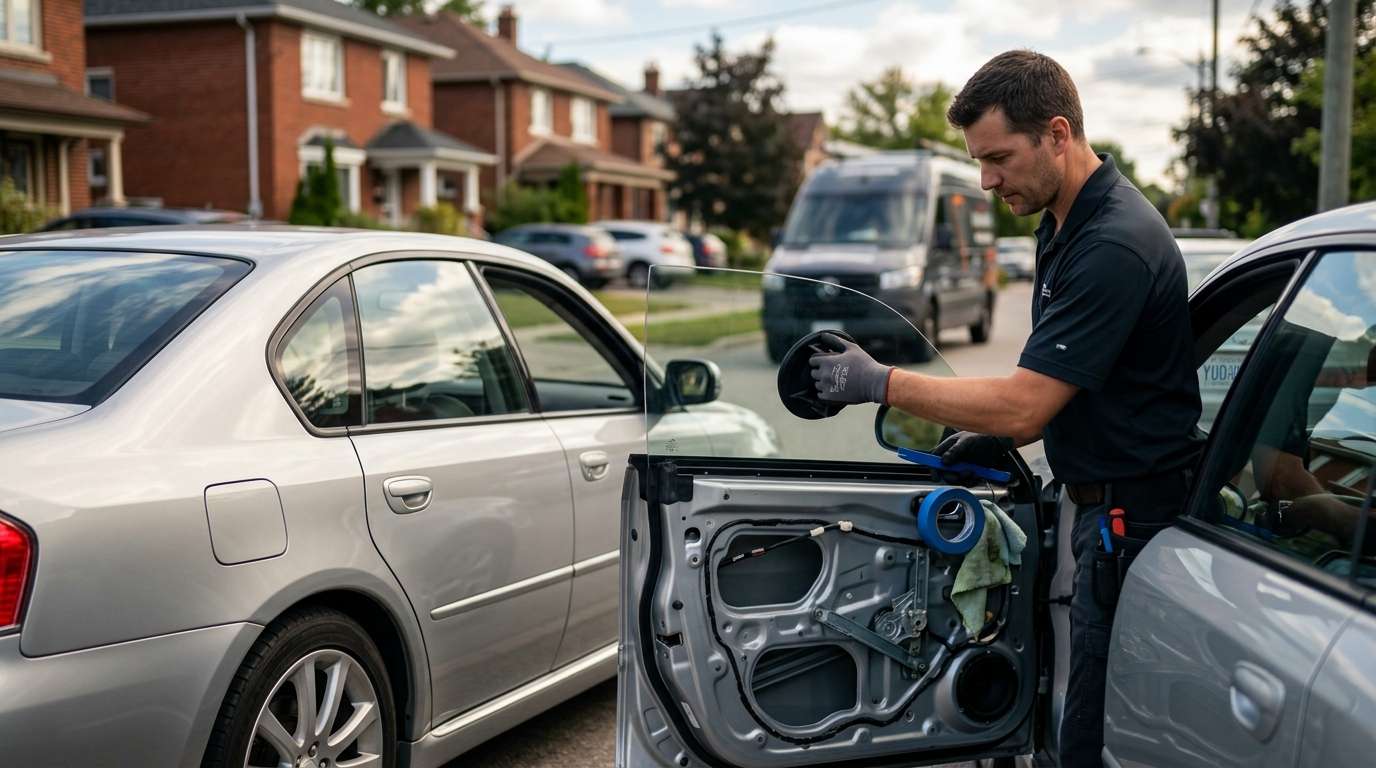
When side window glass shatters on this car, the repair involves far more than simply vacuuming out the door shell and sliding in a replacement. Because the fourth-generation BL sedan and BP wagon were the final Legacy models to feature Subaru's signature frameless side glass design, the window has no surrounding steel frame to guide it into place. When the door shuts, the top edge of the single-pane tempered glass seals directly against the weatherstripping along the roofline, A-pillar, and B-pillar. If that pane is not dialed in with micrometer precision, you get highway whistling, heavy cabin draft, and water pouring into the footwells during rain or car washes.
The front window relies on a triangular corner gusset—often called the sail panel—near the side mirror base, which houses an integrated run channel. Inside the door cavity, the glass anchors to a pair of bottom bolt-on clamping brackets fastened to the power window regulator. Surrounding the glass track are adjustable, felt-lined inner and outer glass stabilizers. Over years of use, those felt pads wear thin, allowing the glass to tilt, rattle violently over highway expansion joints, and put excessive drag on the window motor.
Subaru Legacy Door Window Identifiers and Specs
All factory passenger door glass on these models came standard with a uniform green solar tint designed to block ultraviolet rays. Unlike the rear cargo area on the BP wagon variants which often featured privacy dark glass, the front and rear drop-down door glasses share identical solar-green clarity across standard 2.5i, turbocharged 2.5GT, and flat-six 3.0R models. There are no defroster lines, embedded antennas, or acoustic membranes built into these side windows.
| Window Position | OEM Reference | Key Mounting Components |
|---|---|---|
| Front Left (Driver) | 61011AG030 / 61011AG03A | Dual bottom clamping retainers, forward sail panel run channel, adjustable height stops |
| Front Right (Passenger) | 61011AG020 / 61011AG02A | Dual bottom clamping retainers, forward sail panel run channel, adjustable height stops |
| Rear Left / Right | BL / BP Drop Glass | Vertical division bar channel (separating main drop glass from fixed rear quarter glass) |
I source and fit quality aftermarket door glass manufactured by brands like Pilkington, PGW, FYG, and XYG to ensure the curvature matches the body sweep perfectly. Achieving an airtight seal requires testing the inward tilt, fore-aft rake, and the mechanical up-stops before reinstalling the interior door trim panel and vapor barrier.
Curing Wind Leaks and Window Mechanism Bindings
Many owners believe a persistent highway air leak means they need new rubber body seals, but the problem almost always traces back to the door's mechanical adjustments. If the glass height stop allows the glass to rise even two millimeters too high, the upper edge bites too aggressively into the rubber weatherstrip, curling the lip inward and allowing wind to howl past the A-pillar. Conversely, if the inward-tilt stabilizer bolts back off inside the lower door frame, the glass will not press firmly enough against the roofline gasket at speeds above 80 km/h.
Replacing broken glass also means addressing the electrical components inside the door. These models are notorious for failed power window master switch contacts and burned-out window motors. When aging rubber channels dry out and harden, the friction spikes, forcing the scissor-style regulator to strain. Every glass replacement requires clearing all shattered fragments out of the lower run channels and aligning the bottom clamp retainers so the glass glides freely without binding the motor.


