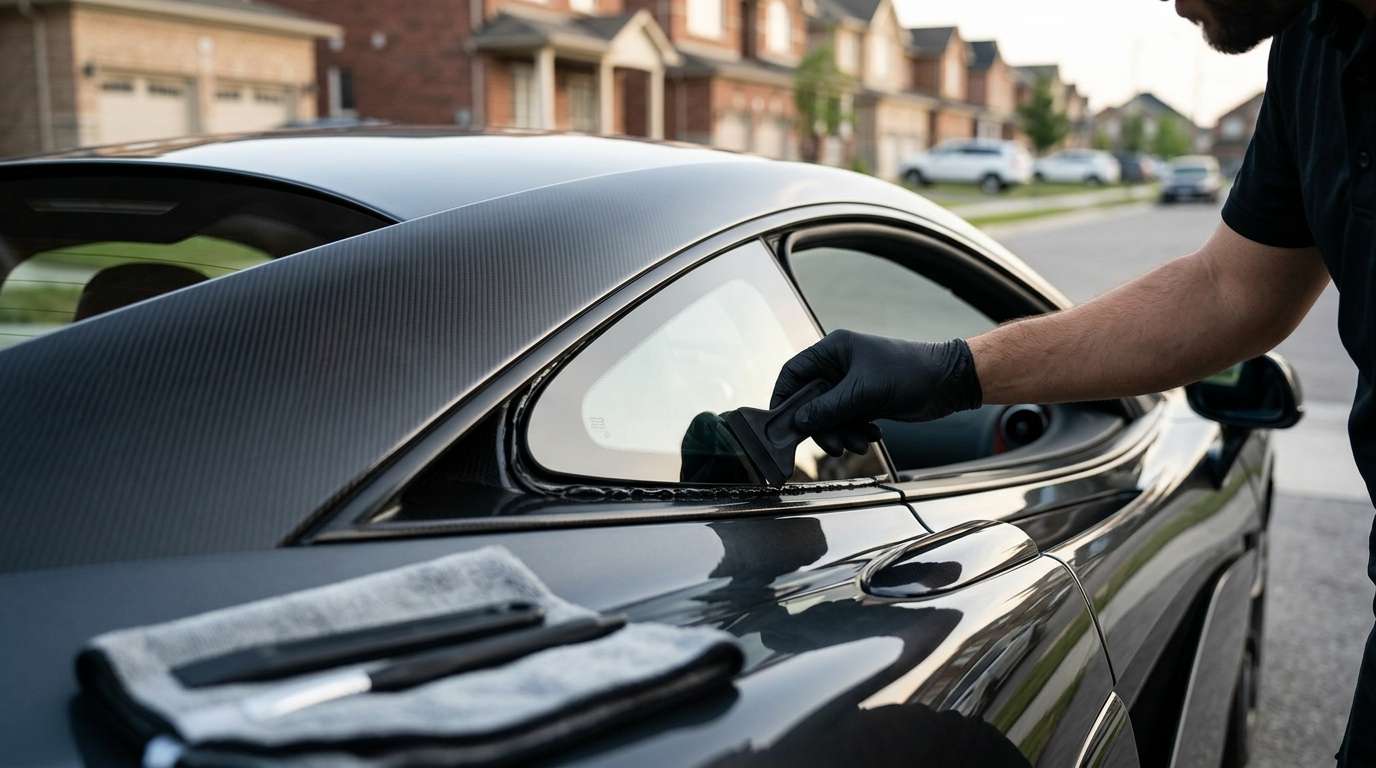
Inspecting the Replacement Quarter Glass Panel Before Installation
When unboxing a replacement side quarter panel for the 540C coupe, the first step is verifying the glass perimeter contour against the distinct curve of McLaren's rear pillar architecture. Because this model shares its structural side aperture with the Sports Series 570S coupe, the glass pane must match the exact curvature of the rear quarter recess directly flanking the functional flying buttress C-pillars. The glass itself is entirely passive; you will find no embedded heater traces, wire harnesses, or radio aerial connectors, as McLaren routed the AM/FM and DAB reception elements away from these side quarters and into the front windscreen and rear glazing.
I examine the ceramic frit border and edge profile meticulously before any work begins on the car. Because the carbon-fiber MonoCell II passenger tub dictates rigid structural bonding requirements, the internal black ceramic masking must be completely intact to shield the high-modulus adhesive line from UV degradation. I also scrutinize the pre-applied perimeter encapsulation for smooth transitions, ensuring no uneven rubber moulding will disrupt the channel where external air flows over the rear deck toward the engine bay.
| Glass Characteristic | 540C Quarter Window Specification |
|---|---|
| Body Style Match | Coupe only (no Spider or GT interchangeable variants) |
| Shared Model Fitment | McLaren 570S Coupe |
| Structural Framework | Carbon-fiber MonoCell II / rear aluminum quarter recess |
| Integrated Electronics | None (aerials and defrosters absent) |
Verifying Clearances and Interior Boundaries After Fitment
Once the quarter window sits in the aperture, post-installation checks center on the clearances between the glass edge and the surrounding panels. The outer surface must sit perfectly flush with the recessed rear aluminum fender edge; even a millimeter of protrusion will interfere with the airflow directed between the cabin glass and the outer flying buttress. I check that the gap between the glass edge and the trailing seal of the frameless dihedral door allows the door to swing open and closed without brushing the moulding.
Every pane I install is backed by a full year of glass defect coverage alongside a lifetime guarantee on my workmanship, ensuring the non-conductive bond preserves the rigidity of the carbon tub over years of driving. Inside the vehicle, my visual inspection focuses on the cabin boundaries. The glass perimeter sits in close proximity to hand-stitched Alcantara, lightweight carpeting, and leather rear quarter trim panels around the parcel shelf. I verify that the interior C-pillar trim re-seats cleanly over the glass edge without puckering the fabric, pinching the hidden trim clips, or leaving uneven visual gaps along the interior roofline.


