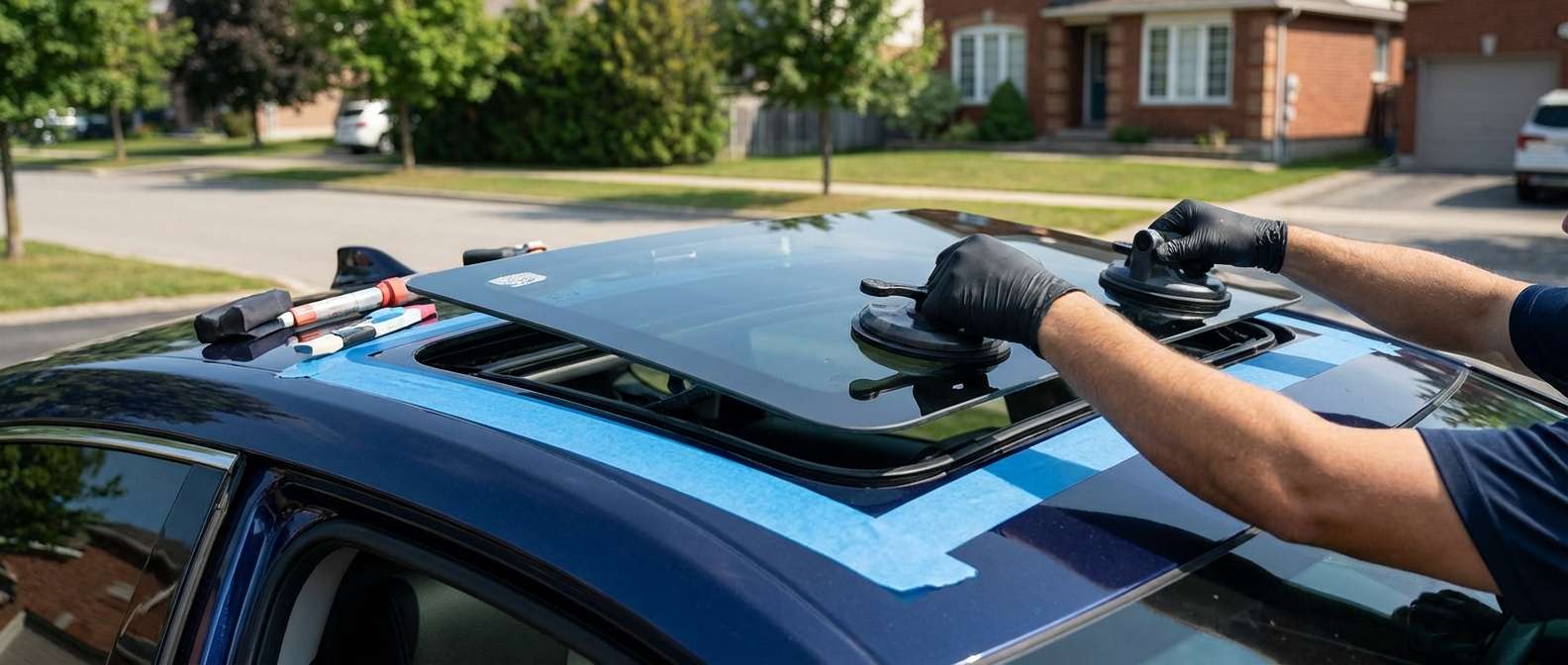
Replacing the Accord Power Tilt-and-Slide Roof Glass
Replacing the shattered or cracked moonroof panel on this car requires working directly with the factory mechanical assembly, because the panel is an unglued, mechanical unit rather than a fixed glass pane. Honda built this setup standard across the EX, EX-L, Sport 2.0T, and Touring trims, leaving the base LX and Sport 1.5T models with a solid steel roof. Unlike many larger sedans that moved toward panoramic roofs, this vehicle relies on a traditional single-pane, power tilt-and-slide panel made of solar-tinted tempered glass.
The glass panel matches Honda OEM reference numbers 70200-TVA-A01 and 70200-TVA-A02. When a stray rock on the 401 shatters the tempered panel, the glass disintegrates, but the underlying drive architecture usually stays intact. The glass sits in an integrated metal frame that mounts to the internal slide tracks via four side-facing Torx bolts hidden behind flexible interior plastic accordion covers. Because the panel does not carry radio antennas, defroster grids, or the forward-facing Honda Sensing monocular camera—which is sealed against the front windshield glass—the swap focuses entirely on mechanical track alignment, glass seating, and drainage clearance.
Hardware, Track Mechanics, and Roof Sealing Details
The perimeter rubber weatherstrip, corresponding to service part 70205-TVA-A01, wraps tightly around the outer rim of the glass to form a seal against the stamped steel roof opening. This seal stops bulk water and manages wind deflection, but it is not intended to be entirely airtight or waterproof under heavy downpours. Any seepage past the outer rubber drops into an internal drainage tray equipped with four water routing hoses: two directing water down through the front A-pillars to the wheel wells, and two routing liquid back through the C-pillars.
When swapping this panel, alignment with the stamped roof line dictates whether your cabin remains quiet or develops whistling at highway speeds. I travel directly to your home or workplace across Toronto and the GTA to replace this panel on-site, bringing all the specialized tools needed to adjust the track heights right in your driveway. The Torx mounting screws sit inside slotted guide brackets, allowing the front and rear corners of the glass to be shimmed flush with the surrounding roof skin.
| Component | Mechanical Role & Vehicle Context |
|---|---|
| Side Guide Brackets | Hold the tempered glass to the cable-driven sliders using four Torx fasteners. |
| Integrated Weatherstrip | Perimeter seal (OEM 70205-TVA-A01) seated flush against the roof opening. |
| Pop-Up Wind Deflector | Spring-loaded leading bar that lifts as the glass slides rearward. |
| Manual Interior Sunshade | Fabric-wrapped slide panel that runs in separate channels below the water tray. |
Motor Reset Sequence and Mechanical Clearing
Any physical disruption or motor detachment triggers the car’s anti-pinch protection, causing the glass to bounce back when you try to close it. Resetting the motor requires an electronic relearn through the overhead console switch. With the ignition switched to ON, push and hold the tilt switch forward until the glass lifts to its full tilt-up limit, hold it there through the momentary pause, and continue holding until the glass drops back slightly to confirm the motor has remapped its rotational pulse counts.
Impact damage usually showers tempered glass fragments throughout the sliding tracks and down into the sunshade cavity. If small cubes of glass bind the push-pull cables or jam the front pop-up wind deflector, the electric motor can strip its gears. Clearing these tracks, cleaning the drainage channel spouts before fragments slide into the A-pillar lines, and inspecting the sliding sunshade guides ensures the new panel glides smoothly along the factory track route without binding.
Can broken sunroof glass cause cabin water leaks later on?
Yes, if loose tempered fragments enter the water trough and block the drain holes. The water tray has four corner exits; if glass chunks clog the front A-pillar tubes, rain overflows the channel and absorbs directly into the headliner fabric, eventually leaking onto the floorboards.
Why is there wind noise after the sunroof glass is replaced?
Excessive cabin noise usually means the glass panel was secured slightly below or above the roof sheet metal. The four Torx adjustment screws must be set so the front edge of the seal sits roughly one millimeter below the roofline and the trailing edge sits flush or a fraction of a millimeter above, keeping airflow smooth over the roof seam.
Does the replacement glass panel include the sunshade?
No, the sliding interior shade is an independent trim piece nested below the glass assembly within the headliner tracks. The replacement panel consists of the framed tinted glass and its perimeter rubber weatherstrip, attaching directly to the slide brackets without disturbing the interior sunshade cloth.


