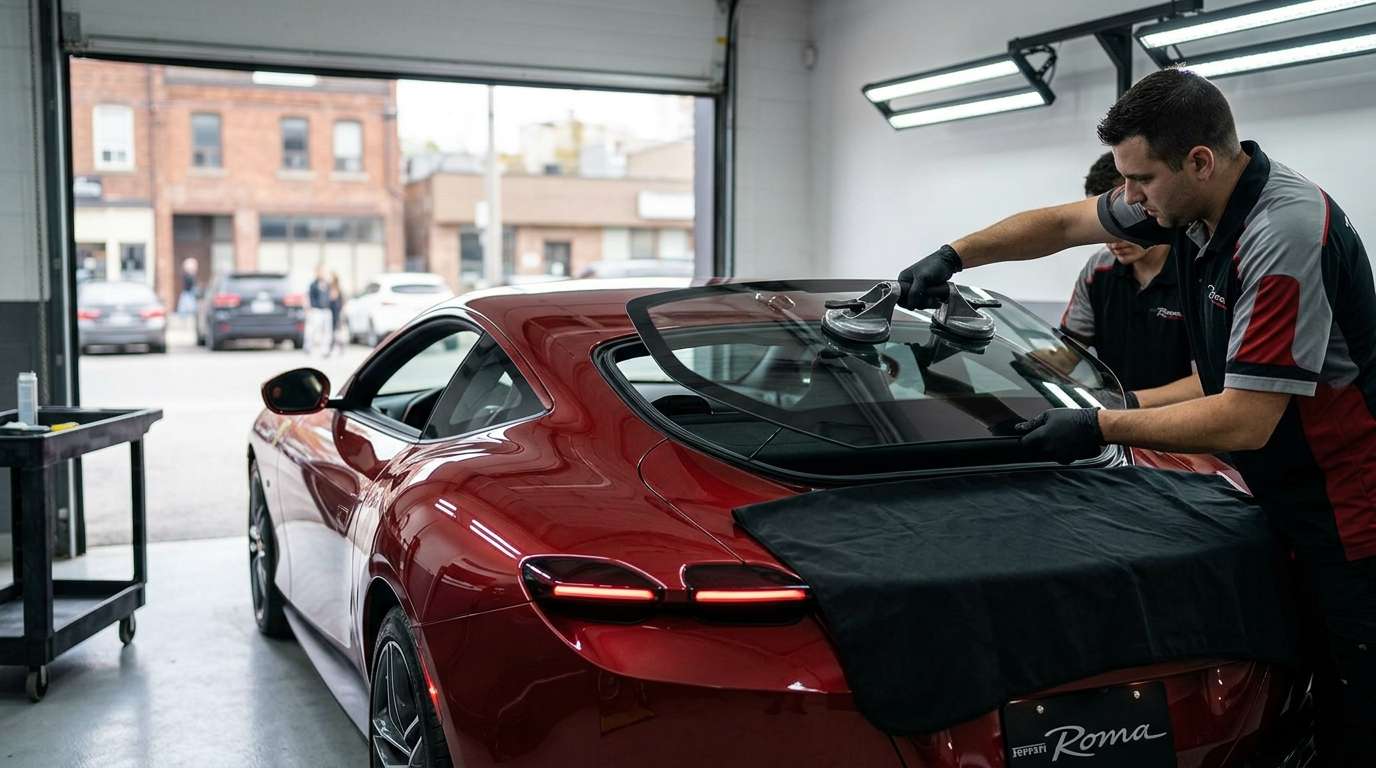
Active Aerodynamics and the Coupe Fastback Rear Screen
Replacing the back glass on the Ferrari Roma coupe (Type F169) centers entirely around its integration with the motorized active rear spoiler assembly sitting flush against the trailing bottom edge of the window. In Low Drag mode, the carbon or painted spoiler surface aligns seamlessly with the lower glass perimeter. If the active spoiler is not locked into its designated service height to clear the lower edge, the motorized mechanism risks severe binding against the perimeter trim (part number 966287) that surrounds the stationary screen. Unlike typical grand tourers, the back glass here is bonded directly to the aluminum roof arches and structural rear quarter framework under precise tolerances so the spoiler can cycle freely between Low Drag, Medium Downforce, and High Downforce angles without clipping the bottom edge of the panel.
The fastback screen itself is engineered without an external wiper or fluid nozzle, relying instead on clean airflow over the roof canopy to shed water. Because the rear rake angle is exceptionally shallow, I come directly to your driveway or workplace parking space across Toronto and the GTA to service these vehicles on-site, saving you the risk of driving with fractured glass that obscures an already narrow rear sightline. The glass panel incorporates an embedded heating grid for defrosting, which ties directly into the vehicle's rear harness routed along the aluminum body frame beneath the custom rear shelf panels.
Coupe Fastback Bond vs Roma Spider Soft-Top Integration
The engineering of the rear glass differs completely between the hardtop coupe and the Roma Spider introduced for 2024. While the coupe uses a structural, urethane-bonded glass pane set between the rear haunches, the Roma Spider encloses a heated safety glass panel directly into the tailored five-layer acoustic fabric convertible canopy. In the Spider, this glass folds down with the mechanical roof linkage rather than remaining rigid against the quarter panels, meaning structural issues or seam separations often require servicing the fabric canopy system rather than standard standalone glass replacement. Furthermore, while the coupe channels airflow over the rear screen into the active spoiler, the Spider manages rear cabin airflow using an electric pop-up wind deflector built directly into the rear seat backrest structure.
| Component / Specification | Roma Coupe (2020–2027) | Roma Spider (2024–2027) |
|---|---|---|
| Glass Mounting Style | Stationary bonded to aluminum body frame | Integrated into 5-layer acoustic fabric top |
| Associated Perimeter Molding | Ferrari P/N 966287 | Integrated roof fabric weatherstrip |
| Lower Glass Interface | Flush-fit active aerodynamic spoiler | Fabric roof well tonneau seam |
| Heating Element | Embedded electric defroster grid | Embedded electric defroster grid |
| Rear Wiper Mechanism | None (aerodynamic shedding) | None (aerodynamic shedding) |
Post-Replacement Inspection Checklist
Once the back glass panel is positioned and sealed, verify the precise alignment of the glass against the surrounding exterior aerodynamic hardware and interior trim pieces:
- Inspect the gap between the lower glass edge and the active rear spoiler to ensure uniform clearance across the full width when the wing sits fully retracted in Low Drag mode.
- Cycle the active spoiler through Medium and High Downforce settings to verify the motorized flap moves without catching or scraping the lower glass trim molding.
- Examine the specialized perimeter trim (P/N 966287) along the C-pillars to ensure it lies completely flat against the aluminum quarter panels without gaps or waviness.
- Turn on the rear defroster circuit from the climate controls to verify that current passes through the embedded heating lines and clears condensation evenly.
- Check the interior C-pillar trim panels and the leather or Alcantara parcel shelf upholstery to confirm that no panels were forced or misaligned during glass positioning.


