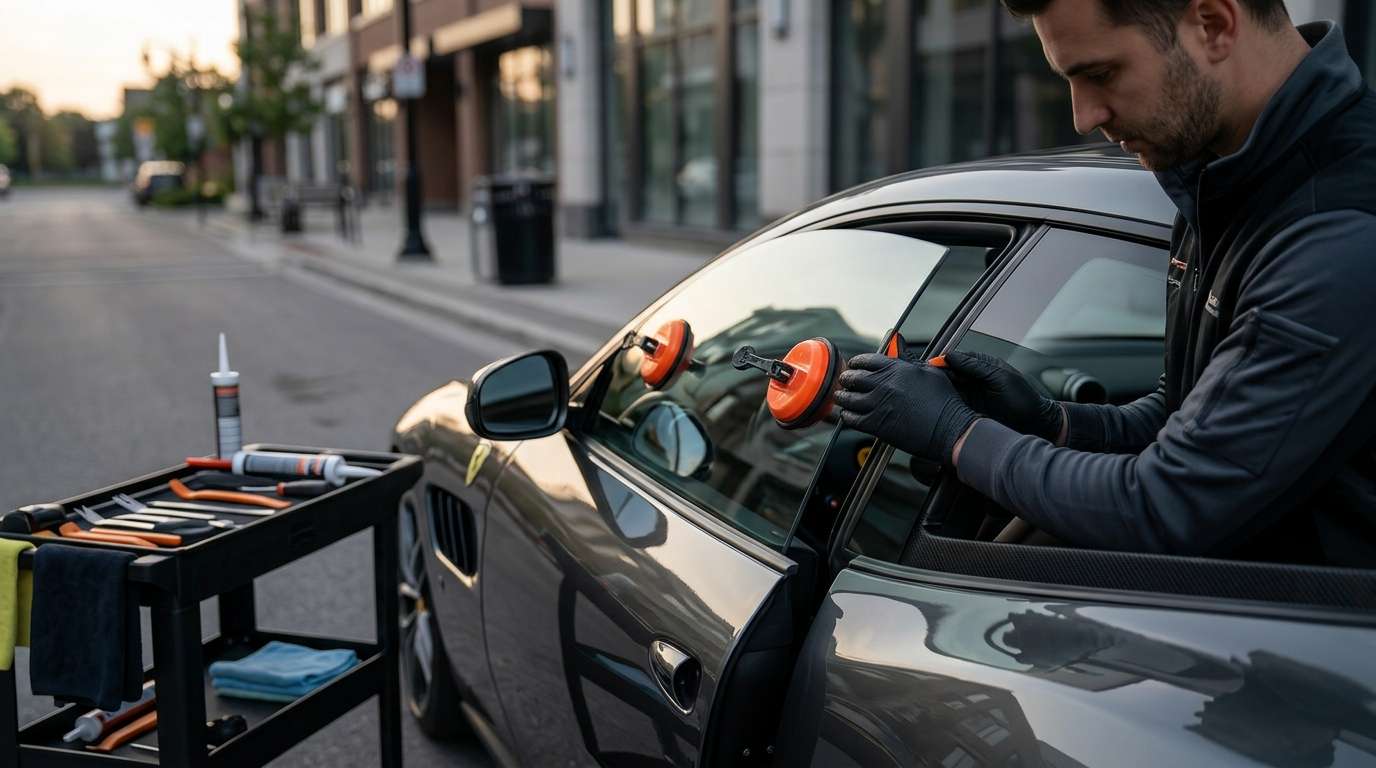
Checking Frameless Door Glass Geometry and Clamping Hardware
Matching the complex curvature of the shooting brake side profile begins before the pane ever slides into the door cavity. Whether dealing with the naturally aspirated V12 all-wheel-drive model or the rear-wheel-drive twin-turbo V8 GTC4Lusso T, both variants share identical front door glass dimensions. The replacement pane must be checked across its lower edge for uniform clamping surface thickness and pristine edge finishing. Because these doors carry no upper metal frames, any deviation in the glass contour causes stress points where the glass mounts into the regulator lift brackets.
I verify that the lower clamping zones match the factory hardware footprint precisely. The dual-cable lift system relies on specific bottom pinch-pads that support the weight of the movable window without creating localized pressure cracks. The glass itself is entirely bare: there are no internal defroster wires, rain sensor brackets, or embedded radio antennas on these movable side panes. What demands scrutiny is the smooth run of the glass profile where it sweeps upward to meet the roofline drip rail.
| Component / Feature | Driver Side (LH) | Passenger Side (RH) |
|---|---|---|
| Ferrari Reference Part Number | 83614500 | 83614400 / 83614600 |
| Body Aperture Weatherstrip | 86872000 | 86872100 |
| Glazing Type | Curved Safety Glass | Curved Safety Glass |
| Lifting Mechanism | Dual-Cable Electric Track | Dual-Cable Electric Track |
Managing Perimeter Seals and Latch Interconnects
Once the leather trim card, moisture barrier, and side airbag harness are cleared, the internal mechanics dictate how the new glass will sit against the car. When I travel to your home or workplace anywhere across Toronto and the surrounding GTA to replace this glass, the first physical clearance check I make inside the door structure involves the latch linkage. Ferrari recall 19V-089 (Campaign C24000067) highlighted how a tensioned Bowden door lock cable could break its bracket; I inspect this specific zone because an impaired latch mechanism directly interferes with how the door glass seats.
The upper body perimeter weatherstrip incorporates an internal stuffer engineered to stop high-speed buffeting against the cabin. If the replacement pane lacks the exact curvature along the upper edge, it will pinch or deform this rubber channel. At the waistline, the full-length horizontal outer belt moulding must maintain even, low-friction contact against the glass face to keep water out of the door cavity without binding the dual-cable regulator tracks.
Short-Drop Indexing and Inward Tilt Alignment
Frameless glass requires meticulous functional validation the moment the panel is fastened to the regulator. The vehicle utilizes an automated short-drop indexing feature governed by microswitches within the interior handles, exterior handles, and the door latch. The instant a handle is engaged, the glass must drop approximately 10 to 15 mm to clear the deep roof drip channel before the door swings outward.
- Handle switch response: The pane must drop immediately upon lifting the exterior release handle without lag, preventing the top glass edge from hooking the body weatherstrip.
- Pitch and inward rake: The internal door adjuster bolts control how aggressively the top of the glass presses against the body aperture. If the inward tilt is set too shallow, high-speed road travel produces wind whistle; if set too deep, the pinch-protection system will reverse the window motor before full closure.
- Center console switch testing: The center console lift toggles on this platform are prone to internal switch wear. I cycle the glass through these controls to confirm that sluggishness is not misdiagnosed as track friction or cable binding.
- Final seal compression: With the door latched completely shut, the top 15 mm stroke must drive the glass firmly into the upper channel, flattening the seal evenly from the front pillar to the rear pillar without bowing the pane.


