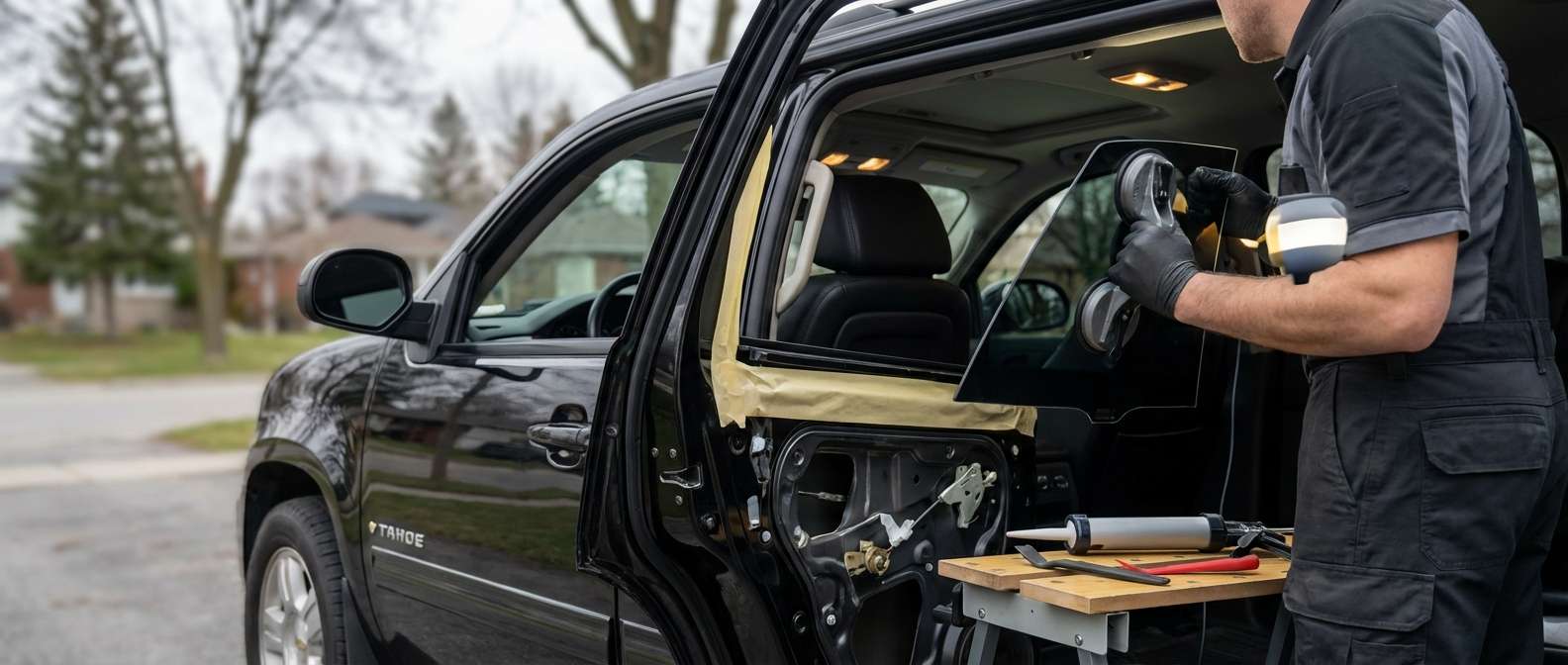
Why Tahoe Rear Doors Lack a Separate Vent Pane
If you are searching for a rear door vent window on this SUV, you will find that the door frame holds only a single, solid pane of glass. Unlike earlier models or the extended-wheelbase Suburban, this door design eliminates the stationary division post entirely. The roll-down window extends from the front guide run straight to the rear pillar. When drivers report broken "vent glass" on these doors, they are usually dealing with either the main rear door glass or the large stationary quarter window mounted into the body behind the C-pillar.
Because the wheel arch cuts deeply into the rear door shell on the short-wheelbase body, the lower trailing edge of the window glass is contoured specifically to match the internal wheel well stamping. As a result, the glass cannot travel all the way down into the cavity; it stops several inches above the beltline. The glass panel rides in continuous rubber run channels, held at the bottom edge by two 10mm clamp fasteners secured to a cable-driven dual-rail regulator assembly.
Glass Identifiers, Tinting, and Mechanical Wear
The roll-down tempered glass carries NAGS part numbers DD11164YPN for the left rear door and DD11165YPN for the right rear door. GM originally cataloged these parts under numbers 15175401 on the left side and 15175402 or 22803680 on the right. Across civilian LT, LS, and LTZ trims, this glass is supplied with factory dark privacy solar tint providing approximately 12% to 20% visible light transmission, while specialized fleet vehicles like the PPV or SSV police pursuit packages (RPO code AKP) utilized clear, non-tinted glass. When sourcing replacements, I rely on aftermarket panes from manufacturers such as Pilkington, PGW, XYG, and FYG, which replicate the factory factory-tinted solar properties and edge bevels cleanly.
The glass itself is completely passive—it carries no defroster grids, antenna lines, or electronic brackets. However, hardware issues inside the door are frequent culprits when glass behaves erratically:
- Loose lower clamp bolts: If the two 10mm regulator clamp screws back out, the glass will wobble, tilt forward, or rattle aggressively inside the run channels when lowered halfway.
- Cable snaps and guide failures: Plastic cable guide blocks on the dual-rail regulator fatigue and fracture over time, causing the cable to spool incorrectly and allowing the window to drop completely into the bottom of the door.
- Master and door switch oxidation: Switch contacts on both the driver master panel and the individual rear passenger switches frequently pit and corrode, halting power delivery to the motor even when the glass and track are physically intact.
- Belt weatherstrip binding: Deteriorated outer belt mouldings (such as GM part 22774085) can catch on the pane, putting excess strain on the motor and misaligning the glass inside the frame.
Why won't my rear door window roll down completely flush with the door sill?
The short-wheelbase Tahoe door frame cuts around the rear wheel housing. The mechanical space inside the lower half of the door is physically blocked by the inner wheel tub, preventing the rectangular lower portion of the glass from dropping any further.
Is the rear door window made of laminated or tempered glass?
This glass is a single sheet of tempered safety glass. If it sustains an impact from road debris or forced entry, it fractures entirely into thousands of small, blunt pebbles rather than cracking like a laminated windshield.
Can I replace just the stationary glass section in the rear door?
No, because there is no stationary glass section in the rear passenger doors. The window is one complete, continuous moving pane from front to rear. If you have broken stationary glass, it is the quarter glass bonded to the vehicle body behind the door opening.


