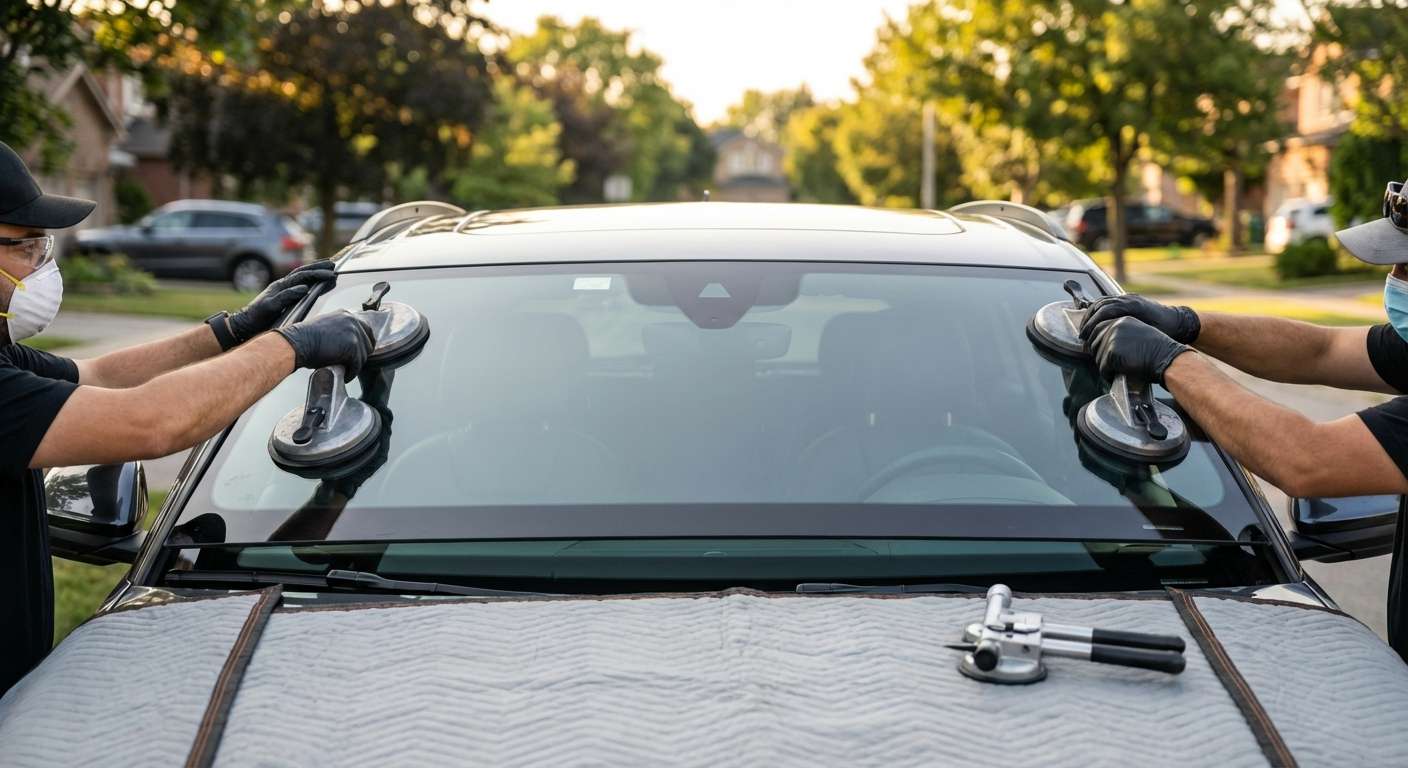
Steep Windshield Rake and Gravel Impact on the Front Glass
The aggressive, sweeping roofline of this luxury crossover positions the windshield at an angle that takes high-velocity stone hits with direct blunt force instead of deflecting them. Because the lower glass edge sits deeply recessed beneath the heavy plastic water deflector cowl that houses the dual wiper arm assemblies, small pebbles kicked up by highway traffic frequently wedge right at the black ceramic frit line. A stone strike near that perimeter edge introduces immediate thermal stress cracks across the driver viewing area, especially when the interior climate control blows cold air onto hot glass in the summer.
Every factory variation across the trim lineup—whether on the base Premium, the Plus, the Prestige, or high-output editions like the SQ8 and RS Q8—relies on an acoustic-laminated sandwich. While this sound-dampening laminate keeps the cabin whisper-quiet at cruising speeds, it behaves differently under impact than conventional glass. A rock chip that strikes the outer layer often causes localized internal delamination within the acoustic vinyl layer before spreading horizontally. When you schedule an appointment, I typically reach your vehicle within about an hour of the call to handle the glass on-site.
Head-Up Display Interlayers and Forward Sensor Hardware
Matching the replacement glass to this specific Audi build requires checking the equipment codes behind the rearview mirror. Vehicles outfitted with the Head-Up Display (referencing base dealer numbers like 4M8-845-099-AC-NVB, which superseded older revisions like -H-NVB and -AA-NVB) do not use a standard flat polyvinyl butyral layer. Instead, they require a specialized wedge-profile interlayer. If standard aftermarket glass without this wedge is installed on a HUD-equipped vehicle, the projected speedometer and driver assist graphics reflect off both the inner and outer glass surfaces unevenly, resulting in severe ghosting and double images.
Beyond the optical wedge, the glass serves as the physical housing for essential onboard electronics. Bonded directly to the inner surface from the factory are two distinct hardware fixtures:
- The Forward-Facing Driver Assist Camera Bracket: Supports the optical unit driving Audi Pre Sense, lane departure warnings, and adaptive cruise assist.
- The G397 Rain, Light, and Humidity Sensor Bracket: Sits directly adjacent to the rearview mirror mount. The optical sensor relies on a clear, bubble-free silicone coupling pad against the windshield to meter wiper cadence and activate automatic headlights.
Non-HUD variants utilize standard acoustic laminated glass (such as base reference 4M8-845-099), but still require the exact factory-positioned camera and sensor brackets to keep safety systems functional.
Audi Q8 Front Windshield Replacement Reference
| Vehicle Feature | Glass Variant Specification | Key Hardware Integration |
|---|---|---|
| With Head-Up Display (HUD) | Acoustic laminate with wedge-shaped PVB interlayer | Dual bracket for camera and G397 sensor, HUD optical zone |
| Without Head-Up Display | Standard acoustic insulation laminated safety glass | Dual bracket for camera and G397 sensor, standard frit |
| SQ8 / RS Q8 Performance Trims | High-clarity acoustic laminate (HUD or non-HUD specific) | Matched radar/camera cutouts, cowl deflector clips |
Why does my rain-sensing wiper system act erratically after glass damage?
The combination G397 rain and humidity sensor behind the rearview mirror monitors infrared light reflection through the outer surface of the glass. If an impact crack runs through the sensor's optical window, or if a stone chip causes micro-fractures in that upper center zone, the refracted light tricks the sensor into reading non-existent moisture, causing the wipers to cycle dry across the windshield.
Can I install a non-HUD windshield if I don't use the Head-Up Display?
No, because the projection unit continues to beam vehicle speed and navigation telemetry onto the windshield surface regardless of whether you look at it. A standard flat acoustic interlayer will create a distorted, disorienting secondary reflection in your forward vision, and the physical bracket configurations on HUD-specific windshields differ from standard glass variants.


