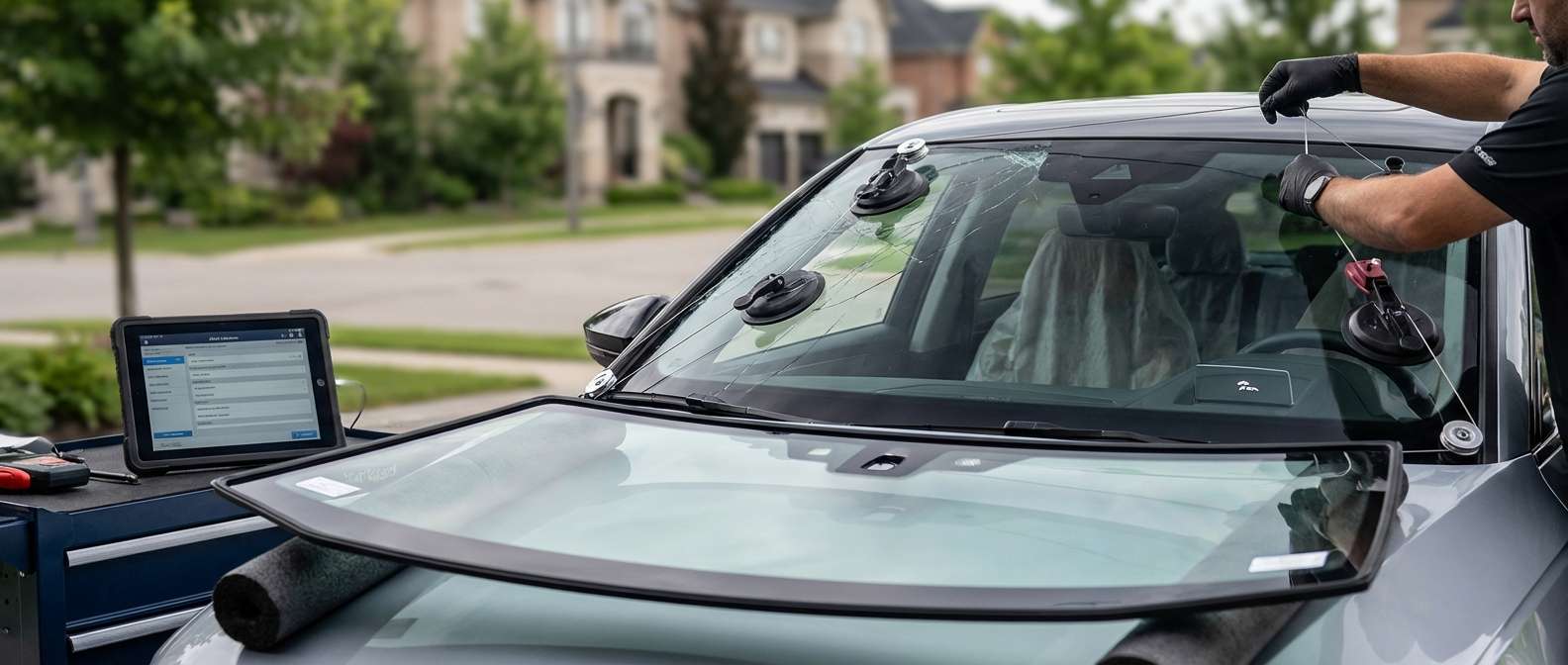
Verifying HUD Optics and Acoustic Interlayers Before Replacement
Matching the replacement windshield on this vehicle requires identifying whether the car uses the standard driver display or the Augmented Reality Head-Up Display (AR-HUD). The AR-HUD projects driving directions and lane markings directly into the driver’s field of view, which requires a specialized wedge-shaped polyvinyl butyral (PVB) interlayer within the laminated acoustic glass. If a standard acoustic windshield is installed on an AR-HUD equipped car, the projection will suffer from double imaging and optical distortion. Before scheduling work, I confirm your instrument cluster setup to source the correct optical specification.
The glass must also arrive with the factory-bonded hardware pre-attached. This includes the upper center windshield frit assembly, which houses the multi-function bracket for the Audi Pre Sense front camera along with the gel-pack bracket for the combination rain, light, and cabin humidity sensor. At the bottom driver-side corner, the ceramic black enamel band features an exact notch revealing the Vehicle Identification Number plate against the dashboard edge. Because this EV relies heavily on aerodynamic efficiency, achieving its 0.21 drag coefficient on the Sportback depends on glass with an exact acoustic laminate profile to isolate high-frequency wind and rolling noise that standard combustion sedans hide behind engine sound.
Moulding Interfaces Across the PPE Architecture
Built on the Platform Electric (PPE) architecture, the windshield shares tight clearance tolerances with adjacent composite and glass elements. The upper perimeter borders either the standard painted roof sheet metal or the panoramic glass roof with polymer-dispersed liquid crystal (PDLC) switchable opacity. This glass-to-glass roof junction requires an exact vertical depth offset to maintain laminar airflow over the cabin and prevent high-speed wind buffeting.
Down the sides, the A-pillars feature flush-mounted aerodynamic trim mouldings designed to channel air cleanly past the frameless door glass. These side trims must seat fully into their body clips without lifting. Along the lower edge, the molded plastic cowl grille shelters the recessed wiper linkage and seals against the base of the glass. Because I run a mobile-only service, I handle the entire replacement directly at your home or workplace across Toronto and the GTA, ensuring your car stays parked while the trim interfaces are meticulously aligned to the cowl and dashboard recess.
Dashboard Interaction Light and Interior Clearance Checks
Inside the cabin, the lower edge of the windshield drops into a dedicated cowl recess running the width of the dashboard. This channel sits immediately ahead of the dynamic interaction light, an active LED arc that sweeps across the base of the windscreen to signal charging status, turn signals, and pre-sense warnings. Replacement glass must seat at the exact factory height to prevent contact with this illumination strip or the surrounding soft-touch dash upholstery.
Post-Installation Inspection Checklist for the Owner
- Inspect the AR-HUD projection against daytime road markings to verify that the graphic overlays appear crisp and free of ghosting or vertical separation.
- Check the glass-to-glass seam where the top edge meets the PDLC panoramic roof to confirm the glass sits completely level with the roofline.
- Examine the flush aerodynamic A-pillar trims on both sides to make sure they sit tight to the high-strength steel frame without protruding into the airflow.
- Confirm that the multi-color dynamic interaction LED strip along the lower dashboard edge reflects cleanly off the inner glass surface without any physical contact against the bottom frit.
- Ensure the lower plastic cowl grille snaps firmly into its retaining track across the base of the glass without sagging over the wiper pivots.
- Verify that the VIN notch in the lower-left frit exposes the entire stamped plate clearly without any offset.
- Test the automatic windshield wipers with water to ensure the rain and humidity sensor behind the rearview mirror bonds flat against the glass without trapped air bubbles.


